There is a specific moment in the grocery store that a lot of parents know well. You are in the refrigerated aisle, your kid has spotted the yellow boxes, and you are doing quick math on how many mornings this week you can realistically assemble a lunch from scratch. Into the cart it goes, along with a small, low-grade guilt that follows you to checkout.
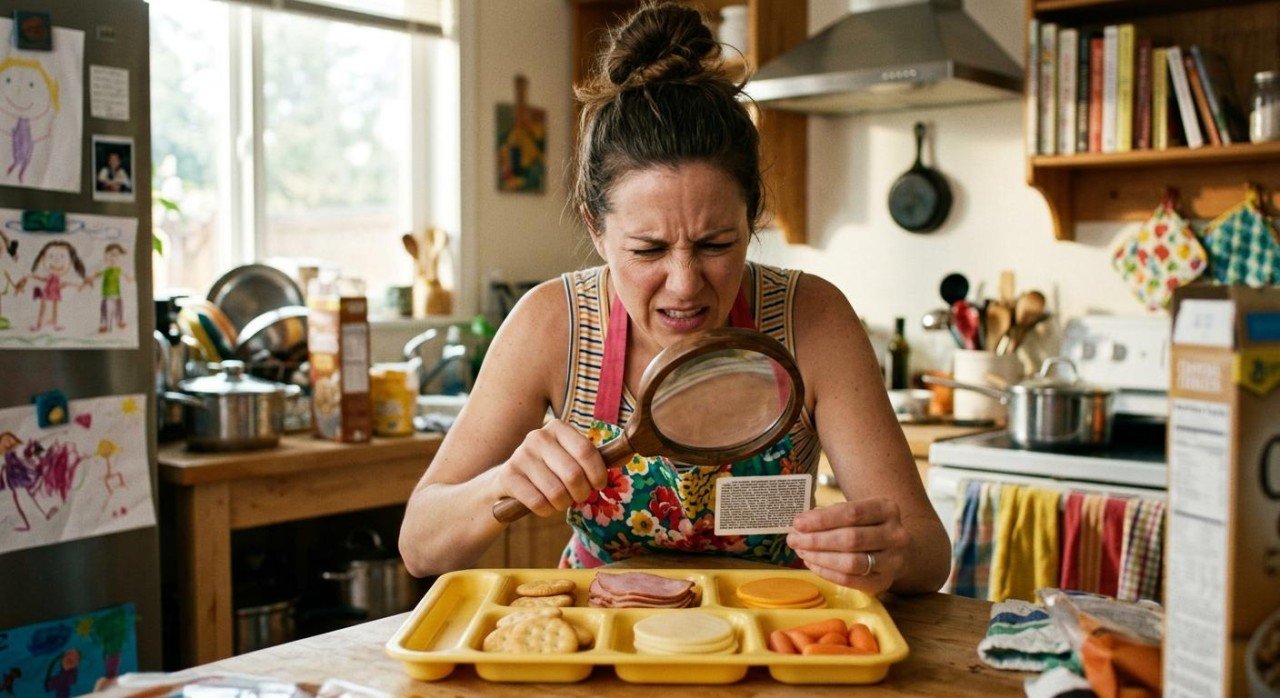
That guilt is not very useful. What is useful is knowing exactly what is in the box, which parts of the criticism hold up, which parts are overstated, and what it would actually take to build something better in the time you have. So let us read the label honestly, give Lunchables credit for the one thing it got genuinely right, and then beat it.
What Is Actually in the Box
Take the flagship product: Lunchables Turkey & Cheddar Cheese with Crackers, the 3.2-ounce tray. At Target it runs $1.99, which works out to about 62 cents an ounce. The label reads 260 calories, 690 mg of sodium, 7 g of saturated fat, and 13 g of protein.
The ingredient list is where the picture sharpens. The turkey is cured roast white turkey with water, potassium lactate, modified cornstarch, dextrose, salt, carrageenan, sodium phosphates, sodium diacetate, sodium ascorbate, and sodium nitrite. The cheddar is not cheddar cheese but a "pasteurized prepared cheese product" built from milk, water, milkfat, milk protein concentrate, whey, sodium citrate, and sorbic acid. The crackers are enriched flour, vegetable oil shortening, sugar, and salt.
Notice how many of those lines contain the word sodium. That is not an accident of one ingredient; it is the architecture of the whole product. Cured meat, process cheese, and salted crackers are three salt deliveries stacked in one tray.
The Sodium Math, Done Properly
The 690 mg on that label carries a "30% Daily Value" next to it, and this is where labels quietly mislead parents. The Daily Value on a Nutrition Facts panel is calculated against 2,300 mg of sodium a day, which is an adult figure. It is not the number for a first grader.
When Consumer Reports tested 12 store-bought lunch and snack kits in 2024, it found sodium ranging from 460 to 740 mg per serving. Measured against what is recommended for a 4- to 8-year-old rather than an adult, the 3.2-ounce Turkey and Cheddar Cracker Stackers delivered 49 percent of a day's sodium. Roughly half a child's daily allowance, from a tray small enough to fit in one hand.
That is the part worth sitting with. Eric Boring, a chemist at Consumer Reports, put the size of the thing plainly: "The kits provide only about 15% of the 1,600 daily calories that a typical 8-year-old requires." Fifteen percent of the calories, about half the sodium.
And it lands on top of a national picture that was already strained. In its last major survey of the question, the CDC found that more than 90 percent of U.S. children aged 6 to 18 eat more sodium than recommended, averaging about 3,300 mg a day before anyone touches a salt shaker at the table. About 65 percent of it came from store-bought foods, and cold cuts and cured meats sat in the top ten sources.
The Processed Meat Question, Handled Carefully
You have probably seen the headline that processed meat is a "Group 1 carcinogen, like tobacco." That is technically accurate and almost always presented in a misleading way, so it is worth being precise.
The World Health Organization's cancer agency does classify processed meat in Group 1, and estimates that every 50-gram portion eaten daily raises the risk of colorectal cancer by about 18 percent. But the WHO is explicit that the grouping "does NOT mean that they are all equally dangerous," because IARC classifications "describe the strength of the scientific evidence about an agent being a cause of cancer, rather than assessing the level of risk." Tobacco is linked to roughly a million cancer deaths a year worldwide; diets high in processed meat, around 34,000.
So this is not a reason to panic about a lunch. It is a reason to think about a pattern. A tray of cured turkey four or five days a week for years is a habit, and habits are what this evidence is actually about. One box before a soccer game is not.
One more thing worth knowing, because it changes what you reach for at the deli counter: the "uncured" and "no nitrates added" labels are largely a labeling artifact. Those products are cured with celery powder, which converts to the same nitrites found in synthetic curing agents. The USDA has been weighing whether to fold celery powder into its official definition of a curing agent precisely because the current labels imply a difference that is not there. Buying "uncured" turkey instead of cured turkey is not the upgrade the package implies. Buying actual roasted chicken is.
The Quiet Problem: Nothing Is In There
The sodium gets the headlines, but the more consequential gap is what the box does not contain. Look at the bigger 9.2-ounce meal kit with a Capri Sun and gummy worms: $2.99 at Target, 250 calories, 550 mg sodium, 14 g of added sugars, 10 g protein, and 0 g of fiber.
Zero. Not "low." None.
That matters more than it sounds, because American kids are already running a fiber deficit. Across a decade of national survey data, children and adolescents aged 4 to 18 averaged 13.2 grams of fiber a day, against an adequate intake of 26 to 38 grams for the 9-to-18 group. Whole grain intake averaged half an ounce-equivalent a day when the recommendation is at least three. Enriched-flour crackers do nothing to close either gap, and neither does a gummy worm.
It is also worth noticing that the 9.2 ounces on the front of that box is mostly beverage. A 6-fluid-ounce drink pouch accounts for the majority of the weight. The food part is under three ounces.
None of this is unique to one brand. It is what a lunch built entirely from ultra-processed components looks like, and that has quietly become the default: a 2021 study in JAMA of nearly 34,000 young people found the share of calories American children and teens get from ultra-processed foods climbed from 61 percent to 67 percent between 1999 and 2018.
The Heavy Metals Finding, in Proportion
The 2024 Consumer Reports testing also found lead, cadmium, or both in all 12 kits it tested, with five of them exposing a child to 50 percent or more of California's maximum allowable level. The Turkey and Cheddar tray hit 74 percent of that lead threshold. Every kit but one also tested positive for phthalates.
Two things are true at once here. None of the products exceeded any legal or regulatory limit, and lead does occur naturally in soil and turns up at low levels across the food supply, which is Kraft Heinz's stated position. But CR's own chemist did not hedge on the conclusion: "We don't think anybody should regularly eat these products." The concern is not one tray. It is that a very small amount of food is delivering a meaningful share of a daily exposure ceiling, week after week.
The School Lunch Chapter
In 2023, Kraft Heinz built two versions of Lunchables specifically for the National School Lunch Program, Turkey & Cheddar Cracker Stackers and Extra Cheesy Pizza, reformulated with more whole grains in the crackers and more protein to meet federal requirements. They were approved for a program serving nearly 30 million children.
Then Consumer Reports tested the school versions and found the Turkey & Cheddar variant contained 930 mg of sodium, against 740 mg in the retail version. The reformulation that added protein and whole grain had also added salt. Consumer Reports and More Perfect Union delivered close to 50,000 petition signatures to the USDA, and on November 12, 2024, Kraft Heinz pulled the products from the program, citing demand below its targets rather than the nutrition criticism. Brian Ronholm, CR's food policy director, said what the campaign had been arguing all along: "Lunchables and other lunch kits with concerning levels of sodium and harmful chemicals have no place on the school lunch menu."
Now the Fair Part: What Lunchables Got Right
Here is where most articles about this stop, and where the useful part actually starts. Lunchables did not sell for nearly forty years because parents are gullible. It sold because it solved a real problem, and because its designers understood something about children that a lot of well-meaning lunch advice still misses.
The product came out of Oscar Mayer in the mid-1980s. As Michael Moss reported in The New York Times Magazine, Bob Drane was the company's vice president for new business strategy and development when he was handed the assignment in 1985. His focus groups with mothers turned up one dominant answer: the problem was time. Packing lunch was a pain and the result was boring.
But the insight that made it a phenomenon was not about mothers at all. It was about who was actually in charge of that lunch once it left the house. Bob Eckert, then Kraft's CEO, described it exactly: "Lunchables aren't about lunch. It's about kids being able to put together what they want to eat, anytime, anywhere." The advertising said the quiet part out loud: "All day, you gotta do what they say. But lunchtime is all yours."
That is not marketing fluff. It is a real finding about how children eat, and the research has caught up with it. In a 2023 study in Appetite, 161 four- and five-year-olds were offered an unfamiliar vegetable, raw celeriac, in three identical closed cups. Half got to pick a cup themselves; half had the researcher pick. The children who chose accepted the vegetable significantly more, 4.7 versus 4.0 on a six-point scale, even though the choice was completely illusory. It was the act of choosing that did the work.
Involvement goes further still. In a 2014 study, children aged 6 to 10 either helped a parent make lunch or sat in the kitchen while the parent made it. The ones who cooked ate 76 percent more salad and 27 percent more chicken, and reported feeling significantly more positive and more in control afterward.
That word again. Lunchables monetized a child's need for control at lunchtime. You can have that need met for free, and get real food into the bargain.
Even Drane came around on the trade-off. Decades later he told Moss: "In the end, I wish that the nutritional profile of the thing could have been better." His daughter's take was blunter: "I don't think my kids have ever eaten a Lunchable."
The 10-Minute Version That Beats It
The formula is not complicated, and it deliberately keeps the compartments, the assembly, and the treat. Five slots:
- A real protein. Leftover roast or rotisserie chicken pulled into strips, hard-boiled eggs, a couple of meatballs from Sunday dinner, chickpeas, or turkey you slice yourself off a cooked breast.
- Actual cheese. Cut from a block, or those individually wrapped sticks and rounds if that is what survives the morning.
- A carb worth eating. Whole grain crackers, pita triangles, or a small whole-wheat tortilla cut into strips. Check the label for whole grain as the first ingredient, because "multigrain" and "wheat" mean nothing on their own.
- Something that grew. Grapes, clementine segments, apple slices, cucumber coins, snap peas, bell pepper strips, berries. Two of these beats one.
- A small treat. Yes, actually. A couple of squares of dark chocolate, two cookies, a handful of pretzels. The treat is not a failure of the system; it is what keeps the rest of the box from being negotiated over.
The swaps that move the numbers most are the protein and the cheese, and the gap is not subtle. In USDA's FoodData Central database, sliced prepackaged deli turkey breast carries about 898 mg of sodium per 100 grams. Plain cooked skinless chicken breast: 47 mg. That is roughly a nineteen-fold difference for the same slot in the box. On the cheese side, natural cheddar runs about 654 mg of sodium per 100 grams, while pasteurized process American cheese lands near 1,670 mg, about two and a half times as much. Cheddar also brings 707 mg of calcium and 23 g of protein per 100 grams along with it.
Do nothing else but replace cured deli meat with leftover chicken and process cheese with cheese, and you have cut the sodium in that lunch by more than half without touching anything a kid would notice.
The Sunday Assembly Line
The reason homemade versions fail is almost never the recipe. It is that they are attempted at 6:45 on a Tuesday morning. Move the work to one 10-minute block instead:
- Line up five containers with compartments, lids off, on the counter.
- Protein first, across all five. Pull the chicken, peel the eggs, portion the chickpeas. One motion, five boxes.
- Cheese next, across all five. Cut the block once, distribute.
- Crackers across all five.
- Produce last, since it is the most perishable. If you are prepping the whole week, do fruit Sunday and Wednesday rather than all at once.
- Lids on, stack them in the fridge. Mornings become: grab a box, add an ice pack, done.
Two practical notes. First, food safety is not optional with meat and cheese sitting in a backpack until noon. USDA guidance, summarized well by Clemson's extension service, is to use an insulated bag with at least two cold sources, one under the food and one on top, to keep everything below 40 degrees F, since bacteria multiply fast between 40 and 140. Paper bags do not cut it.
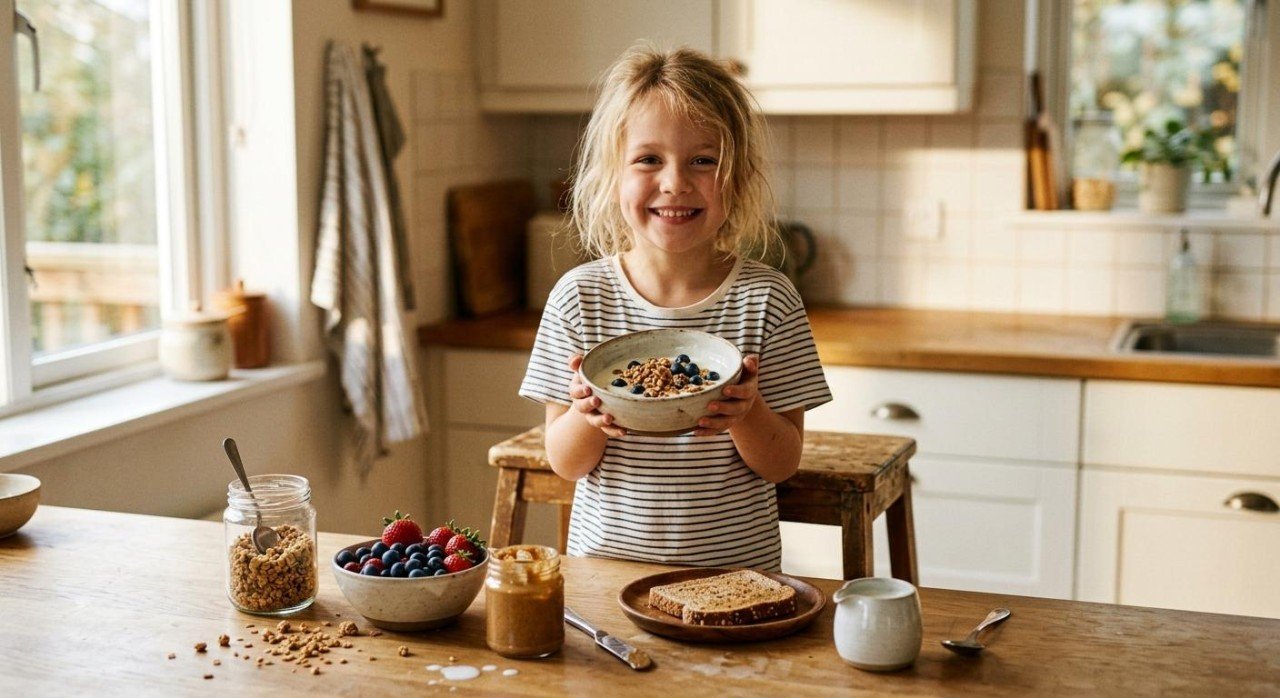
Second: hand the last step to your kid. Let them pick which fruit, which cracker, which treat goes in tomorrow's box, or let them fill the compartments entirely while you supervise. That is the Lunchables feature, the one that actually drove the sales, and it costs you nothing to take back. It also happens to be the single best-evidenced thing you can do to get more of the lunch eaten instead of traded or thrown out.
Take the Guesswork Out of Eating Well
Eat Well Planner helps you organize your favorite recipes, plan balanced meals, and automatically generate shopping lists — all in one place. Whether you're tracking macros, managing dietary restrictions, or just trying to stop asking "what's for dinner?", we've got you covered.
Our AI-powered tools can adapt any recipe to your dietary needs, help you discover new meals you'll love, and even log your nutrition effortlessly. It's meal planning made simple.
Start Organizing Your Meals — FreeThe Honest Cost Comparison
This is where a lot of write-ups overreach, so here are real numbers. That Lunchables tray is $1.99 for 3.2 ounces, or about 62 cents per ounce of food. Meanwhile, in Bureau of Labor Statistics average price data for July 2026, boneless chicken breast averaged $4.15 a pound nationally, about 26 cents an ounce. Natural cheddar was $5.74 a pound, or 36 cents an ounce. Bananas were 65 cents a pound.
So the truthful verdict is this: a $1.99 box is not highway robbery, and if you catch them on sale they are genuinely cheap. But per ounce of actual food, the homemade version comes in at roughly half the price, and the box you pack holds noticeably more food, because you are not paying for a molded plastic tray and a 6-ounce drink pouch. The savings are real; they are just not the main reason to do it. The fiber, the sodium, and the fact that your kid gets a lunch that actually fills them until the bell are the main reasons.
Where Eat Well Planner Fits
Convenience is a planning problem, not a product you have to buy. The reason the yellow box wins is that it has already made every decision for you, and at 6:45 a.m. that is worth a lot. The counter is to make those decisions once, in advance, and then never again that week.
That is essentially what Eat Well Planner is for. Save three or four of your bento formulas as recipes, since they are really just ingredient lists and take a minute to enter, then drop them into the week's meal plan and every component lands on the shopping list automatically. No more standing in the deli aisle trying to remember whether you still have crackers. The Nutrition Score tells you at a glance whether the box you built actually holds up, and if it comes back weaker than you expected, Make It Healthier proposes specific swaps with the nutritional gain calculated before it suggests them, so you are not guessing whether trading the crackers for pita really helped.
If you are working on getting more variety into your kids' produce rotation, Plant Points is a surprisingly good motivator for this exact age group. It counts how many different plants the household hits in a week against a target of 30, and children who resist "eat your vegetables" are often oddly invested in a number going up. Let them pick which fruit goes in the box, and let them watch the counter move.
The Takeaway
Lunchables is not a moral failing in your grocery cart, and buying one does not undo anything. What it is, nutritionally, is a very small amount of food carrying about half a young child's daily sodium, no fiber at all, and in the dessert versions a solid slug of added sugar, sold at a premium per ounce.
What it got right, it got very right: kids want to assemble their own lunch and they want some say in what is in it. That insight is free. Borrow it, put it around real chicken and real cheese and something that grew, spend ten minutes on Sunday building five boxes instead of five frantic mornings, and hand the last decision to your kid.
They get the autonomy. You get the ten minutes back. And the lunch actually comes home empty, which was the whole point.