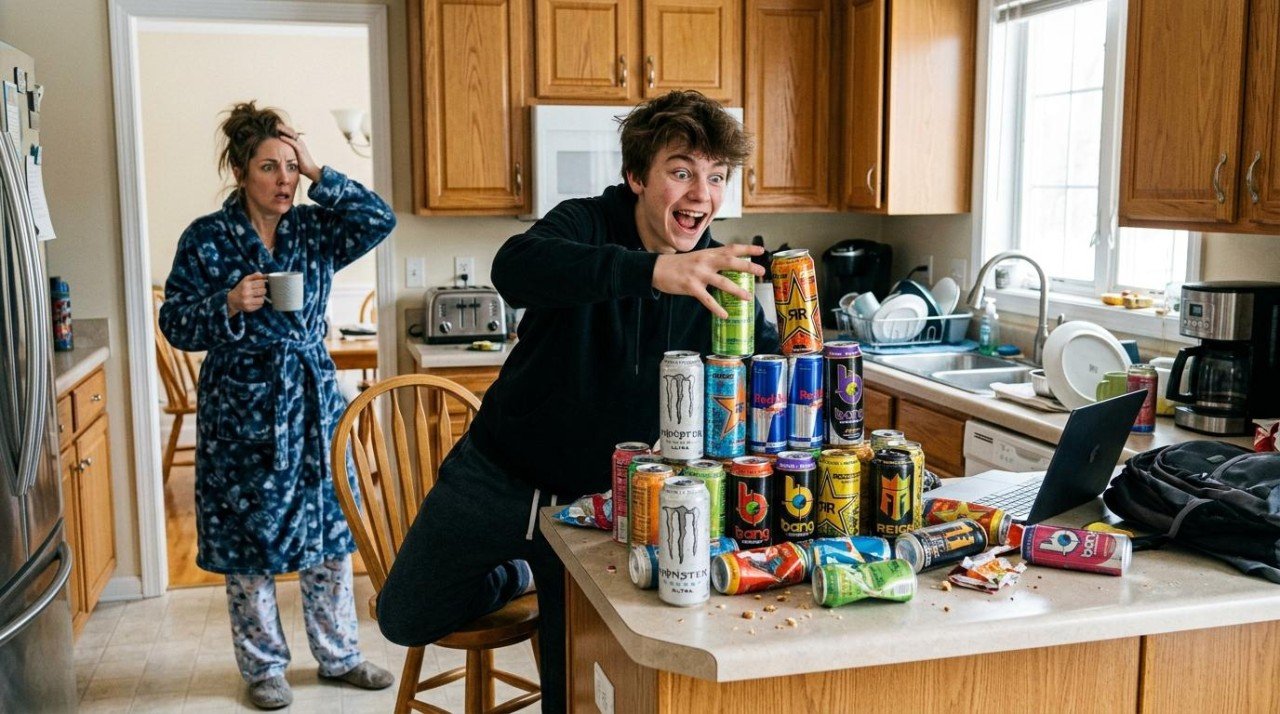
You went to grab the laundry out of your kid's backpack and found the cans. Maybe a Celsius. Maybe a Prime. Maybe three Monsters and a receipt from the gas station near school. And now you are standing in the kitchen trying to work out whether this is a normal teenage thing or something you should actually be worried about.
Here is the honest answer: it is worth paying attention to, but not because energy drinks are uniquely evil. It is because the doses are much bigger than most parents realize, the labels are surprisingly unreliable, and the thing your teen is trying to fix with a can, usually tiredness, almost never gets fixed by caffeine. It gets postponed.
This post walks through what the research actually shows, where the popular scary claims are overstated, and what tends to work better than confiscating the cans.
Most Parents Have No Idea What the Doses Are
Start with the numbers, because they are the part that surprises people.
The American Academy of Pediatrics recommends that kids aged 12 to 18 stay under 100 mg of caffeine a day, and that younger children skip it entirely. The AAP's position on energy drinks specifically is blunter than that. Its clinical report on sports drinks and energy drinks concluded that caffeine and other stimulant substances contained in energy drinks have no place in the diet of children and adolescents.
Now compare that 100 mg ceiling to what is actually on the shelf. The AAP's own parent guide lists the caffeine content of popular products:
- Red Bull Original, 8.4 oz: 80 mg
- Monster Green OG, 16 oz: 160 mg
- Rockstar Original, 16 oz: 160 mg
- Celsius Sparkling Fantasy Vibe, 12 oz: 200 mg
- Alani Nu Hawaiian Shaved Ice, 12 oz: 200 mg
- Reign Total Energy, 16 oz: 300 mg
- Bang Energy Sour Heads, 16 oz: 300 mg
Prime Energy, the drink that turned into playground currency after launching in 2022, contains 200 mg of caffeine in a 12-ounce can, roughly the same as six 12-ounce cans of Coca-Cola. In 2023 it drew enough attention that Senate Majority Leader Chuck Schumer asked the FDA to look into both its caffeine content and its marketing, and the FDA said it would review the concerns.
So a single can is frequently two to three times an entire day's recommended caffeine for a teenager. For comparison, a 12-ounce Mountain Dew has 54 mg and a Diet Coke has 46 mg. A teen who drinks two sodas a day is in a completely different league from a teen who drinks one Reign.
And most parents are not tracking any of this. In a 2024 C.S. Mott Children's Hospital National Poll of 1,095 parents of teens, 1 in 4 said their teen consumes caffeine every day or nearly every day, and 57% said they rarely look at caffeine amounts when buying beverages for their teen. Two out of three parents thought they would know if their teen was getting too much. Given that most people cannot name the caffeine content of a Celsius, that confidence is probably misplaced.
The Label Is Not Always Right
Here is a wrinkle that makes "just read the label" harder advice than it sounds. The FDA does not require beverage makers to print caffeine content on the can at all. Many do it voluntarily, but voluntarily is not the same as accurately.
When Consumer Reports tested 23 energy drinks and energy shots in 2026, only one product, Red Bull at a measured 76 mg, came in under the 100 mg teen limit. Bang Energy tested at 305 mg. And eight of the 23 products contained 8 to 16 percent more caffeine than the amount on the label.
That does not mean labels are useless. It means treat the printed number as a floor, not a ceiling, and pay attention to can size. A 12-ounce can with 200 mg is a much more concentrated product than a 16-ounce can with 160 mg, which is the opposite of what "bigger can" instincts suggest.
The Sleep Problem Is the Real Problem
If you only take one thing from this post, make it this one. The most consistently documented harm from teen caffeine is not a heart event. It is sleep, and sleep is where the whole thing becomes self-sustaining.
The CDC recommends that teens aged 13 to 18 sleep 8 to 10 hours per 24 hours, and in its national survey data it found that 72.7% of US high school students were not hitting that mark. American teenagers are, as a population, already running a sleep deficit before caffeine enters the picture.
Caffeine then makes it measurably worse, and researchers have watched it happen. In a study that put 98 adolescents aged 11 to 17 on seven consecutive nights of at-home EEG sleep monitoring, each additional caffeinated drink in a day cut total sleep time by about 10 minutes, added 8 minutes to how long it took to fall asleep, and reduced REM sleep by 7 minutes. Timing mattered enormously. An evening caffeinated drink cost 28 minutes of sleep, 17 extra minutes to fall asleep, and 11 minutes of REM. Morning caffeine showed no significant effect. The authors concluded that reducing intake, particularly in the afternoon and evening, may improve adolescent sleep.
The effect compounds with regular use. A study of 1,353 Norwegian 15- and 16-year-olds found that those drinking energy drinks four or more times a week got 0.95 hours, about 57 minutes, less sleep per night than those who never drank them, and took an extra 25 minutes to fall asleep. That study also found a striking gender gap: 52.5% of boys had consumed energy drinks at some frequency versus 25.2% of girls.
The loop is easy to see. Tired teen drinks a can in the afternoon. Falls asleep later. Wakes up more tired. Needs a bigger can. The drink is not solving the energy problem; it is borrowing against tomorrow's.
Quitting is not painless either, which is worth knowing before you announce a household ban. In a follow-up study of adolescents assessed for caffeine dependence, the most commonly reported withdrawal symptoms among the dependent teens were feeling drowsy, tired, fatigued or sluggish (83.3% each) and headache (75.0%). Those are the exact symptoms the caffeine was being used to fight. A teen who goes cold turkey on Monday will feel worse on Tuesday, and that is normal rather than evidence that they needed the caffeine.
What About the Heart and Anxiety?
This is where the internet gets dramatic and the research is more measured, so it is worth being precise. Vague scare stories give teens an easy reason to dismiss everything else you say.
Two randomized trials gave healthy children and teenagers an energy drink dosed at 3 mg of caffeine per kilogram of body weight, which is the acute maximum the European Food Safety Authority considers safe for minors, and monitored what happened.
The first found that in 27 healthy children and adolescents, averaging about 14 and a half years old, systolic blood pressure rose by up to 5.23 mmHg and diastolic by up to 3.29 mmHg compared with placebo, with more participants crossing into elevated-blood-pressure and hypertension categories after the drink. Its conclusion: minors, particularly those with pre-existing health conditions, should be discouraged from drinking energy drinks.
The second, in 26 healthy children and teenagers aged 10 to 18, found a significant increase in supraventricular extrasystoles, which are extra beats originating above the ventricles. Notably, it found no significant change in the QTc interval, and no supraventricular tachycardia or dangerous ventricular arrhythmias.
Read those together and the accurate takeaway is: at a dose already considered a maximum, energy drinks measurably raise blood pressure and increase benign extra heartbeats in healthy kids. They did not trigger dangerous rhythms in healthy kids in these trials. The population that should be genuinely cautious is teens with existing heart conditions, high blood pressure, or a family history of arrhythmia, plus anyone on stimulant medication for ADHD.
On mental health, a 2024 systematic review in Public Health covering 57 studies of children and young people up to age 21 found energy drink consumption associated with short sleep duration, poor sleep quality, low academic performance, psychological distress, ADHD symptoms, depressive and panic behaviors, and increased suicide risk, along with smoking, alcohol use, and other substance use. The authors recommended applying the precautionary principle in policy.
Important caveat, and you should say this part out loud to your teen because it makes you more credible, not less: most of those studies are observational. They cannot prove the drinks caused the outcomes. A kid who is anxious, sleeping badly, and struggling in school may reach for energy drinks because of all that. The association is real and consistent across dozens of studies. The direction of the arrow is not settled.
The Zero Sugar Halo
Sugar-free versions have taken over the category, and a lot of teens genuinely believe this makes them a health product. Look back at the AAP's list and the problem is obvious.
Reign, Bang, Ghost, C4, Alani Nu, and Celsius all list 0 g of sugar, and they carry 200 to 300 mg of caffeine. Monster Green and Rockstar carry a lot of sugar, 54 g and 63 g respectively, but only 160 mg of caffeine. In other words, the zero-sugar drinks are, on average, the more caffeinated ones.
Removing the sugar removed the problem people worry about most and left the problem pediatricians actually worry about, at a higher dose. That is a genuinely useful thing to point out to a teenager, because it is a real fact about labels rather than a lecture, and it is the kind of thing they will repeat to friends.
Energy Drinks and Sports: What the Evidence Really Says
You will read that energy drinks dehydrate athletes. That claim is weaker than it sounds, and it is worth getting right.
A review of caffeine and fluid balance found that doses equivalent to normal servings of tea, coffee, and soft drinks appear to have no diuretic action, and found no support for the idea that caffeinated drinks consumed as part of normal life cause fluid loss exceeding the volume drunk. The authors concluded there is no clear basis for avoiding caffeinated drinks in situations where fluid balance might be compromised. If you lead with dehydration and your teen has already read otherwise, you lose the argument.
The real concerns are different and better supported. Energy drinks are not sports drinks, and the AAP's clinical report exists largely to stop people treating them as interchangeable. During exertion, blood pressure is already elevated, and the pediatric trial above shows an energy drink adds to it. Caffeine also blunts perceived effort, which is exactly the signal a young athlete should be listening to in the heat. And a can drunk at a 6 p.m. practice lands squarely in the window that the EEG study showed does the most damage to that night's sleep, which is the thing that actually drives athletic recovery.
For a kid playing 90 minutes of soccer, water is the answer. For long or intense sessions, a drink with electrolytes and no caffeine does the job.
Why the Ban Is the Weakest Tool You Have
Poland ran the large-scale version of this experiment. On January 1, 2024, it banned energy drink sales to anyone under 18, and researchers measured what happened.
The results are genuinely mixed. Among physically active Polish youth, consumption fell from 46.4% before the ban to 19.1% in 2025, which the authors called effective, albeit to a limited extent, while noting the ban did not change why young people drink them. Taste and friends drinking them stayed the top reasons.
But a separate 2025 survey of 1,691 Polish adolescents aged 12 to 17 found 41.1% still drinking energy drinks in the past month. Only 19.3% were consistently asked for proof of age. Only 13.8% were always refused a sale. And 58.1% said the ban did not restrict their access, mostly because adults, older friends or parents, bought the drinks for them. Meanwhile 57% said the ban did not convince them the drinks were harmful, and that group drank them at more than double the rate of their concerned peers, 54.0% versus 23.9%.
That last finding is the one to sit with. The restriction moved the numbers. What moved them more, within the restricted group, was whether the kid actually believed the drinks were bad for them. A rule your teen does not believe in mostly teaches them to buy the can somewhere you cannot see.
Research on how parents actually influence teen diets points the same direction. A path analysis of 3,819 Chinese adolescents found that parents' attitudes toward junk food and sugary drinks had no direct association with what teens consumed. The influence ran entirely through two indirect routes: what was actually available at home, and the teen's own internalized motivation. Persuasion alone did nothing. The kitchen and the buy-in did everything.
The Fix for Tired Teenagers Is Boring
Here is the part nobody wants to hear, including the teenager. In the Mott poll, when parents of frequent caffeine users were asked why their teen used it, the answers were: they like the taste (43%), friends drink it (23%), to stay awake (18%), to cope with early school start times (16%), and to study or focus (13%).
Only the first two are about the drink. The rest are a sleep problem and a schedule problem wearing a beverage costume. And underneath those, very often, is a food problem: a teenager who skipped breakfast, ate a vending-machine lunch at 11:20 a.m., and hit a wall at 2 p.m.
Breakfast in particular does real work. A 12-week randomized controlled trial in 57 habitual breakfast skippers compared a 35 g protein breakfast, a 13 g protein breakfast, and continuing to skip. Only the high-protein group saw reductions in daily hunger, and only that group avoided fat mass gain over the 12 weeks, losing 0.4 kg while the skippers gained 1.6 kg. A real breakfast with actual protein, eggs, Greek yogurt, leftover chicken, changes how the rest of the day feels.
None of this is complicated. It is just hard to do on a Tuesday morning when nobody planned anything. Which is the entire reason the can exists.
That is where having the week's food figured out in advance quietly does more than any lecture. Eat Well Planner builds meal plans around your family's actual recipes and turns them into an organized shopping list, so the protein-heavy breakfast and the grab-and-go afternoon snack are already in the house instead of being a decision someone has to make while running late. Every recipe gets a nutrition score and plain-language nutrient highlights, so you can see at a glance whether a breakfast is genuinely carrying protein or just looks like it should. And if a family favorite is coming up short, the Make It Healthier feature suggests specific ingredient swaps and verifies the nutritional gain with a calculator before showing them, so you are boosting the protein rather than guessing at it.
Making the food easy is not a substitute for the conversation. It just removes the daily gap that the energy drink was filling.
Take the Guesswork Out of Eating Well
Eat Well Planner helps you organize your favorite recipes, plan balanced meals, and automatically generate shopping lists — all in one place. Whether you're tracking macros, managing dietary restrictions, or just trying to stop asking "what's for dinner?", we've got you covered.
Our AI-powered tools can adapt any recipe to your dietary needs, help you discover new meals you'll love, and even log your nutrition effortlessly. It's meal planning made simple.
Start Organizing Your Meals — FreeHow to Actually Have the Conversation
Based on what the evidence supports, a few things tend to work better than "you are not allowed to drink those."
- Lead with the dose, not the danger. "That can has 200 mg. The pediatric limit for your age is 100. Two of those is more caffeine than most adults drink in a day." Numbers are checkable. Doom is not, and a teenager who fact-checks you and wins stops listening.
- Teach the label, including its limits. Show them that caffeine is not required on the label, that a Consumer Reports test found 8 of 23 products over their stated amount, and that a smaller can often means a stronger drink. This is a genuinely useful adult skill, not a rule.
- Make sleep the shared enemy, not the drink. Most teens will not argue that they are exhausted. The EEG data gives you a concrete, non-preachy line: caffeine after about lunchtime is the part that costs them sleep, and morning caffeine barely registered. That is a negotiable boundary rather than a prohibition, which makes it far more likely to survive contact with reality.
- Concede what is true. The mental health research is associational. Caffeine does not dehydrate you meaningfully. Coffee is caffeine too. Granting the accurate points buys you credibility on the ones that matter.
- Change what is in the kitchen. Per the research on parental influence, availability at home did the work that lectures did not. Cold sparkling water, iced tea, fruit, yogurt, and actual breakfast food where they can reach it.
- Taper rather than cut. Withdrawal headaches and fatigue peak in the first few days. Warn them it is coming and that it passes, or the withdrawal itself becomes their evidence that they need the drink.
- Fix the schedule if you can. If the can exists because practice ends at 8 p.m. and homework starts at 9, the drink is a symptom. Sometimes the honest answer is that something has to come off the calendar.
When to Call the Doctor
The AAP lists the signs of too much caffeine as a racing or irregular heartbeat, fast breathing, body shakes or tremors, anxious feelings, and an inability to sit still. Consumer Reports recommends calling a doctor if your teen shows those symptoms.
Worth a conversation with your pediatrician even without acute symptoms:
- Your teen has a known heart condition, high blood pressure, or a family history of arrhythmia or sudden cardiac death
- They take stimulant medication for ADHD, or any medication where a doctor should weigh in on added caffeine
- Chest pain, fainting, or palpitations, especially during or after exercise
- Persistent insomnia, escalating anxiety, or panic symptoms
- Intake is climbing and they cannot cut back without headaches and fatigue that stop them functioning
Some context on scale: the AAP notes that caffeine-related visits to US emergency departments nearly doubled among middle and high school students between 2017 and 2023, and that in 2023 poison control centers recorded a 24% rise in calls about young people reacting to energy drinks. Serious events are still uncommon. They are not zero, and they are trending the wrong way.
The Bottom Line
Energy drinks are not going to ruin your kid. A can at a friend's house is not a crisis, and treating it like one costs you the ability to influence the next hundred cans.
What is worth taking seriously is that a single modern can routinely delivers two to three times a teenager's entire daily caffeine allowance, that labels understate it often enough to matter, that the sugar-free versions are usually the strongest, and that the sleep cost is real, measurable, and self-reinforcing.
The most effective thing you can do is not the ban. It is making the underlying problem smaller: food that shows up on time, a protein-carrying breakfast, a schedule that leaves room for eight hours, and a teenager who understands the dose well enough to make their own call when you are not there.
If the planning part is what keeps falling apart in your house, Eat Well Planner is free and handles the tedious half: meal plans built from recipes your family will actually eat, shopping lists generated automatically, and nutrition tracking that shows you whether the week is genuinely delivering what your teenager needs.