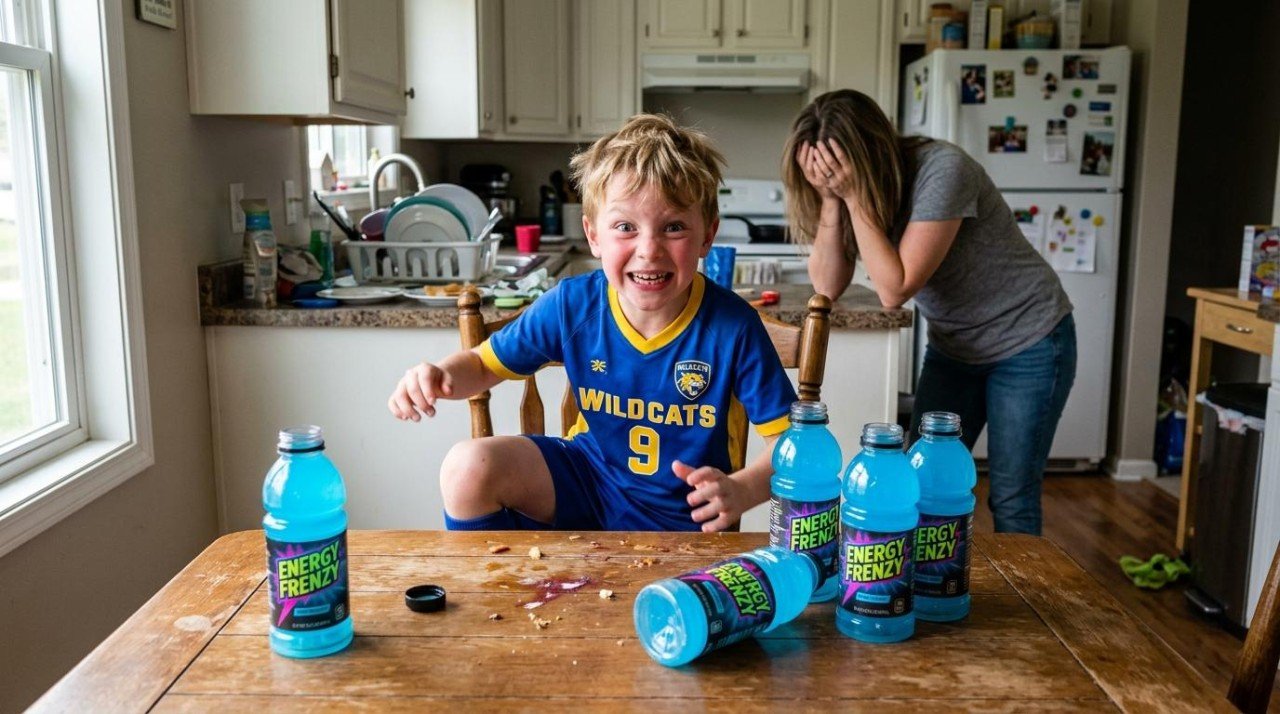
Picture the scene: it's 5:45 p.m., practice ended ten minutes ago, and you're merging onto the highway with a kid in the back seat who is somehow both starving and running on fumes. On the passenger seat is a neon sports drink, because the coach mentioned electrolytes, and dinner is a question you'll answer at a red light. If this is you, you're not doing anything wrong — you're doing exactly what the marketing trained all of us to do.
Youth sports nutrition is dominated by products designed for professional athletes and then sold to eight-year-olds. The bottles are bright, the claims are confident, and the underlying message is that peak performance comes from something you buy in the checkout line. The honest version is far less glamorous and a lot cheaper: most of what young athletes need is real food, enough of it, and a little bit of timing. Let's walk through what actually matters, from the most overhyped thing to the most overlooked.
The Hydration Truth: Water Wins Most of the Time
Start with the drink in the cup holder, because that's where the most money gets wasted. For a typical practice or game lasting under an hour, plain water is all the hydration a child needs. This isn't a fringe opinion — it's the position of the American Academy of Pediatrics, which advises that water is the appropriate first choice before, during, and after activity, and that sports drinks should be reserved for exercise lasting more than an hour or taking place in very hot or humid conditions.
The reason to be picky is sugar. A 20 oz bottle of a classic sports drink contains around 34 grams of sugar — roughly nine teaspoons. Now put that next to the American Heart Association's guidance that children ages 2 to 18 should keep added sugar under about six teaspoons (25 grams) for the entire day, with sugary beverages limited to no more than eight ounces per week. In other words, a single post-practice sports drink can blow past a child's whole daily sugar budget — for a 45-minute soccer scrimmage that water would have covered for free.
Two clarifications keep this fair. First, sports drinks aren't villains; they have a real job. During long, hot, intense sessions — think a summer tournament, a two-hour endurance practice, or back-to-back games in the heat — the sugar and sodium genuinely help with energy and fluid replacement. The problem isn't the product, it's using a tool built for a marathon to hydrate a Tuesday practice.
Second, sports drinks and energy drinks are not the same thing, and the difference matters enormously. Energy drinks contain stimulants like caffeine, and the AAP is unambiguous that they have no place in the diet of children and adolescents — some contain 10 to 15 times the caffeine of a cola, and caffeine is a diuretic that can actually worsen dehydration during exercise. If a can promises to "boost energy" with stimulants, it's not sports nutrition. It's a product to keep away from young athletes entirely.
The Thing That Actually Moves the Needle: Enough Food
Here's the plot twist that surprises most sports parents. The biggest nutrition risk for a young athlete usually isn't what's in their water bottle — it's that they're not eating enough overall. Underfueling is far more common than most families realize, and it hides in plain sight because a busy, growing, active kid always seems hungry.
The stakes are real. When an athlete chronically takes in less energy than their training and growth demand, they can develop what sports medicine now calls Relative Energy Deficiency in Sport (RED-S). It's not just about being tired. Low energy availability disrupts hormones across the body — it can impair bone formation, immune function, and, in girls, menstrual function, all of which are especially consequential in a body that's still developing. A recent review of adolescent athlete nutrition notes that teens show heightened physiological sensitivity to energy deficits compared with adults, precisely because they're building bone and tissue at the same time they're training.
And the deficits aren't hypothetical. The same review documents adolescent volleyball players meeting only about 60% of their estimated energy needs, and adolescent soccer players running daily shortfalls of roughly 1,600 calories. The risk climbs during growth spurts, when calorie needs jump, and in aesthetic or weight-class sports — gymnastics, wrestling, distance running, dance — where there's cultural pressure to stay light. If your athlete seems to be plateauing, getting hurt often, catching every cold, or (for teen girls) losing a regular period, underfueling belongs on the list of suspects. For context, the review pegs the danger zone for low energy availability at under 30 kcal per kg of fat-free mass per day, versus an optimal target of at least 45.
The practical takeaway: before you buy a single supplement, make sure your athlete is actually eating enough real meals and snacks across the day. That's the intervention with the biggest payoff, and it's the one no product can sell you.
Take the Guesswork Out of Eating Well
Eat Well Planner helps you organize your favorite recipes, plan balanced meals, and automatically generate shopping lists — all in one place. Whether you're tracking macros, managing dietary restrictions, or just trying to stop asking "what's for dinner?", we've got you covered.
Our AI-powered tools can adapt any recipe to your dietary needs, help you discover new meals you'll love, and even log your nutrition effortlessly. It's meal planning made simple.
Start Organizing Your Meals — FreeCarbohydrates: The Fuel That Belongs Around Activity
If energy is the headline, carbohydrates are the working fuel. They're what muscles burn during hard efforts, and they refill the glycogen stores a young athlete depletes at practice. The adolescent nutrition review puts daily needs in the range of 6 to 10 grams per kilogram of body weight per day, scaled to how much and how hard the child is training.
You don't need to count grams to get the timing right. The idea is simple: carbs before activity top off the tank, and carbs after activity help refill it. A banana, a granola bar, or a bowl of cereal an hour or two before practice does the job. After a hard session, the review suggests around 1.0 to 1.2 grams per kilogram to kick-start recovery — which in real life just means the meal or snack that follows practice should include a solid carbohydrate source, not just a piece of grilled chicken. For everyday youth sports, this is less about precision and more about not sending a kid into practice on an empty tank or home to bed on one.
Protein: Spread It Out, and Hold the Powder
Protein might be the most oversold supplement category in all of youth sports, so let's be clear about two things. Young athletes do need more protein than sedentary kids — the review cites a range of 1.4 to 2.0 grams per kilogram of body weight per day for athletes. But they almost never need a tub of powder to get there.
What matters more than the total is the distribution. The body uses protein best when it arrives in moderate amounts throughout the day rather than in one giant post-workout shake. Practically, that looks like 20 to 40 grams of quality protein per meal, spaced every three to four hours — eggs at breakfast, yogurt or a sandwich at lunch, a real dinner. Spreading it that way does more for a growing athlete than any single "recovery" product.
As for supplements, the evidence is refreshingly blunt. The review notes that adolescent athletes typically already consume protein at two to three times the recommended level from food alone, and recommends a food-first approach with powders treated as a convenience for unusual situations (travel, tight schedules), not a daily necessity. There's a safety angle too: some commercial protein powders have been found to contain heavy metals like lead and cadmium, which is not something you want to hand a 13-year-old every afternoon when a glass of milk and a chicken thigh would do the same job better.
The Micronutrients That Build a Growing Athlete
A few specific nutrients deserve extra attention in adolescence — not because kids need exotic supplements, but because these are the ones that commonly fall short right when the body needs them most.
Iron, Especially for Girls
Iron carries oxygen to working muscles, and adolescent athletes — particularly girls — are strikingly prone to running low. In one study of 11-to-18-year-old basketball and soccer players, 53% of the female athletes had at least mild iron deficiency, with another 28% moderately deficient — meaningfully higher than their male teammates. Menstruation, rapid growth, and the small iron losses that come with high-impact training all stack up. The consequences of running on empty here are exactly what you'd expect: fatigue, poor endurance, and underperformance that no sports drink will fix.
The adolescent nutrition review lists iron needs of about 11 mg per day for teen boys and 15 mg per day for teen girls, and recommends screening for symptomatic athletes rather than blanket supplementing. The everyday fix is dietary: red meat, poultry, and fish provide the most absorbable iron, while beans, lentils, tofu, and fortified cereals contribute plant-based iron — and pairing those plant sources with vitamin C (peppers, citrus, tomatoes) helps the body absorb them. If you suspect a problem, that's a conversation with a pediatrician and a simple blood test, not a guess.
Calcium and Vitamin D for Bones That Are Still Forming
Adolescence is when the skeleton banks most of the bone mass it will carry for life, which makes calcium and vitamin D non-negotiable for young athletes. The review sets calcium needs at 1,300 mg per day for 14-to-18-year-olds and vitamin D at 600 to 800 IU, while noting that many adolescents fall short of both — raising the risk of suboptimal bone development and, down the line, stress fractures. This is also where underfueling comes back to bite: RED-S undermines bone formation directly, so a kid who's both under-eating and low on calcium is compounding the damage.
Dairy is the easy win here — milk, yogurt, and cheese deliver calcium and often come fortified with vitamin D. For non-dairy households, fortified plant milks, tofu set with calcium, canned salmon or sardines with the bones, and leafy greens all contribute. Sunshine helps with vitamin D, but it's genuinely hard to get enough from food and light alone, so this is another one worth checking with a doctor if your athlete trains indoors or lives somewhere with long winters.
The Practical Playbook
All of this only helps if it survives contact with a real week. Here's how the principles translate into the three moments that trip parents up most.
The Pre-Practice Snack That Isn't a Gas Station Run
The goal before practice is easy-to-digest energy, mostly carbohydrate with a little protein, eaten one to two hours ahead. Think an apple with peanut butter, a banana and a handful of pretzels, yogurt with granola, a cheese stick and crackers, or half a turkey sandwich. The trick isn't finding the perfect snack — it's having something ready so the answer isn't a bag of chips from the corner store. A small cooler bag stocked at the start of the week beats a daily scramble every time.
Tournament-Day Eating Between Games
All-day tournaments are where fueling really matters, because a kid is burning energy across many hours with no proper meals. The strategy is small, frequent, familiar foods rather than one big meal that sits heavy: bananas, oranges, trail mix, pretzels, wraps or sandwiches cut in halves, and plenty of water throughout. This is also the one setting where a sports drink earns its keep — long, hot, repeated efforts are exactly the conditions the AAP describes. Pack more than you think you'll need, and lean on foods your athlete already likes, because tournament day is not the time to experiment.
The Post-Game Meal That's Just Dinner
Here's the most reassuring part: the ideal recovery meal is a normal, balanced dinner. A plate with a protein, a generous serving of carbohydrate (rice, potatoes, pasta, bread), and vegetables covers everything — protein to repair, carbs to refill, fluids and food to rehydrate. No special products required.
One humble drink does have research behind it, though: plain chocolate milk. Its roughly 4-to-1 carb-to-protein ratio makes it a legitimate recovery option, and it's actually been tested in kids. In a five-week field study of 103 high school athletes, the group given chocolate milk after training gained substantially more strength (a 12.3% increase) than the group given a carbohydrate-only sports drink (2.7%). It's cheap, it's familiar, and it quietly outperforms the neon stuff for recovery — a fitting summary of this entire article.
Making the Real-Food Version the Easy One
If there's a single theme here, it's that fueling a young athlete is a planning problem far more than a shopping problem. The families who get this right aren't the ones buying the most supplements — they're the ones who decided on Sunday what practice-night dinners look like and packed the snacks before the week got away from them. That's precisely the part that's hard to sustain when you're tired and running late, and it's exactly where a little structure pays off.
This is where a tool like Eat Well Planner earns its place on a sports family's phone. You can build the week's dinners around the practice schedule so there's a real meal waiting after the field, generate a shopping list that includes the portable snacks (so the cooler bag is actually stocked instead of aspirational), and lean on quick, practical recipes for the nights when you have twenty minutes, not two hours. Because it works from fresh, whole-food recipes, the plan naturally crowds out the drive-through default.
Just as useful is the ability to check the thing that actually matters most: whether your athlete is getting enough. With nutrition tracking and a quick food diary — you can even log meals by voice — you can see at a glance whether the calories, protein, and iron are really there, or whether a growing kid in a heavy training block is quietly underfueling. Every recipe carries a nutrition score and plain-language "good source of" highlights, so you can spot the iron- and calcium-rich meals without decoding a nutrition label. It turns "I hope they're eating okay" into something you can actually see — which, for a young athlete's health and growth, beats any bottle of electrolytes on the shelf.
Young athletes don't need an athletic-looking product. They need water most of the time, enough real food all of the time, carbs around their training, protein spread through the day, and iron and calcium to build the body they're growing into. Get those right, and you've given them something no sponsorship deal can: a foundation that actually holds up.