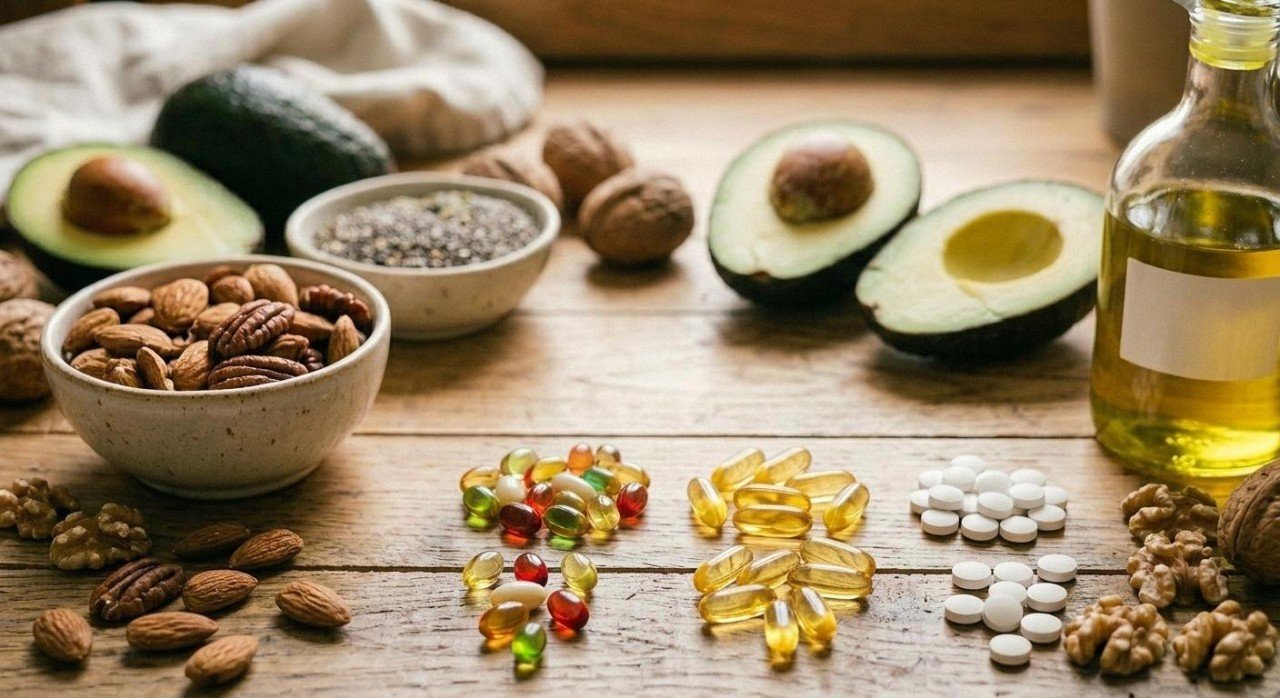
Picture the scene: you're trying to eat better, so you build a big, virtuous salad — spinach, romaine, shredded carrots, a few cherry tomatoes — and to keep it "light," you skip the dressing or reach for the fat-free bottle. Or maybe dinner is a plate of plainly steamed broccoli and zucchini, no butter, no oil. It feels like the responsible choice. Here's the uncomfortable truth: a meal like that can quietly waste a big chunk of the very nutrition you're eating it for.
That's because four of the most important vitamins in vegetables — A, D, E, and K — are fat-soluble. Without a little fat in the same meal, your body struggles to absorb them, and much of that hard-won nutrition passes right through you. The good news is that the fix is almost laughably simple: a drizzle of olive oil, a few slices of avocado, or a small handful of nuts can unlock far more of what's on your plate.
Meet the Fat-Soluble Vitamins
Vitamins fall into two camps based on what they dissolve in. Water-soluble vitamins (the B vitamins and vitamin C) mix easily into the watery environment of your gut and bloodstream. Fat-soluble vitamins don't. As the name says, they dissolve in fat — and that single chemical fact changes everything about how you need to eat them.
There are four fat-soluble vitamins, and each pulls real weight in the body:
- Vitamin A — vision, immune function, skin, and cell growth. In plants it shows up as carotenoids like beta-carotene (the orange in carrots and the deep green in spinach), which your body converts to active vitamin A.
- Vitamin D — calcium absorption, bone strength, and immune regulation. Your skin makes some from sunlight, but diet matters too.
- Vitamin E — a powerful antioxidant that protects your cells from oxidative damage.
- Vitamin K — essential for blood clotting and for steering calcium into your bones rather than your arteries.
You'll notice these vitamins cluster in exactly the foods health-conscious eaters love: leafy greens, colorful vegetables, nuts, and seeds. The irony is that the "cleaner" you try to make those foods by stripping out fat, the less of their goodness you actually get to keep.
How Absorption Actually Works
To understand why fat matters so much, it helps to follow a vitamin on its journey through your digestive system. When fat enters your small intestine, your gallbladder releases bile and your pancreas releases enzymes. Together they emulsify the fat into tiny droplets called micelles — think of them as microscopic delivery vehicles. Fat-soluble vitamins and carotenoids hitch a ride inside these micelles, which ferry them to the cells lining your intestine. From there they're packaged into particles called chylomicrons and shuttled into your lymphatic system before finally reaching your blood.
No fat in the meal means few or no micelles forming — and the fat-soluble vitamins have no way to cross the intestinal wall on their own. The National Institutes of Health's fact sheet on vitamin D puts it plainly: "Because vitamin D is fat soluble, its absorption depends on the gut's ability to absorb dietary fat." The same micelle-based logic applies to vitamins A, E, and K, and to the carotenoids in your vegetables. The NIH notes that the various forms of vitamin A have to be solubilized into micelles in the intestine before they can be absorbed — and that beta-carotene from food is typically only 10–30% absorbed even under good conditions. Take the fat away and that modest number drops further.
The Salad Experiment That Proved It
This isn't just textbook theory — researchers have measured it directly, and the results are striking.
In a frequently cited study published in The American Journal of Clinical Nutrition, scientists fed volunteers salads of spinach, romaine, cherry tomatoes, and carrots topped with dressing containing either 0, 6, or 28 grams of canola oil, then measured how many carotenoids made it into their blood. After the fat-free salads, the appearance of alpha-carotene, beta-carotene, and lycopene in the bloodstream was, in the researchers' word, "negligible." Absorption climbed with the reduced-fat dressing and was highest of all with the full-fat dressing. In other words, the fat-free salad looked healthy but delivered almost none of its carotenoids.
Avocado tells the same story even more dramatically. In a study in The Journal of Nutrition, adding avocado to salsa boosted lycopene absorption to 4.4 times and beta-carotene to 2.6 times the levels from avocado-free salsa. When researchers added about 150 grams of avocado (or 24 grams of avocado oil) to a salad, absorption of alpha-carotene rose roughly 7-fold, beta-carotene about 15-fold, and lutein about 5-fold compared with the fat-free version. Those aren't rounding errors — that's the difference between eating a salad and actually benefiting from it.
So how much fat do you really need? Less than you might think — and the type matters. In a Purdue University study of 29 adults, researchers served identical salads with 3, 8, or 20 grams of three different fats: a monounsaturated oil (canola), a polyunsaturated oil (soybean), and a saturated fat (butter). The monounsaturated oil delivered just as much carotenoid absorption at 3 grams as it did at 20 grams, while the saturated and polyunsaturated fats needed larger amounts to reach the same effect. The takeaway is encouraging: a modest splash of olive or avocado oil — the monounsaturated fats at the heart of the Mediterranean diet — does the job without piling on calories.
It's Not Just Salad: Vitamins D, E, and K
The salad studies make the point vividly, but the principle reaches across your whole diet.
For vitamin D, a randomized trial gave people a single oral dose and paired it with either a high-fat meal (about 26 grams of fat) or a near-fat-free one (under 2 grams). The high-fat group ended up with meaningfully higher blood levels of vitamin D in the weeks that followed. It's a useful reminder if you take a vitamin D supplement: swallowing it with a fat-containing meal, rather than on an empty stomach, helps it actually get absorbed.
Vitamin E is so tied to fat that the Merck Manual notes "a very low fat diet lacks vitamin E, because vegetable oils are the main source of this vitamin and because vitamin E is best absorbed when eaten with some fat." Strip the oils and fatty foods out of your diet and you remove both the vitamin itself and the vehicle that carries it.
Vitamin K follows suit. According to Oregon State University's Linus Pauling Institute, all forms of vitamin K are absorbed in the small intestine via a mechanism requiring bile salts, and the vitamin K locked inside green vegetables is absorbed less efficiently than the form in oils — but its uptake "is increased with the addition of a fat source to a meal." That kale salad does far more for your bones when it's not eaten dry.
The Hidden Cost of Going Too Low-Fat
For a couple of decades, "low-fat" was treated as a synonym for "healthy," and the habit lingers. But dietary fat isn't the enemy it was made out to be — and cutting it too aggressively carries a real, if quiet, cost. The International Food Information Council sums it up neatly: dietary fat helps us absorb vitamins A, D, E, and K, so a diet that's too low in fat can leave those four nutrients chronically under-absorbed even when you're eating plenty of vegetables.
This is why the National Academies of Sciences set the recommended range for fat at 20–35% of daily calories — not as a ceiling to fear, but as a healthy band that supports nutrient absorption. The problem with the dutiful plain-salad, steamed-veggie approach isn't that the vegetables are bad. It's that without a little fat alongside them, you're leaving much of their value on the table. You did the hard part — buying and preparing the vegetables — and then accidentally undercut it.
To be clear, this isn't a license to drown everything in oil. The studies above show that small amounts of the right fats do the trick. The goal is balance: enough healthy fat in each meal to unlock the nutrients, not so much that the meal becomes calorie-heavy. That balance is exactly the kind of thing that's easy to know in theory and easy to forget in the rush of a weeknight.
Take the Guesswork Out of Eating Well
Eat Well Planner helps you organize your favorite recipes, plan balanced meals, and automatically generate shopping lists — all in one place. Whether you're tracking macros, managing dietary restrictions, or just trying to stop asking "what's for dinner?", we've got you covered.
Our AI-powered tools can adapt any recipe to your dietary needs, help you discover new meals you'll love, and even log your nutrition effortlessly. It's meal planning made simple.
Start Organizing Your Meals — FreeSimple Pairings for Everyday Meals
The fix doesn't require recipes or measuring. It's about reflexively adding a little healthy fat wherever vegetables show up. Some easy moves:
- Salads: Skip the fat-free dressing. Whisk a real vinaigrette with olive oil, or toss in avocado, olives, nuts, seeds, or a little crumbled cheese.
- Steamed or roasted vegetables: Finish them with a drizzle of olive oil, a pat of butter, or a sprinkle of toasted seeds before serving.
- Tomato-based dishes: Cook your tomatoes, salsa, or marinara with olive oil — heat plus fat dramatically improves lycopene absorption.
- Smoothies and fruit: Blend in a spoonful of nut butter, some avocado, or a few seeds so the carotenoids in your greens and orange fruits come along for the ride.
- Carrots and bell peppers as snacks: Pair the raw veggies with hummus, guacamole, or a yogurt dip rather than eating them bare.
- Leafy greens like kale and spinach: Sauté them in a little olive oil, or build them into a meal that already contains some fat, to get more vitamin K and carotenoids.
- Vitamin D supplements: Take them with your largest, fat-containing meal of the day rather than on an empty stomach.
Notice how many of these fats are also genuinely good for you — extra-virgin olive oil, avocado, nuts, and seeds bring their own heart-healthy benefits while doing double duty as nutrient unlockers. You're not adding fat as a guilty compromise; you're adding it because it makes the rest of the meal work.
Making Balanced Meals the Default
Knowing all this is one thing. Remembering it at 6 p.m. on a Tuesday, when you're tired and just want to get dinner on the table, is another. The plain salad and the dry steamed broccoli happen precisely because they're the path of least resistance when no one has planned anything better.
That's where having a system helps more than willpower. Eat Well Planner is a free app built to make the genuinely nourishing choice the easy one. When you plan your week with it, you're working from balanced recipes — the kind that naturally pair vegetables with a little olive oil, avocado, nuts, or seeds — so the fat-soluble vitamins you're eating for actually get absorbed. You can save and import recipes from anywhere (a website, an Instagram reel, a YouTube cooking video), and the app's nutrition tracking lets you see your vitamin A, D, E, and K intake instead of guessing. If you're adapting a recipe, the built-in AI recipe chat can suggest a smart way to add healthy fat to an otherwise too-lean dish. And because every plan generates an organized shopping list, the olive oil, avocados, and nuts that unlock your vegetables are on the list before you ever get to the store.
The bottom line is reassuring: eating well doesn't mean eating joyless, naked vegetables. A little good fat isn't cheating on your healthy diet — it's what makes your healthy diet actually deliver. Drizzle the oil, add the avocado, toss in the nuts. Your vitamins will thank you.