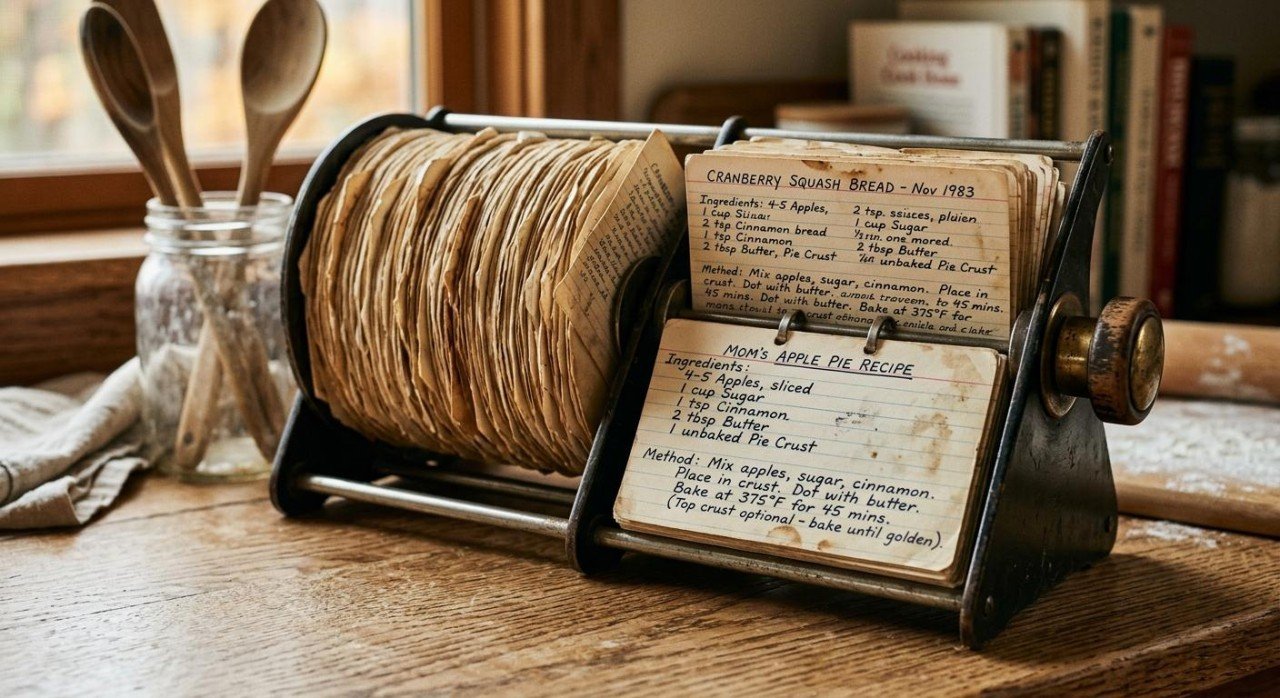
Somewhere in most families, there is a box. A battered tin, a stuffed envelope, or a three-ring binder with the spine giving out. Inside are index cards softened by decades of handling, the ink fading, the corners stained with whatever was bubbling on the stove the day someone wrote them down. These cards hold the food that defines a family: the Sunday gravy, the birthday cake, the stew that somehow tastes like being seven years old again.
And they are astonishingly easy to lose. A flood, a move, a house cleared out in a hurry, a relative who passes before anyone thought to write down how she actually made the pie crust. In a 2023 survey of 2,000 Americans commissioned by Bob Evans and conducted by OnePoll, 15% admitted they had already lost or damaged a treasured recipe that had been handed down to them. Once that ink is gone, it is usually gone for good.
The good news is that preserving these recipes has never been simpler. You do not need to be a chef, an archivist, or particularly tech-savvy. You need a phone, an afternoon, and a plan. Here is how to turn a fragile shoebox of cards into a searchable, shareable cookbook that will outlive the paper it started on.
Why Family Recipes Are Worth the Effort
It is tempting to think of a recipe as just a list of ingredients and steps. But the same survey found that family recipes evoke something far deeper: respondents associated them with joy (48%), love (46%), and nostalgia (35%). A recipe card in your grandmother's handwriting is one of the few objects that lets you, in a sense, cook alongside someone who is no longer there.
Food historians and cultural organizations make the same point in more formal terms. UNESCO, in its work on food and living heritage, describes culinary traditions as "not simply recipes, but living practices sustained and transmitted through families, kitchens, markets, and communities." Food, the project notes, functions as "a language of care" — a way of communicating affection that families often cannot put into words. A handwritten recipe is that language, written down.
There is a genealogical value, too. Family recipes quietly record migration, marriages, regional ingredients, and the texture of everyday life in a way that birth certificates and census records never will. Preserving them is not sentimentality for its own sake. It is keeping a piece of your family's actual history.
The Clock Is Quietly Ticking
Here is the uncomfortable part. Despite living in an age of cloud backups and infinite storage, most families are keeping their most irreplaceable recipes in their most fragile formats. In that same survey, Americans said they store family recipes on physical note cards (46%), in a physical recipe book (40%), or purely from memory (25%). Only 13% had digital scans.
Sit with that for a second. A quarter of people are relying on memory alone — which means an entire recipe can vanish with a single phone call you didn't think to make in time. And paper, the most common format by far, is exactly the format most vulnerable to spills, fire, fading, and the slow entropy of an attic.
The recipes most at risk are usually the best ones: the dishes that live in one relative's head, the ones nobody ever needed to write down because "she just knows." Those are the recipes to capture first, ideally by cooking alongside that person and writing down what they actually do, not what they say they do.
Take the Guesswork Out of Eating Well
Eat Well Planner helps you organize your favorite recipes, plan balanced meals, and automatically generate shopping lists — all in one place. Whether you're tracking macros, managing dietary restrictions, or just trying to stop asking "what's for dinner?", we've got you covered.
Our AI-powered tools can adapt any recipe to your dietary needs, help you discover new meals you'll love, and even log your nutrition effortlessly. It's meal planning made simple.
Start Organizing Your Meals — FreeStep 1: Capture Everything Before You Fix Anything
The single most important step is also the easiest: get a faithful copy of every card before you do anything else. Do not start "cleaning up" recipes or retyping them yet. First, simply photograph or scan each card exactly as it is — coffee stains, marginal notes, crossed-out lines and all. Those imperfections are part of the document.
The National Archives recommends scanning as "a good way to preserve a collection of clippings while enhancing use and sharing with other family members." It also offers practical handling advice that applies to any heirloom paper: store cards flat and unfolded rather than adding new creases, keep them away from moisture (ink "may show evidence of inks running or bleeding because water or another liquid was splashed on them"), and avoid old magnetic photo albums, which "will discolor paper, making it increasingly difficult to safely remove the recipes without tearing them." When you do cook from an original, slip it into a clear polyester sleeve to protect it from spills and greasy fingerprints.
Once you have a clear photo, you have already beaten the worst-case scenario. The recipe now exists in more than one place, and no kitchen accident can erase it.
This is also where a recipe app earns its keep. With Eat Well Planner, you can add a recipe straight from a photo or type it in manually, and the app pulls the ingredients, instructions, and nutrition data into a clean, structured format. Instead of a drawer of loose cards, you end up with a digital recipe book where every dish is backed up, searchable, and impossible to misplace. You can keep the originals safely stored away and cook from your phone, leaving the fragile cards untouched.
Step 2: Translate the Vague Bits
If you have ever tried to actually cook from an old recipe card, you have hit the wall: "a knob of butter," "a teacup of sugar," "bake in a quick oven till done." Older recipes assumed a level of shared kitchen knowledge that simply doesn't exist anymore — and decoding them is part of the fun of preserving them.
For most of cooking history, there was no standard at all. As Chowhound notes, before the 1880s "no standardized measurements existed for cooking," and instructions leaned on household objects and intuition — which is a polite way of saying "not all human hands are the same size." That changed largely thanks to Fannie Merritt Farmer, whose 1896 Boston Cooking-School Cook Book introduced American cooks to standard "level" teaspoon, tablespoon, and cup measurements. As Mass Moments recounts, Farmer essentially self-published the book and retained the copyright; it became an immediate success and has never gone out of print. She is remembered, fittingly, as the "Mother of Level Measurements."
Many of the old terms can be translated with a quick reference. Drawing on guides like Eating the Eras and Chowhound, here is a starter key for the most common offenders:
- A gill — about ½ cup (note that historic British and American gills differ slightly).
- A teacup — roughly ½ to ¾ cup, depending on the cup.
- A wineglass — about ¼ cup.
- A knob of butter — somewhere between 1 and 2 tablespoons, and deliberately flexible.
- A dessertspoon — about 2 teaspoons.
- A pinch — about ⅛ teaspoon; a smidgen is roughly half that.
For the truly cryptic instructions, modern tools help. Eat Well Planner's AI recipe chat lets you ask, in plain language, what "a moderate oven" probably means in Fahrenheit, or how to convert a gill into cups, or what to use in place of an ingredient that no longer exists on store shelves. It is a little like having a knowledgeable friend read the card over your shoulder — without losing the character of the original.
Step 3: Scale It for How You Actually Cook
Old recipes were often written for the household that used them — which might mean a dish sized for ten people on a farm, or a cake baked in a pan no one owns anymore. Part of bringing a recipe back to life is making it fit your kitchen.
When you adjust portions, do it carefully and write down the new numbers rather than redoing the math every time. Scaling is not always perfectly linear — baking times, pan sizes, and seasoning often need a lighter touch than a straight doubling implies — but for everyday cooking, halving or doubling gets you most of the way there. Keeping both the original and your adjusted version is worthwhile: the original is the heritage document, and the scaled version is the one you'll actually cook on a Tuesday.
This is another place where digitizing pays off. In Eat Well Planner you can adjust serving sizes and let the app recalculate quantities, and you can use recipe variations and the AI chat to adapt a dish for today's needs — making Grandma's casserole gluten-free, lowering the sodium, or working around a dairy allergy — while keeping the original recipe intact and untouched. The family classic stays exactly as it was; you simply gain a version that fits the people at your table now.
Step 4: Make It Searchable and Shareable Forever
A shoebox has one fatal flaw beyond fragility: you can't search it. Finding the right recipe means flipping through dozens of cards, and only one person can hold the box at a time. The whole point of digitizing is to break those limits.
Once your recipes live in a searchable digital cookbook, you can find "the one with the lemon and the almonds" in seconds, even if you've forgotten its name. More importantly, you can share it. Instead of a single physical artifact that exists in one house, the family recipe becomes something every cousin, sibling, and grandchild can have their own copy of — across the country, across generations, permanently backed up.
That shareability matters more than it might seem. The same survey found that more than one in four people (27%) have created their own recipes specifically intending to start a tradition of passing them down. A family cookbook isn't just a way to look backward; it's a place to add your own contributions, so the collection keeps growing. With Eat Well Planner, recipes you save sit in a personal recipe book you can search instantly, and you can even publish recipes to a community of people focused on real, home-cooked food — turning a private heirloom into something others can discover and enjoy.
Don't Lose the Stories
One thing the digitizing process can't do on its own is capture the context — and that context is often the most precious part. A recipe that says "Mom always made this the night before the first day of school" is worth more than the recipe alone. So as you transcribe each card, add the things that aren't written anywhere: who it came from, when it was served, the substitutions everyone secretly made, the disasters and the triumphs.
If an older relative is still around, this is the moment to sit them down and cook together. Watch what they actually do — the handful of this, the "until it looks right" — and write it down in real measurements as you go. You will preserve not just the recipe but the technique and the memory, the parts that usually die with the cook. A digital recipe entry gives you a single, durable place to keep all of it together: the steps, the photo of the original card, and the story behind it.
Start With One Card
The whole project can feel daunting if you picture digitizing an entire box at once. So don't. Pick one card — the most important one, or the most fragile one — and capture it today. Photograph it, translate the vague bits, write down what you remember about it, and save it somewhere it can't be lost. Then do the next one tomorrow.
Every card you preserve is one your family will never have to grieve. And the food that has quietly held your people together for generations gets to keep doing exactly that — for the generations still coming.
Ready to give those recipe cards a permanent home? Try organizing your family recipes with Eat Well Planner — import them from photos, make them searchable, and keep them safe to share for good.