It's 3:40 p.m. and the negotiation has already started. Your kid wants the chips. You counter with an apple. They counter with crying. Somewhere around the third round you fold, hand over the bag, and add another tally to the running scoreboard of snack battles lost this week. If this is your house, here's the reframe that changes everything: you don't have a willpower problem, and neither does your child. You have a layout problem. The chips are winning because the chips are easier — more visible, more grabbable, more ready-to-eat than anything you'd rather they ate.
The fix isn't more vigilance or better lectures. It's a one-time reset of where snacks live in your kitchen so that the healthy choice becomes the easy, obvious, grab-it-yourself default. Kids are wonderfully predictable in this one way: they eat what's in front of them. This post walks through the science of why that works, the step-by-step reset, and a full stock list to get you started.
Snacks Are Basically a Fourth Meal Now
First, the stakes — because snacks stopped being a side note in kids' diets a long time ago. A study in Health Affairs that tracked more than 31,000 American children across three decades of national dietary surveys found that by the mid-2000s, kids were averaging well over two snacks a day — nearly double the rate of the late 1970s — and snacking had grown to roughly 27% of their daily calories. That's not a treat here and there. That's a meal-sized share of the day's nutrition, decided mostly in the thirty seconds between "I'm hungry" and whatever gets grabbed first.
And what gets grabbed first is rarely great. The same study found desserts were the single largest source of snack calories, with salty snacks the fastest-growing category and sweetened beverages close behind — while fruit was shrinking as a snack choice. Zoom out to the whole diet and the picture sharpens: a 2021 study in JAMA analyzing the diets of 33,795 American children and teens found that ultra-processed foods had climbed from 61% of kids' total calories in 1999 to 67% by 2018, while whole, unprocessed foods fell to under a quarter.
Here's the encouraging flip side: if snacks are a quarter of your child's calories, then upgrading just the snacks — without touching a single dinner battle — is one of the highest-leverage changes you can make to how they eat. And it happens to be the easiest one to engineer.
Kids Eat What They Can See and Reach
The core principle behind the snack drawer reset comes from a simple, repeatedly confirmed finding: proximity and visibility drive eating far more than intentions do.
In one tidy demonstration, researchers gave 96 people access to apple slices and carrot sticks served either in clear or opaque bowls, placed either right next to them or about six feet away. When the food sat close by, people ate more of it — and when the apples were in a clear bowl where they could be seen, people ate more of those too. Nobody told participants what to choose. The placement did the persuading. The study was done with college students, but if anything the effect is stronger with kids, who snack opportunistically and won't excavate the back of the fridge for a tub of cut melon they don't know exists.
The home-environment research backs this up directly. A study of children's eating habits found that the availability and accessibility of fruit, juice, and vegetables at home — whether they were in the house at all, and whether they were within reach, ready to eat, and visible — accounted for as much as 35% of the variability in how much of those foods girls ate. Even more useful for parents of picky eaters: for kids who didn't much like fruits and vegetables, accessibility mattered most of all. The researchers' conclusion was that parents of reluctant produce eaters need to make extra efforts on access — washed, cut, at eye level, ready to grab — precisely because preference won't carry the load on its own.
In other words: a whole cantaloupe in the crisper drawer is technically "available." It is not, to an eight-year-old, food. Cubed cantaloupe in a clear container on the low shelf is food.
Why Banning the Junk Backfires
At this point a reasonable parent thinks: fine, I'll just throw out everything processed and be done with it. Tempting — but the research says heavy-handed restriction tends to boomerang.
In a series of classic experiments summarized in a review of parental influence on children's eating, researchers Jennifer Fisher and Leann Birch found that keeping a desirable food visible but off-limits — cookies in a jar the children could see but not have — dramatically increased kids' interest in it, and when access was finally granted, those children took larger portions and ate more than kids who'd had the food freely available all along. Longer-term studies in the same review found that mothers' restrictive feeding practices predicted daughters who ate more in the absence of hunger and gained more weight over time. Forbidding a food, it turns out, is one of the most effective ways ever devised to make a child obsessed with it.
So the snack drawer reset deliberately avoids the ban. The goal is to quietly rearrange the defaults, not to declare war on goldfish crackers. The cookies don't become contraband — they just stop being the first thing within arm's reach, and they show up sometimes on the menu like anything else. Less forbidden fruit, more boring shelf placement.
This is also where a framework called the division of responsibility in feeding, developed by dietitian and family therapist Ellyn Satter and endorsed by the Academy of Pediatrics, fits beautifully. The idea: parents decide what food is offered, when, and where — and kids decide whether they eat it and how much. A well-stocked snack drawer is the division of responsibility made physical. You curated everything in it, so every option is one you're happy with. Your kid gets genuine free choice within it, so there's nothing to fight about. "Can I have a snack?" becomes "Sure — pick whatever you want from your drawer," and the negotiation simply ends, because every answer is a win.
The Snack Drawer Reset, Step by Step
The whole reset takes about an hour, once. Here's the playbook:
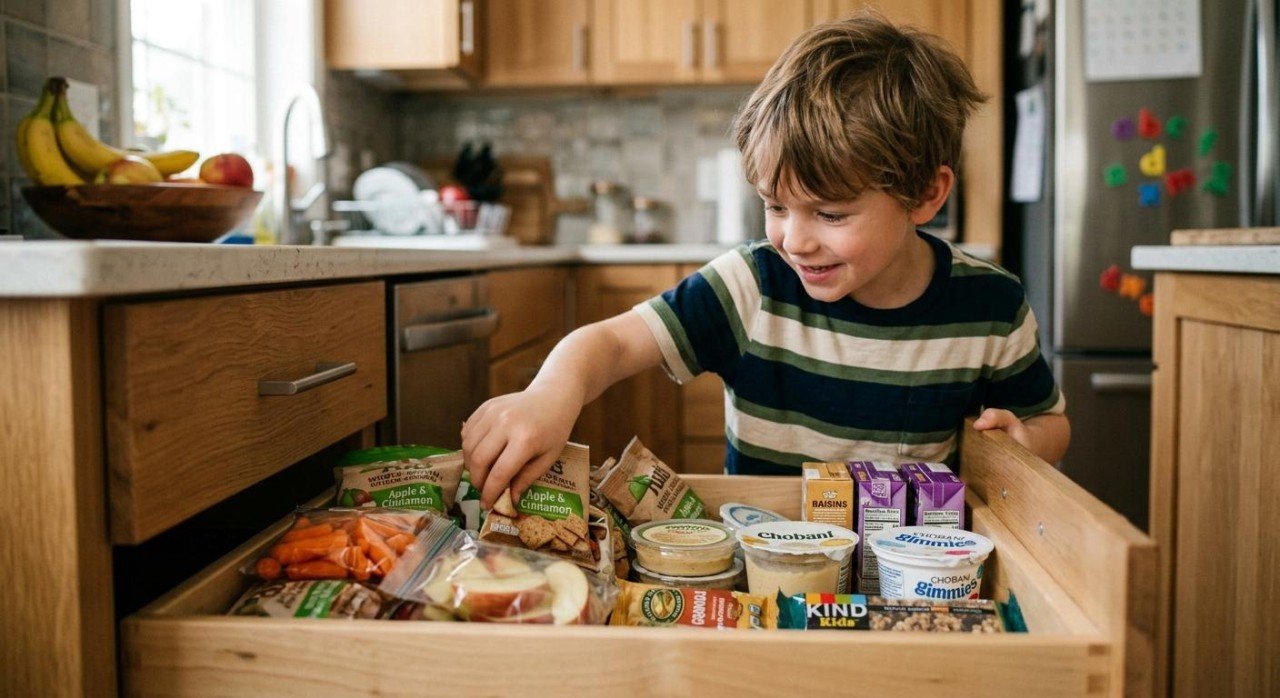
- Claim one low drawer or shelf in the pantry, and one drawer or shelf in the fridge. Both at your child's height — if they can't reach it without asking, it doesn't count. These two spots are now "the snack drawer," and the rule is simple: anything in there is always a yes.
- Use clear containers. Visibility was half the effect in the research. Clear bins, glass containers, or open baskets — your kid should see cut strawberries, not Tupperware mystery.
- Pre-portion everything. Accessibility means ready-to-eat form, not just location. Wash the grapes. Cut the melon. Portion nuts and popcorn into small cups or bags. A snack that requires prep is a snack that loses to the chip bag every time.
- Move the ultra-processed stuff up and out of sight. Not in the trash — just to a high cabinet, in its original opaque packaging, where it requires a parent and a step stool. It's still part of life; it's just no longer the path of least resistance. You've reversed the convenience gradient.
- Set loose timing guardrails, then get out of the way. Free choice within the drawer doesn't mean grazing until dinner. Something like "snack drawer is open after school and closes an hour before dinner" keeps appetite intact while preserving the autonomy that makes this work.
- Let them help stock it. Kids who picked the snow peas at the store are dramatically more invested in eating the snow peas. Give them a vote on what goes in each week — within your curated universe.
What to Stock: The Master List
The American Academy of Pediatrics' snack guidance boils down to two moves: use snack time as a vehicle for fruits and vegetables, ideally paired with protein, dairy, or whole grains — and keep a range of healthy foods handy so the good choice is the easy one. Here's a working list to rotate through. You don't need all of it — six to eight options at a time keeps the drawer interesting without overwhelming anyone.
The fridge drawer
- Cut fruit in clear containers: melon cubes, pineapple, orange segments, berries, grapes (halved for little kids)
- Apple slices tossed with a little lemon juice so they keep in the fridge without browning
- Veggie cups: baby carrots, cucumber rounds, bell pepper strips, snap peas — with small cups of hummus, ranch, or guacamole for dipping
- Cheese sticks or cubes
- Plain or low-sugar yogurt cups or tubes (add berries or a drizzle of honey for kids over one)
- Hard-boiled eggs, peeled and ready
- Edamame in pods (kids love the popping)
- Leftover cut-up chicken or turkey roll-ups
The pantry shelf
- Small cups or bags of nuts and trail mix (skip whole nuts for kids under four — they're a choking hazard)
- Air-popped or lightly salted popcorn, pre-bagged
- Whole-grain crackers portioned into small containers
- Roasted chickpeas or roasted edamame
- Unsweetened applesauce pouches
- Dried fruit without added sugar: raisins, apricots, mango, freeze-dried strawberries
- Rice cakes or whole-grain mini bagels
- Nut butter packets or a jar with a kid-accessible spoon system you can live with
Worth a 20-minute Sunday prep
- Energy balls (oats, nut butter, a little honey, mix-ins) — kids can roll them, which doubles as the sales pitch
- Mini muffins made with fruit or shredded veggies
- Homemade trail mix where each kid designs their own blend
- Frozen banana "coins" or frozen grapes (for kids past choking age) in a freezer-door bin
Take the Guesswork Out of Eating Well
Eat Well Planner helps you organize your favorite recipes, plan balanced meals, and automatically generate shopping lists — all in one place. Whether you're tracking macros, managing dietary restrictions, or just trying to stop asking "what's for dinner?", we've got you covered.
Our AI-powered tools can adapt any recipe to your dietary needs, help you discover new meals you'll love, and even log your nutrition effortlessly. It's meal planning made simple.
Start Organizing Your Meals — Free"But My Kid Will Only Eat Crackers"
Two honest caveats, because a stocked drawer isn't a magic spell.
First, new foods take repetition — way more than feels reasonable. In a randomized trial with families of three- and four-year-olds, parents offered a tiny piece of a vegetable their child disliked once a day for 14 days, with nothing but a sticker for tasting it. Before the program, 45% of the kids refused the vegetable outright; afterward, only 9% did, and nearly three-quarters were willingly eating three or more pieces. The vegetable didn't change. The exposure count did. So when the cucumber cups come back untouched the first week, that's not failure — that's exposure two of ten. Keep restocking without commentary.
Second, what you do matters as much as what you stock. In a trial that successfully raised kids' fruit and vegetable intake, researchers dug into why it worked — and found the gains traveled through two channels: parents offering produce to their kids more often, and parents eating more of it themselves. Simply having it in the house wasn't the active ingredient on its own. The drawer sets the stage, but the show is you, standing at the counter, eating the pepper strips like it's the most unremarkable thing in the world. Kids study that far more closely than anything you say.
The Real Boss Fight: Keeping It Stocked
Here's where most snack drawer resets quietly die — not in week one, but in week three, when the drawer runs empty on a Tuesday, nobody planned a grocery run, and the high-shelf cookies descend from exile because they're the only thing left. An empty snack drawer isn't neutral; it's a relapse machine. The whole system depends on the boring logistics of restocking, which means the snack drawer is really a planning habit wearing a kitchen-organization costume.
The fix is to stop treating snacks as an afterthought and plan them like the fourth meal they statistically are. When you sketch out the week's dinners, decide the week's snack lineup at the same time — which fruit, which veggie-and-dip combo, which protein options, what's getting prepped Sunday — so it all lands on the same grocery list and arrives in the same cart.
This is exactly the kind of drudgery Eat Well Planner was built to absorb. You can save your family's go-to snacks as recipes right alongside dinners — including ones you grab from Instagram or YouTube, where half the good kid-snack ideas live now — and pull them into the weekly meal plan, and every ingredient flows automatically onto an organized shopping list. The energy balls' oats and nut butter, this week's dip, the popcorn kernels: already on the list before you set foot in the store. And a planned cart is its own quiet win, because the impulse-grab snack aisle has much less pull when the snacks are already accounted for. If you're stuck for ideas, the AI recipe chat can riff on what your kids already like — "my kid loves ranch, give me three veggie snacks built around that" — or adapt any snack for a nut-free classroom or a dairy-free sibling.
Quiet Wins the Snack War
The before-and-after here is striking mostly for how undramatic it is. Before: daily negotiations, a parent playing snack police, and a quarter of your kid's calories decided by whatever's nearest. After: a kid who pads into the kitchen, opens their drawer, picks the mango cup over nothing-because-everything-in-reach-is-a-yes, and wanders off. No battle, no lecture, no willpower spent by anyone.
You're not going to out-argue a seven-year-old about chips — no one in history ever has. But you can rig the kitchen so you never have to. Set up the drawer this weekend, plan the refills like you mean it, and let the layout win the fights for you.
Ready to make the restocking automatic? Try planning your family's snacks and meals with Eat Well Planner — it's free, and the shopping list writes itself.