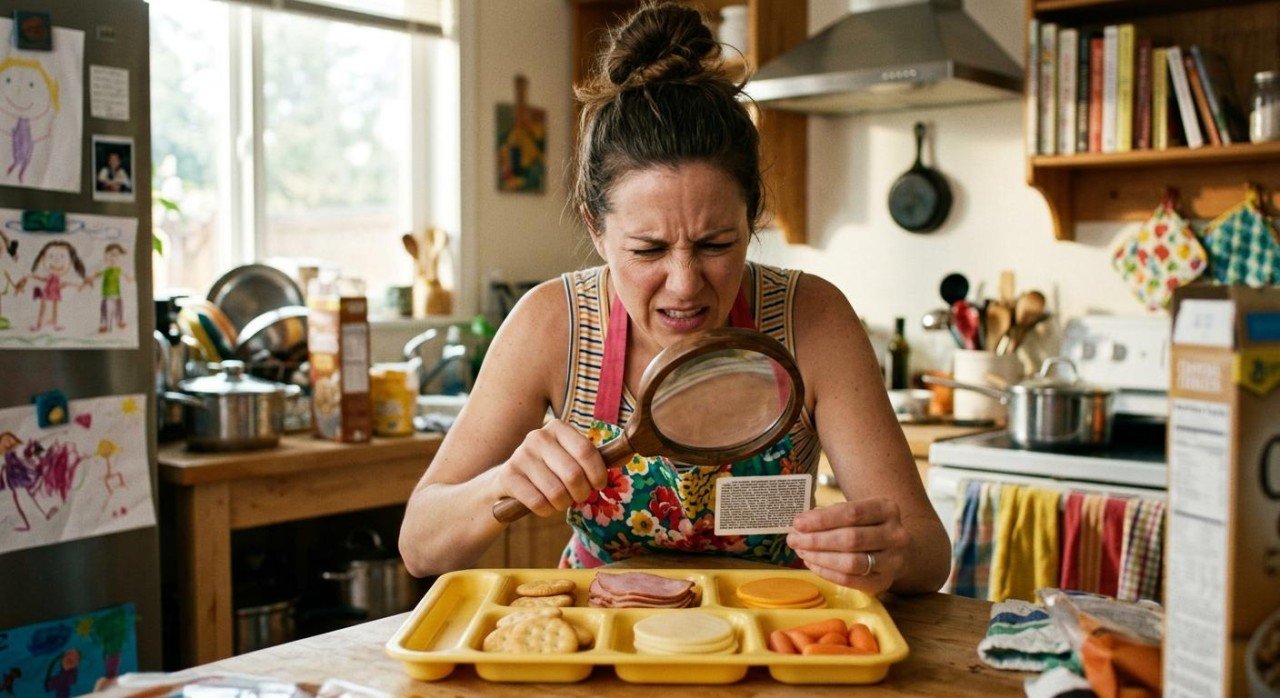
Open almost any diaper bag in America and you will find them: three or four squeeze pouches, slightly warm, wedged in next to the wipes. They are arguably the most convenient food ever invented for a hungry toddler strapped into a car seat. If your kitchen drawer rattles with them, you are in very good company.
You have probably also seen a headline implying you have quietly wrecked your child's palate. So let's put the honest version up front: pouches are not dangerous, and nobody needs to feel bad about the box already in the pantry. What the research actually shows is narrower, and a lot more useful. Pouches are considerably sweeter than their packaging suggests. They skip the textures and vegetable flavors that babies need practice with. And the real issue is not whether you use them, but whether they have quietly become the default way your child eats.
How pouches took over the baby aisle
This is not a small corner of the market anymore. When researchers at The George Institute for Global Health audited 651 commercial infant and toddler foods from the ten largest US grocery chains in 2023, 47% of everything on the shelf was a pouch. Their sales data tells the story even better: pouches went from about 6% of the category in 2010 to roughly 60% in 2023 — a 900% increase in thirteen years.
Actual use is harder to pin down, because nobody tracks it well in the US. A 2025 scoping review pulled together eleven studies from New Zealand, Sweden, the UK, Spain, and Australia and found that somewhere between 23.5% and 85.4% of infants and young children had eaten from a pouch, with 8.7% to 29.2% using them daily. The same review noted that between 16.7% and 47.8% of infants had eaten from a pouch before six months — earlier than solids are generally recommended at all.
What is actually inside: sweet by design
Here is the part most parents find genuinely surprising. In a 2019 analysis published in Nutrition Today, researchers at the University of Colorado Anschutz built a database of 548 US infant and toddler foods that contained vegetables. Half of them were pouches — and pouches contained significantly more sugar per serving, and got a significantly higher share of their calories from sugar, than the same foods sold in jars or packs.
The reason is structural. Pouches were far more likely to be fruit-and-vegetable blends, while jars were far more likely to contain a single vegetable or a mix of vegetables only. As the Colorado team put it, fruit purees and juice concentrates can create a "health halo" that leads caregivers to believe a blend is more nutritious than it is — and the blend format may limit a baby's early exposure to dark green vegetables.
An Australian audit called "The Big Squeeze" shows how far the gap between the front of the package and the back can stretch. Reviewing 276 pouches from 15 manufacturers, researchers found that of 25 products naming a meat first in the product title, none actually listed meat first in the ingredients — 88% listed vegetables first instead. Of 44 products naming a vegetable first, only about three-quarters genuinely had a vegetable as the main ingredient. And 72.8% of the pouches contained free sugars, while 59% carried a "no added sugar" claim on the front.
That last point deserves fairness, because it is where a lot of online outrage goes off the rails. Most pouches genuinely do not contain added sugar in the regulatory sense — the sweetness comes from fruit puree and juice concentrate. But the researchers auditing these products argue that is a distinction without much difference for a baby, because blending fruit into a smooth puree breaks down the cell structure that slows sugar release in whole fruit. European data backs up the scale of it: a 2020 analysis of 2,634 baby food products across ten countries found fruit purees derived 72% to 79% of their energy from sugar.
Meanwhile, the American Academy of Pediatrics advises avoiding foods and drinks with added sugar entirely for children under two. Against that standard, the US market is not doing well: in the George Institute audit, only 69% of pouches met international recommendations for total sugar, and a follow-up study published in Nutrients in 2026 classified 73% of pouch products as ultra-processed. An earlier snapshot of 397 US squeeze pouches from 2015 found the same pattern: in the fruit, vegetable, and fruit-and-vegetable categories, pouches were more likely to contain added sugar than the same foods in other packaging.
The flavor lesson a pouch teaches
Babies arrive already liking sweet. That is not a flaw — it is a survival feature. The interesting question is what happens next, and the answer is that flavor preference is learned, and learned fairly quickly.
Work summarized by Julie Mennella and colleagues at the Monell Chemical Senses Center shows that infants eat significantly more of a given pureed fruit or vegetable after roughly eight to nine days of repeated exposure. Bitter vegetables — the green ones — typically need more exposures than that. And crucially, mothers in these studies were often unaware their child's acceptance had improved, because babies keep making the same unimpressed face long after they have started eating more.
Now put that next to what is in the pouches. In the Australian audit, only 9.1% of products contained a bitter or green vegetable like spinach or broccoli at all — and when those vegetables did appear, they were mixed with free sugars. Most of the "vegetable" content came from sweet-tasting starches like pumpkin and sweet potato.
So a child can eat something labeled "Spinach, Apple & Kale" forty times and never once taste spinach. The exposure that would eventually build acceptance never happens, because apple got there first. That is not a moral failing of pouches. It is just a mismatch between what the label promises and what the tongue receives.
Texture: the part that is easiest to miss
Sucking a smooth puree and eating food are different physical acts. As feeding specialists at Nationwide Children's Hospital explain, drinking or sucking requires a forward-to-backward motion of the tongue and not much else from an oral motor perspective. A pouch also skips the hands-on part — squishing, dropping, smearing — that helps a baby learn what food is before deciding whether to eat it.
Does that matter later? The best available evidence is indirect but hard to dismiss. In the ALSPAC birth cohort, Coulthard and colleagues followed 7,821 mother-child pairs and grouped children by when lumpy solids were introduced. The 18.1% who did not meet lumpy textures until after nine months ate less of all ten fruit and vegetable categories at age seven, and were reported to have significantly more feeding problems, compared with children introduced between six and nine months.
That is why international guidance has started naming pouches specifically. The World Health Organization's European nutrient profile model recommends that children not drink pureed foods through a spout at all, and the European sugar analysis called for phasing out spouted pouches for purees on the grounds that they discourage the development of chewing skills. When University of Leeds researchers assessed 632 UK baby food products in 2025, they found spouted pouches made up 38% of the market and about half carried no advice against drinking straight from the spout. Europe is now actively debating maximum sugar limits and mandatory front-of-pack warnings for baby food. The US has no equivalent on the table, which means for American parents the reading falls to you, in the aisle, holding a toddler.
What the evidence does not show
Being honest about this cuts both ways, and the alarmed version of this story overreaches.
The 2025 scoping review looked specifically for research testing whether squeeze pouches actually cause developmental harm — and found none. Expert bodies have raised the concern, and the texture-timing research above makes it plausible, but no study has yet followed pouch-fed children and measured oral motor or eating outcomes against a comparison group.
There is also at least one study pointing the other way. An observational study of 933 New Zealand children published in Nutrients in 2024 compared frequent pouch users (five or more times a week) with non-users. It found no significant association with BMI z-scores at any age, and preschoolers who used pouches frequently actually consumed slightly less energy per day. The authors concluded plainly that their findings "do not support the strong concerns expressed about their use." Notably, only about 5% of frequent users in that study sucked directly from the nozzle — which may be exactly why the feared outcomes did not appear.
So the fair summary is this: what is in the pouch is well documented and often not great. What the pouch does to a child's development is a reasonable extrapolation, not an established fact. That should lower your anxiety without changing the practical advice much, because the practical advice is cheap and easy either way.
Teeth: frequency matters more than quantity
The dental concern is the most concrete of the bunch, and it has less to do with how much sugar is in a pouch than with how it is delivered. A 2021 systematic review of ten prospective cohort studies found that free sugar exposure — a definition that explicitly includes sugars in fruit juices and concentrates — was consistently associated with dental caries in children, with daily 100% fruit juice and sweet drinks near bedtime standing out as risk factors.
A pouch nursed slowly over an hour in a stroller behaves much more like a juice cup than like a bowl of fruit. The puree clings to teeth, and each new sip resets the clock before saliva has neutralized the acid from the last one. Ten minutes at the table is a very different exposure than sixty minutes of grazing, even if the pouch is identical.
One more reason to know what is in there
This is not an argument against pouches as a format, but it is worth remembering. Between late 2023 and 2024, the CDC identified 566 cases of lead poisoning across 44 states, DC, and Puerto Rico linked to cinnamon applesauce pouches sold under the WanaBana, Schnucks, and Weis brands. About 55% of cases were children under two. The FDA traced the contamination to cinnamon ground in Ecuador that contained lead chromate, likely added deliberately to boost weight and color.
Any food can be recalled. But a smooth, shelf-stable puree is uniquely opaque — you cannot see, smell, or taste what went into it. That is a good reason to know your brands and to keep some portion of your child's diet made of food you can recognize by looking at it.
The practical middle path
None of this means throwing out the pouches. It means demoting them from "meal" to "tool." Here is what that looks like day to day:
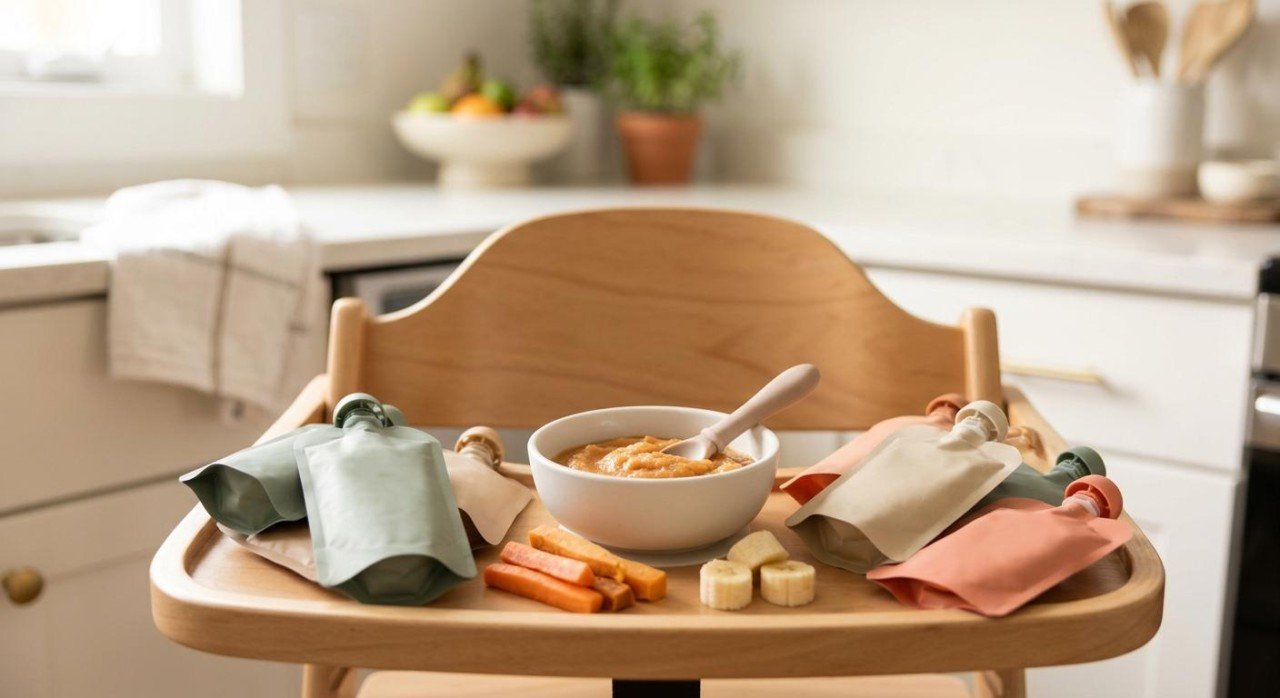
- Squeeze it into a bowl. This one change addresses most of the concerns at once — it restores the spoon, the smell, the mess, and the pacing, and it lets you see how much your child actually ate. It costs you one bowl.
- Keep the spout for the car and the airplane. Direct sucking is the specific behavior guidance warns about. Reserving it for genuinely on-the-go moments is a reasonable compromise, and it is roughly what most families already do.
- Read the ingredient list, not the front. Ingredients are listed by weight, so the first one tells you what you are really buying. If a pouch called "Broccoli & Pear" opens with pear or apple juice concentrate, it is mostly a fruit snack — which is fine, as long as you are not counting it as the day's vegetable.
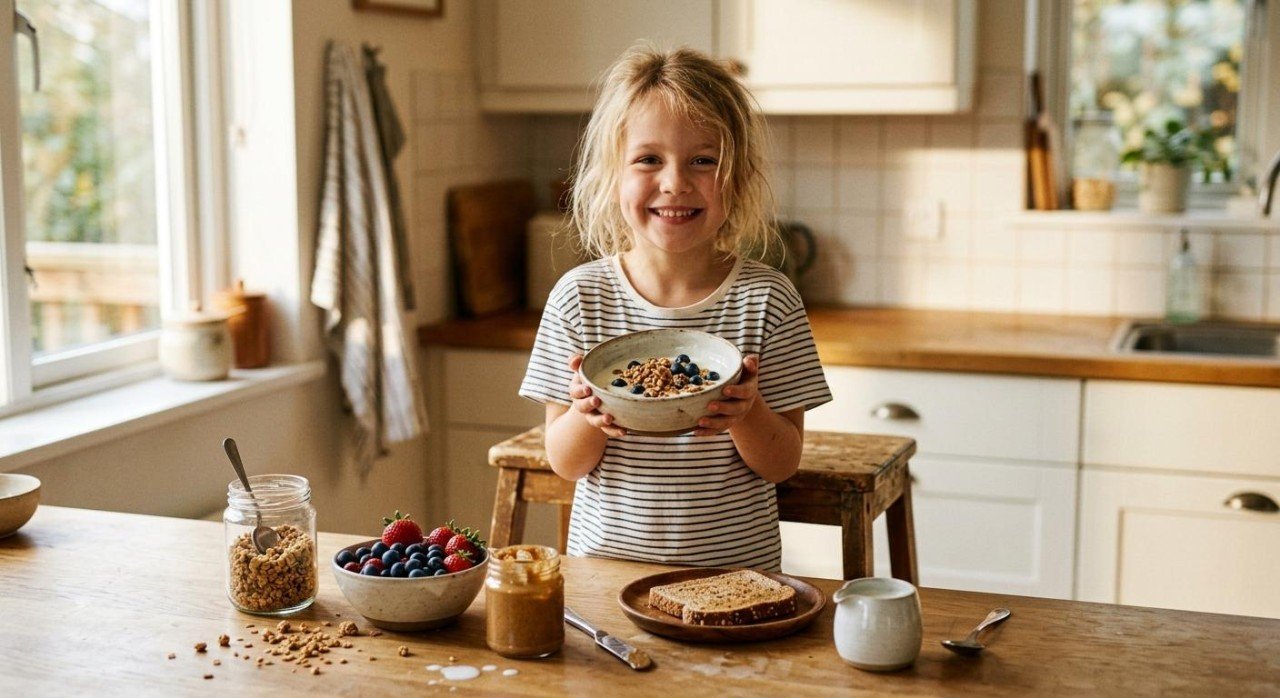
- Serve real textures on purpose between six and nine months. Soft-cooked vegetable sticks, torn bread, well-cooked pasta, flaked fish, small pieces of ripe fruit. This is the window the ALSPAC data points to, and it is short.
- Offer the actual vegetable separately, repeatedly. Eight or nine tries is the working number from the exposure research, and more for bitter greens. A grimace on attempt three is not a verdict.
- Make your own when it is easy. Steamed and mashed sweet potato, blended peas, roasted squash, or plain unsweetened applesauce cost a fraction of pouch prices and freeze beautifully in ice cube trays. Reusable pouches exist if the format itself is what your child likes.
- Pair, don't replace. A pouch alongside a hard-boiled egg, a few soft-cooked carrot coins, or a piece of toast gives the meal the protein, fat, iron, and texture that a fruit puree by itself does not.
Children's Healthcare of Atlanta's Strong4Life program frames the transition simply: between six and nine months, most babies are ready to move beyond pureed food, and that is the natural moment to let pouches become an occasional convenience rather than a staple.
Closing the convenience gap
Here is the uncomfortable truth underneath all of this: pouches win because they are the only option that requires zero planning. At 5:40pm with a melting toddler, the pouch is not competing against a lovingly prepared plate of textured vegetables. It is competing against nothing, because nothing was prepped.
Which means the real fix is not willpower — it is closing the gap so that something real is as easy to reach for as the pouch. That is precisely the problem Eat Well Planner was built to solve. You can plan a week of simple family meals and get an auto-generated shopping list so the soft-cooked vegetables and proteins are actually in the fridge. The Meal Prep system turns a Sunday hour into a set of reusable components — roasted squash, cooked grains, shredded chicken — that assemble into toddler-sized plates in about ninety seconds. Plant Points tracks how many different plants your household has eaten this week, which is a much better measure of variety than "did they eat vegetables today." And when you find a genuinely quick recipe on Instagram or a cooking video, you can import it straight into your recipe book instead of losing it.
Feed your child the same real ingredients you are already cooking, just softer and smaller, and the pouch quietly goes back to being what it should be: the thing in the diaper bag for emergencies.
Take the Guesswork Out of Eating Well
Eat Well Planner helps you organize your favorite recipes, plan balanced meals, and automatically generate shopping lists — all in one place. Whether you're tracking macros, managing dietary restrictions, or just trying to stop asking "what's for dinner?", we've got you covered.
Our AI-powered tools can adapt any recipe to your dietary needs, help you discover new meals you'll love, and even log your nutrition effortlessly. It's meal planning made simple.
Start Organizing Your Meals — FreeThe bottom line
Pouches are useful. They are also sweeter than they look, thinner on texture than a growing eater needs, and easy to over-rely on precisely because they solve a real problem. The evidence for what is inside them is strong; the evidence that they cause lasting developmental harm is not yet there.
You do not need to ban them. You need to move them out of the center of the plate: squeeze them into a bowl, read the back of the package, serve real textures during the months that window is open, and offer the actual vegetable often enough that it stops being a stranger. That is a small set of habits, and it is far more achievable than perfection — which was never on the menu anyway.