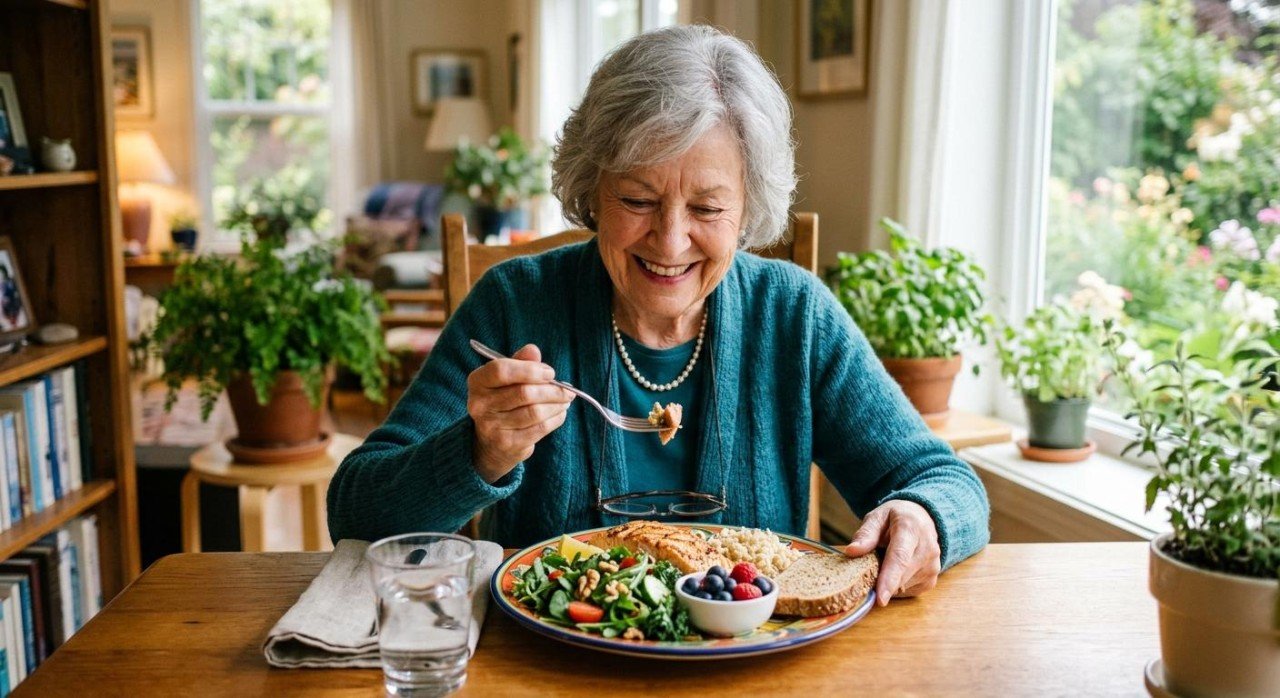
Of all the things people hope to carry into their eighties, a sharp mind is near the top of the list. We want to recognize our grandchildren, follow a conversation, keep our independence, and stay ourselves. And the fear of losing that is widespread for good reason: an estimated 7.4 million Americans age 65 and older are living with Alzheimer's in 2026, roughly one in nine people in that age group — a number projected to reach 13.8 million by 2060 unless prevention or treatment improves dramatically.
Here's the encouraging part: the brain is not simply at the mercy of your genes. A growing body of research suggests that what you eat over the years can meaningfully influence how well your mind ages. And one eating pattern has been designed from the ground up specifically to protect the aging brain — the MIND diet. It's practical, it doesn't require an overhaul of your kitchen, and the foods it emphasizes are ones you probably already like. Let's walk through what it is, what the science actually shows (the promising parts and the honest caveats), and how to start following it without turning your life upside down.
What Is the MIND Diet?
MIND stands for Mediterranean-DASH Intervention for Neurodegenerative Delay — a mouthful that describes exactly what it is. It's a hybrid of two of the most well-studied eating patterns in the world: the Mediterranean diet, repeatedly linked to heart and longevity benefits, and the DASH diet (Dietary Approaches to Stop Hypertension), developed to lower blood pressure.
The MIND diet was created by the late Martha Clare Morris, ScD, a nutritional epidemiologist at Rush University in Chicago, working with colleagues at Harvard. Rather than just borrowing wholesale from those two diets, Morris and her team built the MIND diet around the specific foods and nutrients that nutrition and neurology research had tied to brain health. The result is a pattern that singles out brain-protective foods — leafy greens and berries in particular — that the parent diets treat more generally.
The Research That Made People Pay Attention
The MIND diet first made headlines in 2015, when Morris's team published two studies based on the Rush Memory and Aging Project, a long-running study of older adults.
The first study looked at who went on to develop Alzheimer's disease. Among 923 older adults followed over several years, those who adhered most closely to the MIND diet had a 53 percent lower risk of developing Alzheimer's compared to those who followed it least. Even people who followed it only moderately well saw about a 35 percent lower risk. That second number is the one Morris found most exciting, because it suggested you didn't have to be perfect to benefit.
The second 2015 study looked at the rate of cognitive decline rather than diagnosis. Following 960 participants over an average of 4.7 years, the researchers found that those in the top third of MIND diet adherence declined more slowly than those in the bottom third — a difference the authors described as "equivalent to being 7.5 years younger in age." For an aging brain, 7.5 years is enormous.
It's worth being clear about what kind of studies these are. They're observational — they track what large groups of people eat and what happens to them, but they can't fully prove cause and effect. The researchers themselves noted that a controlled trial would be needed to confirm the findings. We'll come back to that, because it matters. But first, let's look at the foods.
The Ten Foods the MIND Diet Wants You to Eat
The MIND diet is built around ten brain-healthy food groups. According to Harvard's Nutrition Source, the targets look like this:
- Green leafy vegetables — 6 or more servings a week
- Other vegetables — at least 1 serving a day
- Berries — 2 or more servings a week
- Nuts — 5 or more servings a week
- Beans — 4 or more meals a week
- Whole grains — 3 or more servings a day
- Fish — at least 1 meal a week
- Poultry — 2 or more meals a week
- Olive oil — used as your main cooking oil
- Wine — modest amounts in the original research (more on this below)
Two of these get special emphasis, and the reason is the research behind them.
Leafy greens: the single most studied MIND food
In a 2018 study published in Neurology, Morris's team followed 960 older adults (average age 81) for an average of 4.7 years. Those who ate the most leafy greens — around 1.3 servings a day — declined more slowly than those who ate almost none, a gap "equivalent to being 11 years younger in age." Spinach, kale, collards, and even ordinary lettuce are loaded with nutrients the researchers think drive the effect: vitamin K, lutein, folate, beta-carotene, and nitrate. As with the earlier work, Morris was careful to note this shows an association, not definitive proof — but a daily serving of greens is a low-risk, high-upside habit either way.
Berries: the brain's favorite fruit
The MIND diet specifically calls for berries rather than fruit in general, and that's deliberate. In a 2012 study in Annals of Neurology drawing on the Nurses' Health Study, researchers led by Elizabeth Devore tracked over 16,000 women age 70 and older and found that those eating two or more servings of strawberries and blueberries a week had delayed memory decline by as much as 2.5 years. The leading theory is that flavonoids — the pigments that give berries their deep color — have antioxidant and anti-inflammatory effects that protect brain cells.
The Five Foods to Keep in Check
Just as important as what you add is what you scale back. The MIND diet asks you to limit five groups it considers harder on the aging brain, largely because of their saturated fat, trans fat, and refined sugar content:
- Red meat — less than 4 servings a week
- Butter and stick margarine — less than 1 tablespoon a day
- Cheese — less than 1 serving a week
- Fried and fast food — less than 1 serving a week
- Pastries and sweets — fewer than 5 servings a week
Notice the framing. The MIND diet doesn't ban anything outright or label foods "good" and "bad." A weekly burger or a slice of birthday cake fits comfortably inside these limits. The goal is to shift the balance of your week toward the brain-protective foods, not to live in fear of cheese.
Why These Foods May Protect the Brain
There's no single magic mechanism — it's a combination of effects that line up well with what we understand about how the brain ages. Leafy greens, berries, nuts, and olive oil are rich in antioxidants and anti-inflammatory compounds, and chronic inflammation and oxidative stress are both thought to contribute to cognitive decline. Fatty fish supplies omega-3 fatty acids that are structural building blocks of brain cell membranes. Leafy greens deliver folate and vitamin K, both linked to cognitive function. And the DASH influence means the pattern naturally supports healthy blood pressure — which protects the small blood vessels that feed the brain, a major factor in vascular dementia.
A quick word on the wine. The original MIND diet research included a daily glass as one of its components, but later trials dropped it for safety reasons, and major health bodies have grown more cautious about any "healthy" level of alcohol. If you don't drink, this is not a reason to start — you can follow the entire rest of the pattern and skip it.
The Honest Caveat: What the 2023 Trial Found
Any responsible look at the MIND diet has to address the elephant in the room. In 2023, the first large randomized controlled trial of the MIND diet — the gold standard for testing cause and effect — was published in the New England Journal of Medicine, and the results were more sobering than the early headlines.
Researchers randomly assigned 604 older adults (average age 70) with a family history of dementia to either the MIND diet or a control diet with mild calorie restriction, and followed them for three years. Both groups improved slightly on cognitive testing — and the difference between them was not statistically significant. Both groups also lost a similar amount of weight (around 11 pounds each). The authors concluded that over three years, the MIND diet did not produce greater cognitive benefit than the control diet.
So is the MIND diet a bust? Not so fast. There are good reasons not to throw it out. Three years is a short window to detect changes in a process that unfolds over decades, and the participants started out cognitively healthy with relatively little room to decline. Both groups improved their eating and lost weight, which may itself protect the brain — so this was less "diet versus nothing" than "one healthy approach versus another." And it doesn't erase the larger body of observational evidence connecting these specific foods to slower decline. The fair takeaway is that the MIND diet is very likely a genuinely healthy way to eat, but it's probably not a magic shield, and a few years of it late in life isn't a substitute for decades of good habits.
The good news for anyone deciding whether to bother: every food on the MIND list is independently good for your heart, your gut, and your waistline. There is essentially no downside to eating this way even if the brain benefits turn out to be more modest than the 2015 studies suggested.
How to Actually Adopt It Without an Overhaul
The beauty of the MIND diet is that the 35 percent risk reduction seen in the original study came from moderate adherence — you don't have to score a perfect ten. Here are realistic ways to nudge your week in the right direction:
- Anchor one daily serving of greens. A handful of spinach wilted into scrambled eggs, blended into a smoothie, or piled under whatever you were already going to eat. Make it automatic.
- Keep frozen berries on hand. They're cheaper than fresh, last for months, and work in oatmeal, yogurt, or a smoothie — an easy two-plus servings a week.
- Make olive oil your default. Swap butter for olive oil in everyday cooking. One swap, done once, changes dozens of meals.
- Put beans and fish on the calendar. A bean-based dinner twice a week and a fish meal once a week covers two whole food groups with minimal effort.
- Snack on nuts. A small handful most days quietly hits the five-servings-a-week target.
- Shift, don't ban. Aim to crowd out fried and ultra-processed foods by having something better already planned — not by white-knuckling willpower.
That last point is where most good intentions fall apart. You decide to eat for your brain, then a busy Tuesday rolls around, the fridge is a question mark, and the path of least resistance is takeout. The fix isn't more discipline — it's a plan that's already made before you're tired and hungry.
This is exactly the problem Eat Well Planner is built to solve. You can save MIND-friendly recipes — import them straight from a website, an Instagram reel, or a YouTube video — and the app's AI will build a balanced weekly meal plan around the foods you want more of, like leafy greens, berries, beans, and fish. It then turns that plan into an organized shopping list automatically, so the brain-protective ingredients are in your kitchen before the busy day hits. The built-in nutrition tracking lets you see whether you're actually hitting those targets across the week, instead of guessing.
Take the Guesswork Out of Eating Well
Eat Well Planner helps you organize your favorite recipes, plan balanced meals, and automatically generate shopping lists — all in one place. Whether you're tracking macros, managing dietary restrictions, or just trying to stop asking "what's for dinner?", we've got you covered.
Our AI-powered tools can adapt any recipe to your dietary needs, help you discover new meals you'll love, and even log your nutrition effortlessly. It's meal planning made simple.
Start Organizing Your Meals — FreeThe Bottom Line
The MIND diet isn't a miracle, and the most rigorous trial to date tempered some of the early excitement. But here's what hasn't changed: a pattern rich in leafy greens, berries, nuts, beans, whole grains, fish, and olive oil — and lighter on fried food, sweets, and excess red meat — is one of the most thoroughly validated ways to eat for overall health that exists. It protects your heart and blood vessels, supports a healthy weight, and feeds the body the nutrients linked to a sharper, more resilient brain.
You don't have to be perfect, and you don't have to start at 80. Each leafy-green lunch, each handful of berries, each olive-oil swap is a small deposit in an account you'll be glad to have later. The best time to start eating for the brain you want at 80 is whatever decade you're in right now.