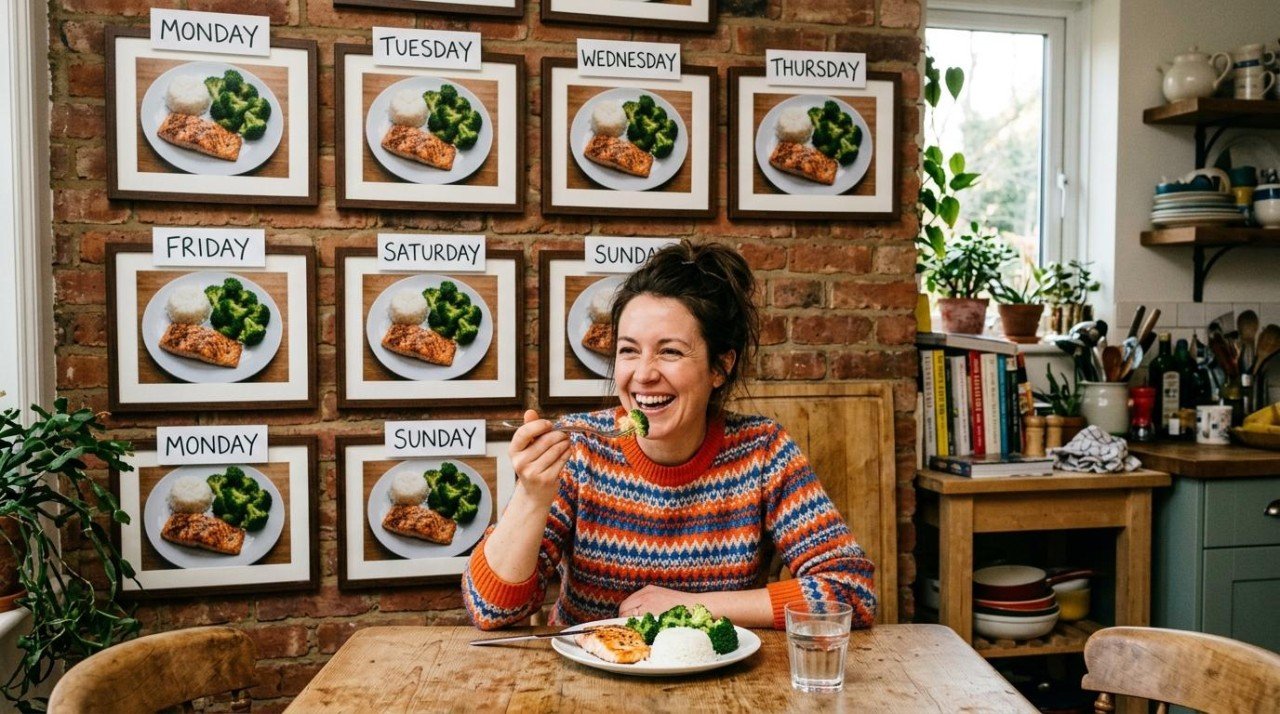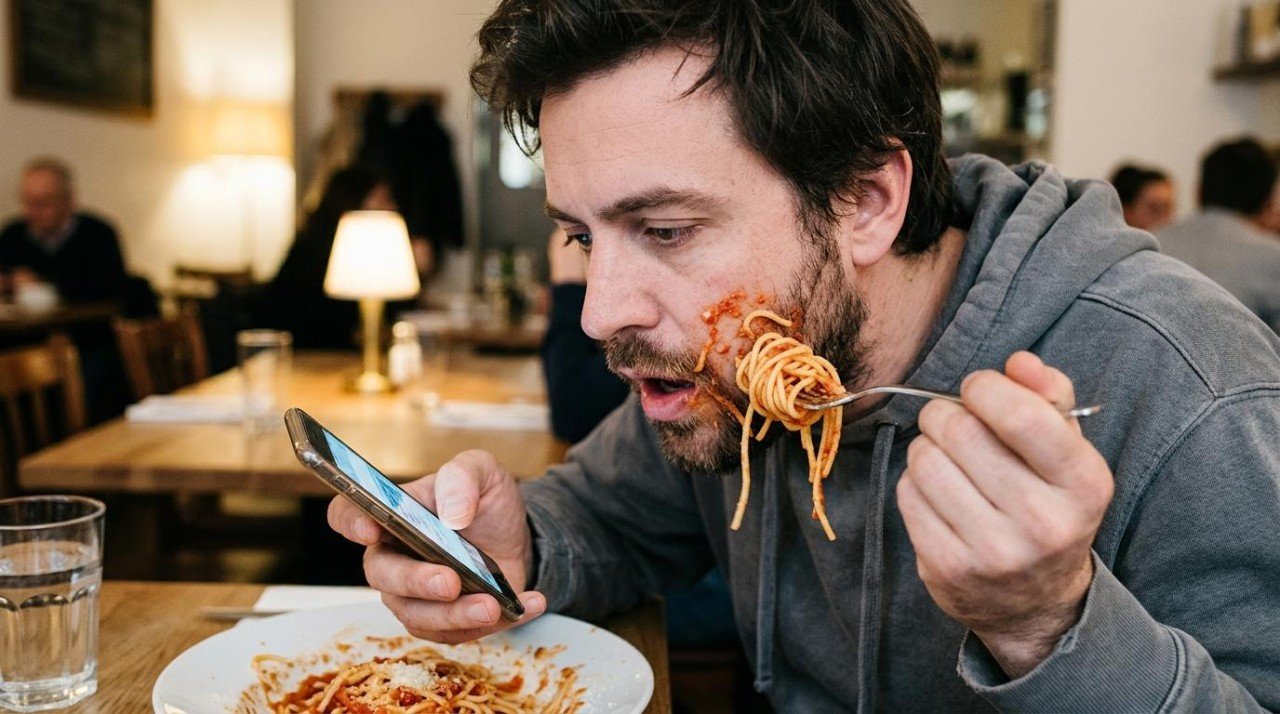
Think about the last thing you ate. Not what it was, but how you ate it. Were you at a table, tasting each bite? Or were you standing at the counter, scrolling your phone, half-watching a show, or answering email with a fork in your other hand? For most of us, most of the time, it is the second one. We eat fast, we eat distracted, and we finish our plates before our bodies have had a chance to tell us we have had enough.
Mindful eating is the simple practice of paying attention to that experience instead of tuning it out. It costs nothing, requires no special food, and does not ask you to give anything up. And a surprisingly deep body of research suggests it genuinely changes how much you eat and how satisfied you feel afterward. Let us look at what mindful eating actually is, why it works at the level of your biology, and how to start doing it without turning your dinner into a meditation retreat.
What Mindful Eating Actually Means (and What It Doesn't)
Mindful eating borrows the core idea of mindfulness — paying full, non-judgmental attention to the present moment — and points it at the act of eating. In practice, that means noticing the color, smell, texture, and flavor of your food; registering the physical sensations of hunger before a meal and fullness during it; and eating slowly enough that you actually experience the meal instead of just clearing the plate.
Here is what it is not: it is not a diet. There are no banned foods, no points to count, no macros to hit, and no rules about when you are allowed to eat. Nothing is off-limits. Mindful eating does not care whether you are having a salad or a slice of pizza — it only asks that you be present while you eat it. That distinction matters, because diets tend to work by adding restriction and willpower, both of which tend to run out. Mindful eating works by removing the distractions that override your body's own, already-excellent signals about how much food it needs.
This also makes it one of the few eating practices that improves your relationship with food rather than straining it. Instead of framing meals as a test of self-control, mindful eating reframes them as something to notice and enjoy. That shift — from restriction to attention — turns out to be the whole game.
Your Body Has a Fullness Signal. It's Just Slow.
The reason attention matters so much comes down to a timing problem built into human physiology. When you eat, your body launches a cascade of fullness signals: stretch receptors in your stomach wall register the volume of food, and your gut releases satiety hormones — cholecystokinin (CCK), GLP-1, and peptide YY — that travel to your brainstem and hypothalamus to say, essentially, that nutrients have arrived and you can stop now.
The catch is that this system is not instant. According to Harvard Health Publishing, it takes roughly 20 minutes for the brain to register satiety. That figure is an approximation, not a stopwatch reading — but the underlying reality is well established: the hormonal fullness signals build gradually over the course of a meal rather than flipping on the moment food hits your stomach. If you can finish a large plate of food in eight or ten minutes, you can easily eat well past the point of comfortable fullness before your brain ever gets the memo. By the time the signal catches up, you are not satisfied — you are stuffed.
Eating slowly is the fix, because it lets your body's own signals arrive while you are still at the table, in time to actually influence how much you eat. This is not a willpower trick. It is simply giving a slow biological system enough time to do its job.
The Evidence: Slower Eating Means Eating Less
This is not just a plausible-sounding theory. A systematic review and meta-analysis of 22 studies, published in the American Journal of Clinical Nutrition, found that a slower eating rate was associated with significantly lower energy intake compared with eating quickly (a standardized mean difference of 0.45). The effect held up across many different ways of slowing people down, from chewing more to putting utensils down between bites.
Notably, the same review found no significant difference in hunger between fast and slow eaters at the end of the meal or even hours later. In other words, people who ate slowly ate less food but did not feel any hungrier for it. They got the same satisfaction from a smaller amount — exactly what you would expect if slowing down simply lets the fullness signal land on time.
Chewing more is one of the most concrete versions of this. In a study of 47 adults summarized by Consultant360, participants who chewed 50% more than they normally would ate about 10% less food — roughly 70 fewer calories per meal — and those who doubled their chewing ate about 15% less, around 112 fewer calories. The effect showed up across normal-weight, overweight, and obese participants alike. Chewing more forces the meal to take longer, which again buys time for fullness to register.
Zoom out to the population level and the pattern is striking. A study of nearly 4,800 middle-aged Japanese civil servants found that self-reported eating speed tracked steadily with body mass index: people who described themselves as very fast eaters had a BMI roughly 1.5 points higher than medium-speed eaters, and the relationship held even after accounting for how many total calories people ate. A broader systematic review of 21 studies reached the same conclusion: across nearly every study examined, faster eaters had higher BMIs and larger waistlines than slower eaters. Eating speed is not the only thing that shapes body weight, of course — but it is a real, measurable, and completely modifiable factor.
The Screen Problem: Why Distraction Makes You Eat More
If slowing down helps, distraction does the opposite — and the research here is some of the most interesting in the field. A landmark meta-analysis by Eric Robinson and colleagues, also published in the American Journal of Clinical Nutrition, pooled dozens of experiments on attention and memory during meals. The findings are worth sitting with.
Eating while distracted — watching TV, playing a game, scrolling — moderately increased how much people ate during that meal (a standardized mean difference of 0.39). But the more remarkable finding was what happened later: distraction during a meal produced an even larger effect on how much people ate at the next meal (a standardized mean difference of 0.76, nearly double). People who ate their lunch in front of a screen went on to eat more at snack time or dinner, apparently because they had formed a weaker memory of having eaten.
That last point is the crux of it. The review concluded that a vivid memory of your recent meals actually helps regulate future eating — enhancing that memory reduced later intake. When you eat on autopilot, staring at a screen, you barely encode the meal at all. Your body ate, but your brain did not really notice, so an hour later you feel unaccountably peckish. Paying attention while you eat is not just about the current meal; it lays down the memory that helps keep the rest of your day in balance.
More Than Weight: A Healthier Relationship With Food
It would be a mistake to frame mindful eating purely as a weight-loss tactic, because some of its clearest benefits are psychological. For people who struggle with binge eating or a fraught, all-or-nothing relationship with food, mindfulness-based approaches have a solid evidence base. An updated systematic review and meta-analysis of 54 studies, published in the Journal of Behavioral Medicine in 2025, found that mindfulness-based interventions produced medium-to-large reductions in binge eating severity (a Hedge's g of around -0.65), and that these improvements were reasonably maintained at follow-up.
Interestingly, that same body of research is clear-eyed about the limits: mindfulness-based programs did not reliably produce weight loss on their own, and were about as effective as established therapies like cognitive behavioral therapy rather than dramatically better. The honest takeaway is that mindful eating is a genuinely useful tool for how you relate to eating — feeling more in control, less driven by autopilot and emotion, more able to enjoy food without guilt — and that any effect on the number on the scale tends to be a gentle downstream consequence, not a guarantee. That is arguably a healthier goal anyway.
How to Actually Eat Mindfully
None of this requires candles or a silent retreat. Mindful eating is a set of small, concrete habits, and you do not need all of them at once. Pick one or two to start:
- Eat without a screen. This is the single highest-leverage change. Put the phone in another room, turn off the TV, and step away from your desk. Given how strongly distraction drives both current and later eating, removing the screen does more than any other single tweak.
- Put your fork down between bites. A ridiculously simple mechanical trick that naturally slows your pace. Take a bite, set the utensil down, chew, swallow, and only then pick it back up.
- Chew more thoroughly. You do not need to count to 40, but aim to actually taste and break down each bite rather than swallowing on autopilot. The research suggests even a modest increase makes a measurable difference.
- Check in on your fullness partway through. Halfway down the plate, pause and ask: how full am I right now, on a scale of not-at-all to uncomfortably-stuffed? You are aiming to stop at comfortably satisfied, not maxed out. There is no rule that says you have to finish everything.
- Notice the food. Spend the first few bites deliberately registering flavor, temperature, and texture. This is not woo — it is the mechanism by which you form the meal memory that helps regulate the rest of your day.
- Ask if you are actually hungry. Before you eat, pause for a beat and check whether you are physically hungry or just bored, stressed, or eating out of habit. Both are valid reasons to eat, but naming which one it is puts you back in the driver's seat.
A gentle way to build this awareness, especially at the start, is to simply keep a record of what and how you eat. The act of noting a meal — pausing to acknowledge that you ate it, and how it felt — is itself a form of paying attention, and it surfaces patterns you would otherwise never notice: the mid-afternoon snacking that only happens on stressful days, the meals you barely remember because you ate them at your keyboard, the difference in how satisfied you feel after a slow dinner versus a rushed one.
This is where a tool can quietly help. Eat Well Planner's food diary lets you log meals in seconds — you can even log by voice — and it works out the nutritional picture for you, so the effort goes into noticing rather than into data entry. Over a week or two, that running record does exactly what mindful eating cultivates: it makes your eating visible to you, so you can spot the autopilot moments and eat a little more intentionally. Awareness is the whole point, and a diary is one of the easiest ways to build it.
Take the Guesswork Out of Eating Well
Eat Well Planner helps you organize your favorite recipes, plan balanced meals, and automatically generate shopping lists — all in one place. Whether you're tracking macros, managing dietary restrictions, or just trying to stop asking "what's for dinner?", we've got you covered.
Our AI-powered tools can adapt any recipe to your dietary needs, help you discover new meals you'll love, and even log your nutrition effortlessly. It's meal planning made simple.
Start Organizing Your Meals — FreeWhere Planning Fits In
There is one more piece worth naming. It is a lot easier to eat slowly and attentively when you are not making a frantic, stressed decision about food in the first place. So much distracted, rushed eating happens because we did not plan — we are grabbing something in a hurry, standing up, already thinking about the next thing. When a nourishing meal is already planned and the ingredients are already in the fridge, the whole act of eating slows down. You are not scrambling; you are sitting down to something you decided on in a calmer moment.
That is the connection between mindful eating and a bit of gentle structure. Planning your meals ahead — and shopping from a list instead of on impulse — removes the daily decision fatigue that pushes people toward eating fast, distracted, and often more than they meant to. Eat Well Planner can build a week of meals from recipes you actually like, generate the shopping list automatically, and track how it all adds up, which clears the mental clutter that makes mindless eating so easy to fall into. Mindful eating handles the moment; a little planning handles everything leading up to it.
The Free Habit Worth Keeping
Mindful eating is not a diet, a cleanse, or a rule to follow. It is just the practice of showing up for your meals — tasting your food, eating slowly enough for your body to keep up, and noticing when you have had enough. The science is refreshingly consistent: slower, attentive, screen-free eating leads people to eat less without feeling deprived, forms the meal memories that keep the rest of the day in balance, and builds a calmer, more trusting relationship with food.
You already own everything you need for it. The next time you sit down to eat, try just one thing: put the phone away, and taste the first three bites like you mean it. That is the entire habit, and it is free.