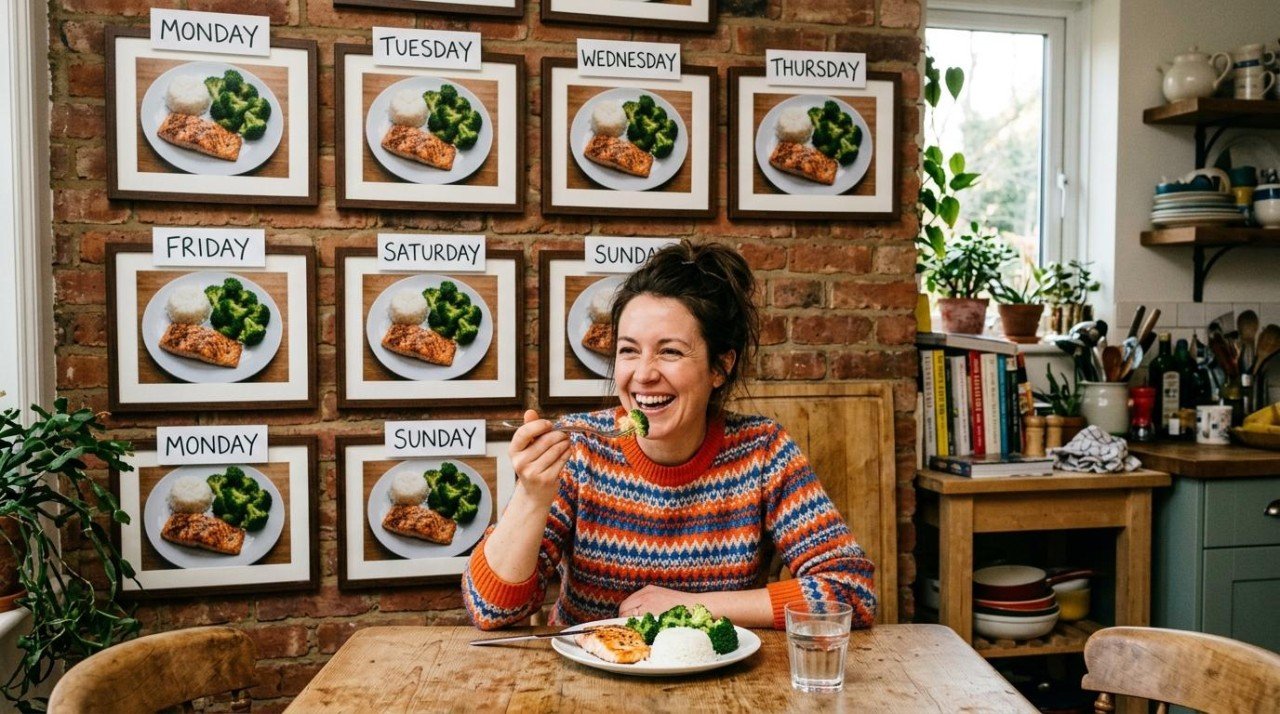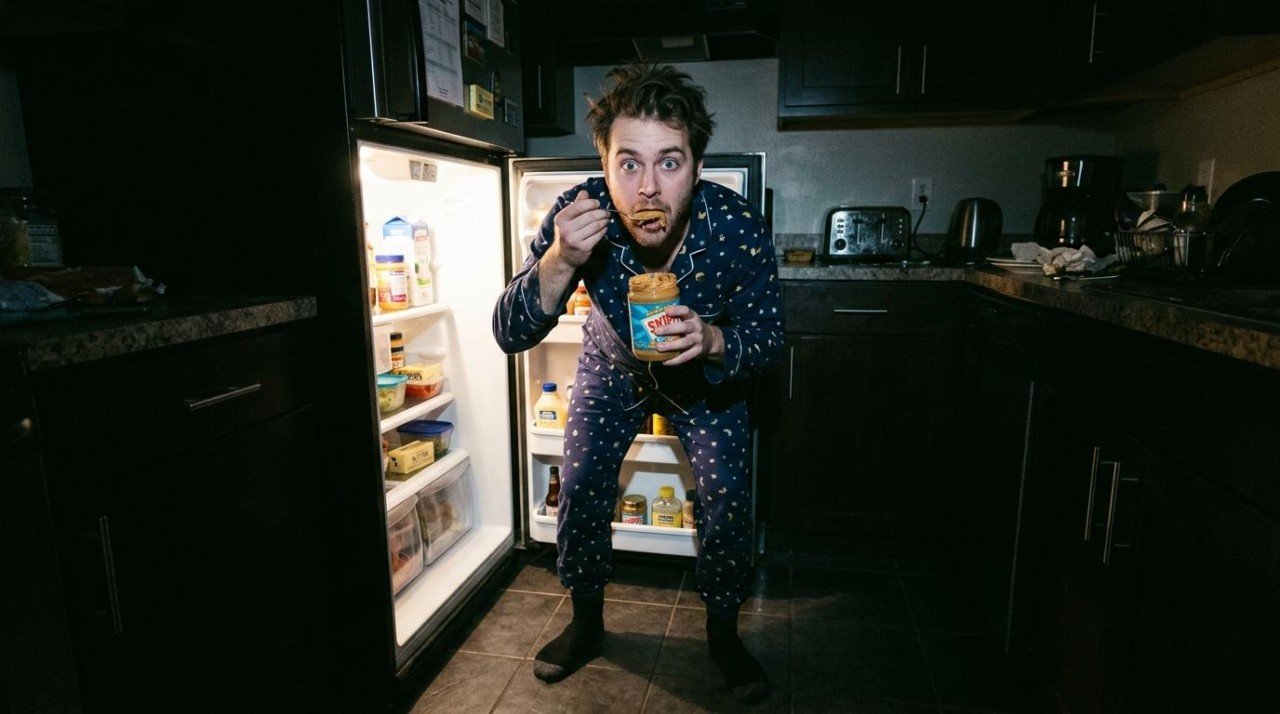
You made it through the day like a champion. A real breakfast, a decent lunch, a sensible dinner. Then somewhere around 9 p.m. — with the dishes done and a show queued up — you find yourself standing at the pantry, working through crackers or cereal or the ice cream you swore you would leave alone. It does not feel like hunger, exactly. It feels like a pull you cannot argue your way out of.
If that sounds familiar, the first thing worth knowing is that you are not weak, and you do not lack discipline. Late-night snacking is one of the most common eating patterns there is, and the people who struggle with it are usually the ones trying hardest to eat well the rest of the time. The reason willpower keeps failing you at night is that willpower was never the right tool. The pull has real drivers — some biological, some behavioral, some about how your whole day was set up — and once you understand them, you can address the causes instead of gritting your teeth against the symptom.
This is not about a crackdown. It is about making the evening easier to navigate so you are not white-knuckling your way to bedtime.
Your body is genuinely hungrier at night — and that is normal
Here is something that reframes the whole conversation: your appetite is supposed to rise in the evening. A tightly controlled study published in Obesity put participants on a schedule that stripped away the usual cues of clocks, meals, and daylight, and found a strong internal circadian rhythm in hunger. Appetite bottomed out in the biological morning, around 8 a.m., and peaked in the biological evening, around 8 p.m. — completely independent of when people had actually eaten.
Even more telling, that evening surge was strongest for exactly the foods you would predict: sweet, salty, and starchy items. Cravings for vegetables and dairy showed no such rhythm. In other words, your body's internal clock specifically ramps up the desire for calorie-dense food as the night approaches, likely an evolutionary leftover from preparing to fast through the night's sleep.
So when you feel a stronger pull toward chips than toward carrots at 9 p.m., that is not a character flaw. It is physiology. Knowing this matters because it takes the shame out of the equation — and shame is what fuels the all-or-nothing spirals that make snacking worse. The goal is not to have zero evening appetite. It is to meet a normal evening appetite with a plan instead of a battle.
The biggest driver is usually what happened earlier in the day
Most late-night snacking is not really a nighttime problem. It is a daytime problem that shows up at night. If you under-eat during the day — skipping breakfast, grabbing a sad desk lunch, running on coffee — you arrive at the evening with a genuine energy deficit stacked on top of that natural circadian hunger peak. The result is a hunger that feels bottomless.
Two nutrients do the heavy lifting for staying full: protein and fiber.
Protein is the most satiating macronutrient, and eating enough of it earlier measurably changes evening behavior. In one study of young women who habitually skipped breakfast, researchers compared a high-protein breakfast (35 grams from eggs and beef) against a normal-protein breakfast (13 grams from cereal) and against skipping entirely. The high-protein breakfast — and only the high-protein breakfast — reduced evening snacking on high-fat foods. Participants who ate it consumed noticeably less fat from evening snacks than the breakfast-skippers or the cereal group. One protein-forward meal in the morning quietly reshaped what happened twelve hours later.
Fiber works through a different but complementary mechanism: it adds bulk, slows how fast your stomach empties, and triggers the gut signals that tell your brain you are full. In a trial where people added a substantial amount of daily fiber, participants reported feeling fuller, snacking less, delaying their next meal, and eating smaller portions afterward. Fiber-rich foods — beans, lentils, whole grains, vegetables, fruit, nuts — keep satiety going long after the meal is over.
The practical takeaway is almost boringly simple: if you want to snack less at night, eat more — and better — during the day. Front-load protein and fiber into meals that actually satisfy you, and the evening loses much of its desperation.
Why strict dieting backfires
It is tempting to respond to a snacking habit by clamping down: cut the carbs, ban the snacks, draw a hard line at 7 p.m. The trouble is that rigid restriction tends to set up the exact rebound it is trying to prevent.
Researchers studying real-world eating found an "ironic effect" of dietary restraint. Among women with high dietary restraint — the ones working hardest to restrict — low daily self-control predicted more overeating and more binge episodes. Women who were not restricting so tightly showed no such spike when their willpower ran low. The very act of forbidding foods makes them more mentally loud, so that the moment your self-control is depleted — which, conveniently, is exactly what happens after a long, stressful day — you eat more, not less.
This is the cruel math of the restrict-and-rebound cycle. You under-eat and white-knuckle all day, your self-regulation is spent by evening, the forbidden food is now irresistible, you overeat, you feel like you failed, and you resolve to restrict even harder tomorrow — which primes the next rebound. The way out is not more restriction. It is enough, satisfying, regular eating that never lets you get that depleted or that deprived in the first place.
Take the Guesswork Out of Eating Well
Eat Well Planner helps you organize your favorite recipes, plan balanced meals, and automatically generate shopping lists — all in one place. Whether you're tracking macros, managing dietary restrictions, or just trying to stop asking "what's for dinner?", we've got you covered.
Our AI-powered tools can adapt any recipe to your dietary needs, help you discover new meals you'll love, and even log your nutrition effortlessly. It's meal planning made simple.
Start Organizing Your Meals — FreePoor sleep quietly turns up the hunger dial
If you are short on sleep — and a late-night snacking habit often eats into sleep, creating a loop — your hunger hormones shift against you. When researchers restrict people's sleep, the satiety hormone leptin drops while the hunger hormone ghrelin rises. In one influential set of findings summarized in a review of the metabolic consequences of sleep loss, sleep restriction significantly increased hunger and overall appetite — and the increase was strongest for carbohydrate-rich foods, tracking with the shifted ghrelin-to-leptin ratio. Strikingly, the drop in leptin was comparable to what you would see after serious calorie restriction, even though the participants were eating normally. Your body reads sleep loss as a kind of famine.
That means an early night is not a consolation prize — it is one of the most effective anti-snacking tools you have. Protecting sleep lowers the biological hunger pressure before it ever reaches the pantry.
Stress, emotion, and the comfort-food loop
Sometimes the pull toward evening snacks is not about physical hunger at all. Chronic stress raises cortisol, and as Harvard Health explains, cortisol increases appetite and, in combination with insulin, appears to steer cravings toward fatty and sugary foods specifically. Once eaten, those foods have a feedback effect that dampens stress responses — so they genuinely do provide a moment of relief. That relief is real, which is precisely why the habit is so sticky. The evening, when the day's demands finally quiet down and everything you have been holding together starts to loosen, is prime time for this.
The answer is not to shame yourself for finding comfort in food. It is to build in other ways to decompress — a walk, a bath, calling a friend, actually resting — so that food is one of several tools rather than the only one. When you have other exits from stress, the snack stops being the automatic release valve.
The habit loop: eating because the couch says so
Much of what feels like nighttime hunger is really a cue. You sit on the couch, turn on a screen, and your brain — having paired that scene with snacking dozens of times — expects food. It is not your stomach talking; it is the environment.
Screens make this worse in two ways. First, they build the association: when eating and watching become cognitively linked, the couch itself becomes a trigger. Second, they blunt your ability to notice you are full. As the Cleveland Clinic notes, distracted eating means you miss the visual and physical cues of fullness — you are not tasting or tracking the food, so you keep going for the length of the episode. You can eat a whole bag of something and barely remember the middle of it.
Two simple structural changes help more than any amount of willpower:
- Break the cue. If you are going to snack, do it at a table, then return to the couch. Unpairing the two activities weakens the automatic association over time.
- Make trigger foods less accessible. This is not about banning anything — it is about friction. If the ice cream requires a trip to the store rather than a trip to the freezer, you get a real pause to check whether you actually want it. Keep the grab-and-graze foods out of arm's reach and the genuinely satisfying options easy to find.
Telling real hunger from habit
Before you eat in the evening, it is worth a five-second check-in: is this physical hunger, or is it habit, boredom, stress, or a screen cue? Real hunger builds gradually and will accept a range of foods — an apple sounds fine. Habit or emotional hunger tends to hit suddenly, fixate on one specific food, and come with a sense of urgency. Neither answer is wrong, but knowing which one you are dealing with changes what will actually satisfy you. If it is stress or boredom, food will not fix the underlying thing, and a walk or a warm drink might.
Plan the snack instead of fighting it
Here is the reframe that ties everything together: if your body is genuinely hungrier at night, a small, satisfying evening snack is not a failure — it is a reasonable thing to plan for. The problem was never that you ate in the evening. The problem is unplanned, distracted grazing on foods that do not satisfy, driven by a day of under-eating and a couch full of cues.
So give the evening a real routine and a real snack. Choose something with protein and fiber — Greek yogurt with berries, an apple with peanut butter, hummus and vegetables, a small bowl of oatmeal, cottage cheese with fruit. Put it in a bowl, sit down, and actually eat it. A planned snack that satisfies you ends the evening. An endless bag in front of the TV never does. When you stop treating the evening as a temptation to survive and start treating it as a part of the day to nourish, the whole white-knuckle dynamic dissolves.
Spot your own patterns first
Everything above is a menu of possible causes — but yours are specific to you. Maybe your lunches are consistently too small. Maybe it is only on high-stress workdays. Maybe it is tightly tied to a particular show, or to nights you slept badly. The fastest way to change the pattern is to see it clearly, and that is where a little tracking helps.
Keeping a simple food diary for a week or two — noting not just what you ate but when, and how you felt — tends to make the drivers obvious. You might discover that the nights you snack least are the ones you ate a real lunch, or that your worst grazing follows your shortest sleep. Patterns you cannot see, you cannot change.
This is where Eat Well Planner can quietly do the heavy lifting. Its food diary lets you log meals and snacks fast — even by voice — and its AI works out the nutrition for you, so you can actually see whether your days are giving you enough protein and fiber to stay full into the evening. And because the biggest lever is eating satisfying meals earlier, the meal planning side helps you build balanced, filling days in advance: set your preferences, let it generate a weekly plan from real recipes, and get an auto-organized shopping list so the satisfying option is the one already in your kitchen. When your days are planned and your fridge is stocked with food that fills you up, the 9 p.m. pantry raid loses most of its power — not because you fought it off, but because you were never that depleted to begin with.
The bottom line
Late-night snacking is not a discipline problem, and treating it like one — with more rules, more restriction, more white-knuckling — reliably makes it worse. The pull is real, and it has real causes: a natural evening rise in appetite, a day of under-eating, too little protein and fiber, restrictive dieting, poor sleep, stress, and habit cues. Address those, and the evening gets dramatically easier.
Eat enough satisfying food during the day. Protect your sleep. Find non-food ways to decompress. Break the couch-and-snack cue. And when a normal evening hunger shows up, meet it with a planned, satisfying snack instead of a fight. That is not giving in. That is working with your body instead of against it.