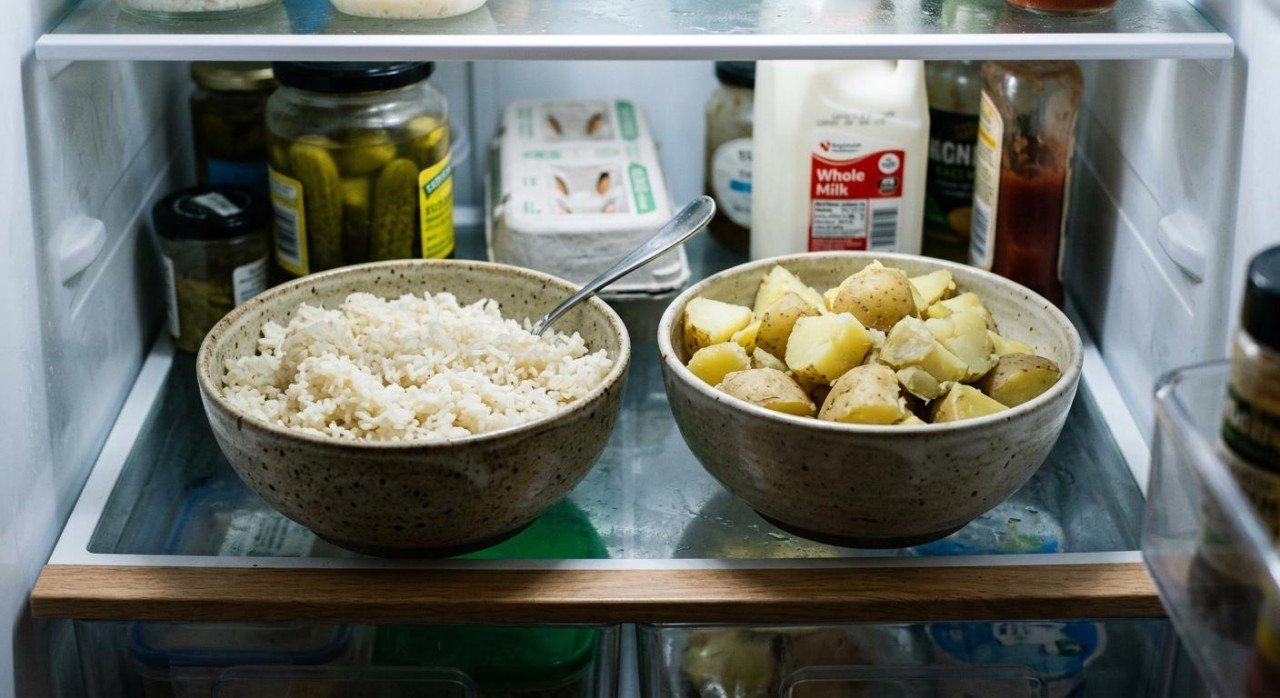
Here is a small kitchen plot twist: the leftover rice sitting in your fridge from last night's dinner may actually be better for you than it was when it came off the stove. Same rice, same grains, but something useful happened while it cooled. The same goes for that bowl of boiled potatoes you forgot about, or the pasta you stashed for tomorrow's lunch.
The reason is a quietly fascinating compound called resistant starch. It is one of the rare nutrition upgrades that costs nothing, requires no special products, and works on foods you already eat. You just have to know the trick — and the trick is mostly about timing and your refrigerator.
What Is Resistant Starch, Exactly?
Most of the starch we eat — in bread, rice, potatoes, pasta — gets broken down quickly in the small intestine into glucose, which spikes blood sugar and gets absorbed for energy. Resistant starch behaves differently. As the name suggests, it resists digestion in the small intestine and passes through largely intact, behaving much more like dietary fiber than like a typical carbohydrate.
As UCLA Health puts it, resistant starch is a carbohydrate that resists digestion and instead "moves on, largely unchanged, to the large intestine." Once it arrives there, it becomes food for your gut bacteria — and that is where the magic happens, which we will get to shortly.
This matters because most of us are running a serious fiber deficit. According to Harvard Health, American adults eat only 10 to 15 grams of total fiber per day, while the recommendations are 25 grams for women and 38 grams for men under 50. Resistant starch is one of the easiest ways to help close that gap without choking down a fiber supplement.
The Four Types of Resistant Starch
Not all resistant starch is the same. Researchers generally sort it into four categories, and it helps to know them because the foods on your plate fall into different buckets:
- RS1 — Starch that is physically locked away inside intact cell walls, so digestive enzymes simply cannot reach it. Think whole or coarsely ground grains, seeds, and legumes.
- RS2 — Raw, tightly packed starch granules that resist enzymes by their natural structure. Green (unripe) bananas, raw potatoes, and high-amylose corn are the classic examples.
- RS3 — Retrograded starch, formed when starchy foods are cooked and then cooled. This is the one hiding in your day-old rice and potatoes, and it is the star of this post.
- RS4 — Chemically modified starches created in food manufacturing. These are the ones you do not make in your own kitchen.
The first three types are all fermented by your gut bacteria, and the 2025 review in Foods notes that these natural sources — "raw potatoes, green bananas, high-amylose corn starch, and raw peas" for RS2, plus cooled starchy foods for RS3 — are where most people can realistically get their resistant starch. The good news is that RS3 is the one you have the most control over.
The Cooling Trick: How Day-Old Rice Becomes a Gut Food
Here is the part that feels almost too easy. When you cook a starchy food, heat and water cause the starch granules to swell and unravel — a process called gelatinization. That is what makes cooked rice soft and a baked potato fluffy. But as the food cools, those loosened starch molecules begin to re-bond into new, tightly ordered structures. This is called retrogradation, and the resulting starch is much harder for your digestive enzymes to break apart.
In other words, cooling literally transforms ordinary digestible starch into resistant starch. And the effect is measurable. In a 2015 study in the Asia Pacific Journal of Clinical Nutrition, researchers measured the resistant starch in white rice prepared three ways:
- Freshly cooked rice: 0.64 grams of resistant starch per 100 grams
- Cooked, then cooled 10 hours at room temperature: 1.30 grams per 100 grams
- Cooked, then chilled 24 hours in the fridge and reheated: 1.65 grams per 100 grams
That is more than double the resistant starch simply from chilling the rice — and notice that the highest figure belongs to the rice that was reheated. This is the question everyone asks: does warming it back up undo the benefit? In this study, it did not. The chilled-and-reheated rice held onto the most resistant starch of all, and it also produced a significantly lower blood sugar response than the fresh rice (a glycemic response of 125 versus 152). Gentle reheating does not reverse retrogradation.
Colder and longer is generally better, up to a point. UCLA Health notes that "for the first four days after cooking, each chill day increases the percentage of resistant starch." So an overnight stay in the fridge is good; a couple of days is even better. Cook your rice, potatoes, or pasta, let them cool, and refrigerate — then eat them cold in a salad or grain bowl, or reheat them for dinner. Either way, you keep most of the benefit.
Why Your Gut Loves It: The Butyrate Connection
So what actually happens when resistant starch reaches your large intestine intact? It becomes a feast for your gut microbiome. Your bacteria ferment it and, in the process, produce short-chain fatty acids (SCFAs) — primarily acetate, propionate, and butyrate.
Butyrate is the one to know. The 2025 Foods review describes butyrate as "the most abundant SCFA produced during the digestion of RS," and it plays an outsized role in gut health. Butyrate is the preferred fuel source for the cells lining your colon, helping them stay healthy and function properly. The review notes that butyrate "promotes the proliferation of normal colonic cells while inhibiting the proliferation of cancer cells," and that SCFAs more broadly help maintain the colon's protective lining and even help lower blood cholesterol and triglyceride levels.
In plain terms: feeding your gut bacteria resistant starch helps them produce a compound that nourishes your gut barrier, calms inflammation, and keeps the whole system running smoothly. This is the same reason fiber-rich diets are so consistently linked to better digestive health — resistant starch is essentially a particularly tasty, particularly fermentable form of fiber.
Steadier Blood Sugar and a Fuller Stomach
The gut benefits would be enough on their own, but resistant starch also helps with two things almost everyone cares about: blood sugar and appetite.
Because resistant starch is not broken down into glucose in the small intestine, swapping some regular starch for it blunts the post-meal blood sugar spike — exactly what happened with the cooled rice above. Zoom out to the bigger picture and the pattern holds. A 2020 systematic review and meta-analysis in the British Journal of Nutrition, pooling 19 randomized controlled trials with 503 participants, found that resistant starch significantly lowered fasting blood glucose and improved insulin resistance (measured by HOMA-IR). The effects were strongest when people consumed more than about 28 grams a day or stuck with it for longer than eight weeks.
The insulin benefit may depend on where you are starting from. In a 2016 randomized controlled trial published in Nutrition & Metabolism, women with existing insulin resistance saw their insulin sensitivity improve by roughly 16% after taking 30 grams of high-amylose maize resistant starch daily — while women who were already insulin-sensitive saw no change. Resistant starch seems to help most the people who need the help.
Then there is satiety. In a 2018 study in Nutrients, overweight and obese men who ate 48 grams of resistant starch split across breakfast and lunch went on to eat significantly less at a later test meal — about 4,551 kilojoules versus 5,197 in the placebo condition. (That dose was a supplemental amount used to test the mechanism, not a daily target — and notably, the effect did not carry across the full 24 hours.) Still, it points to a real phenomenon: those gut-produced short-chain fatty acids appear to send fullness signals that can take the edge off your appetite.
The Best Food Sources of Resistant Starch
You do not need a powder or a pill. Here are the everyday foods that deliver resistant starch, drawing on the sources above:
- Cooked-and-cooled potatoes — Potato salad made the day before is a genuinely smart move. Boil, chill overnight, and eat cold or gently reheated.
- Cooked-and-cooled rice — Think rice salads, sushi, or leftover rice reheated for stir-fries (just reheat thoroughly for food safety).
- Cooked-and-cooled pasta — Cold pasta salad is a resistant-starch win, and chilled-then-reheated pasta keeps much of the benefit.
- Beans, lentils, and other legumes — Naturally high in resistant starch (RS1) and a fiber powerhouse in their own right.
- Green (slightly underripe) bananas and plantains — A top RS2 source. The greener the banana, the more resistant starch; as it ripens and sweetens, that starch turns to sugar.
- Oats — Especially when eaten less processed; overnight oats let some retrogradation happen too.
- Whole grains and seeds — Intact, minimally processed grains keep more of their starch locked away.
You will notice a theme: the biggest, easiest wins come from cooking starchy staples ahead of time and letting them cool. Which brings us to the one real catch.
The One Catch: It Takes a Little Planning
Resistant starch from retrogradation requires you to cook before you are hungry. You cannot decide at 6 p.m. that you want cooled, day-old rice for dinner — the benefit comes from food that has already had its time in the fridge. That means thinking a day or two ahead, batch-cooking your grains and potatoes, and building meals around the cook-once-eat-later rhythm.
For a lot of people, that planning step is exactly where good intentions fall apart. This is where having your meals mapped out in advance turns a nice idea into an actual habit. Eat Well Planner is a free app built for this kind of cook-ahead cooking: it generates weekly meal plans from your saved recipes, so you can deliberately schedule a batch of rice, potatoes, or beans early in the week and plan the meals that use the cooled leftovers later. Its auto-generated shopping lists mean you actually buy what you need to cook ahead, and you can import recipes from any website, Instagram reel, or YouTube video — so when you find a great rice-salad or grain-bowl recipe, it goes straight into your collection. The nutrition tracking even lets you keep an eye on your overall fiber intake as you build the habit.
Take the Guesswork Out of Eating Well
Eat Well Planner helps you organize your favorite recipes, plan balanced meals, and automatically generate shopping lists — all in one place. Whether you're tracking macros, managing dietary restrictions, or just trying to stop asking "what's for dinner?", we've got you covered.
Our AI-powered tools can adapt any recipe to your dietary needs, help you discover new meals you'll love, and even log your nutrition effortlessly. It's meal planning made simple.
Start Organizing Your Meals — FreeThe point is not to overhaul your diet. It is to make the path of least resistance the one that quietly builds resistant starch into your week — a pot of rice cooked Sunday, a tray of potatoes chilled overnight, a batch of lentils ready to go.
How to Add It Without the Bloat
One honest caveat: because resistant starch is fermented by your gut bacteria, adding a lot of it too quickly can cause gas and bloating while your microbiome adjusts. As UCLA Health advises, "if foods high in resistant starch are new to your diet, add them gradually in order to avoid gas and bloating."
A sensible approach:
- Start small. Begin with one cooled-starch meal a day — say, swapping fresh rice for chilled rice at lunch — rather than overhauling every meal at once.
- Ramp up over a couple of weeks. Give your gut bacteria time to adapt. The discomfort some people feel early on typically settles as your microbiome adjusts.
- Drink water and keep moving. Standard advice for any increase in fiber, and it helps here too.
- Vary your sources. Different resistant starches feed different microbes, so rotating between cooled potatoes, beans, green bananas, and oats supports a more diverse, resilient gut.
If you have a condition like IBS and are sensitive to fermentable carbohydrates, introduce resistant starch especially slowly and pay attention to your own tolerance.
The Bottom Line
Resistant starch is about as close as nutrition gets to a free lunch — or, more accurately, a free leftover lunch. By cooking your rice, potatoes, and pasta ahead of time and letting them cool, you convert ordinary starch into a gut-feeding, blood-sugar-steadying, fiber-like nutrient, with no new ingredients and no extra cost. Reheat it gently and you keep most of the benefit. Add it to your week gradually and your gut bacteria will thank you with a steady supply of butyrate.
The science is genuinely encouraging, but the real barrier is just remembering to cook before you are hungry. Plan a few cook-ahead meals into your week, let your fridge do the quiet chemistry, and you will be eating better without really trying.
Try organizing your cook-ahead meals with Eat Well Planner and make resistant starch a built-in part of your weekly routine.