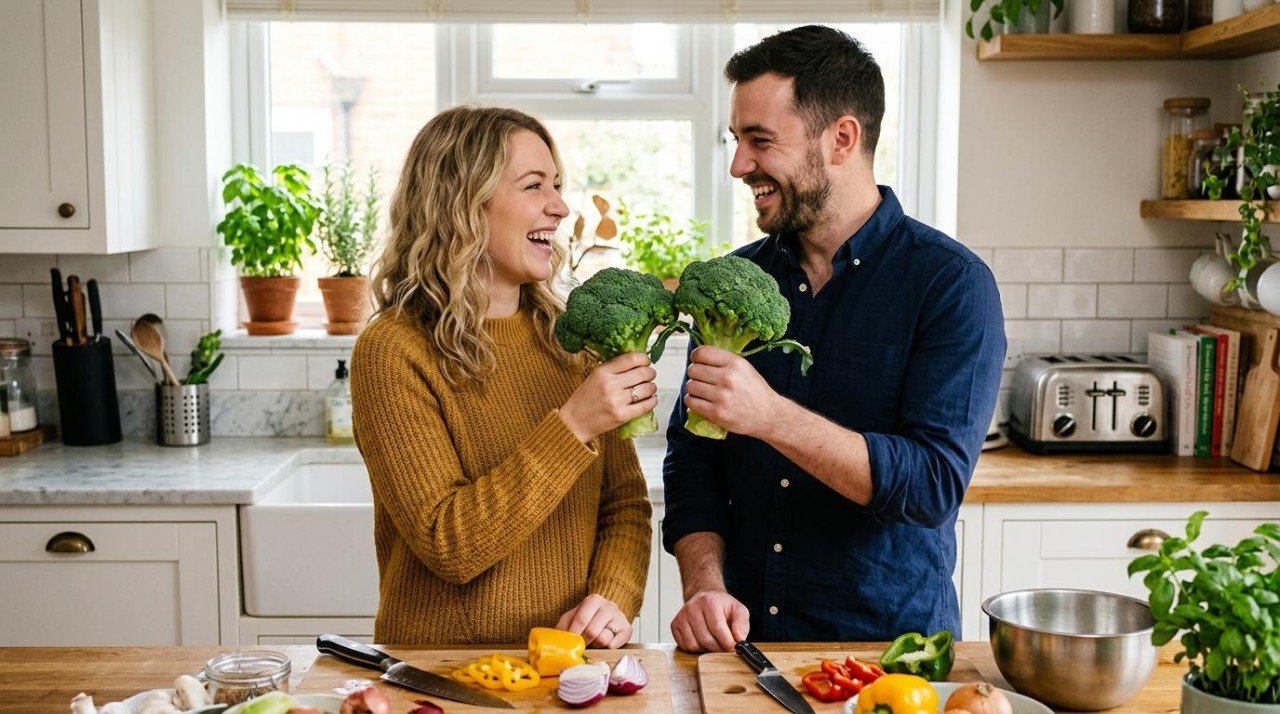
When couples start trying for a baby, the nutrition advice tends to land almost entirely on one person. She takes the prenatal vitamin, she reads the food-safety lists, she rethinks her morning coffee. Meanwhile, her partner keeps eating exactly as before. That split made a certain intuitive sense a generation ago, but the science no longer supports it. Fertility is a two-person project, and what both partners eat in the months before conception can genuinely tilt the odds.
Before we go further, one honest caveat that should frame everything below: food is a supporting player, not a magic switch. Diet can nudge the biology in a helpful direction, but it does not override age, genetics, or an underlying medical condition, and it is never a substitute for seeing a doctor. Roughly 10% to 15% of couples experience infertility, according to the American Society for Reproductive Medicine, and for many of them the answer lies in medicine, not menus. What eating well can do is stack a few more cards in your favor while you work with your care team. With that said, here is what the evidence actually points to.
Sperm Health Is Half the Equation
It is worth stating plainly, because the culture still forgets it: male factors are involved in about half of all infertility cases. The same ASRM overview notes that roughly one in five cases traces to a male factor alone, and another 30% or so involve both partners. A man's contribution to conception is not just "showing up" — sperm carry half the genetic blueprint, and sperm quality is measurably shaped by lifestyle.
There is also a bigger backdrop worth knowing. A widely cited 2017 meta-analysis in Human Reproduction Update pooled data from men across North America, Europe, and Australia and found that sperm concentration fell by about 52% between 1973 and 2011, with no sign of leveling off. Researchers are still debating the causes, and diet is only one thread in that story. But it reframes the stakes: sperm quality is not fixed, it responds to how we live, and that means it is partly within a couple's control. The encouraging flip side is that sperm are constantly being made — a full production cycle takes roughly three months — so dietary changes have a real window to matter before conception.
The Eating Pattern That Keeps Showing Up
If you strip away the supplement hype and look at what the strongest research rewards, one pattern appears again and again: a Mediterranean-style way of eating. Not a branded diet, just a shape — lots of vegetables and fruit, whole grains, beans and lentils, nuts and seeds, olive oil, fish and seafood, with red and processed meat pushed to the edges of the plate.
The most striking evidence on the female side comes from the Nurses' Health Study, where researchers tracked 17,544 women over eight years as they tried to conceive. Women whose diets most closely matched a "fertility" pattern had a 66% lower risk of ovulatory-disorder infertility than those whose diets matched it least (relative risk 0.34). The pattern that did it will sound familiar: more unsaturated fat and less trans fat, more protein from plants than from animals, more slow-digesting whole-grain carbohydrates, plus iron from plant foods and a daily multivitamin. When the researchers layered in a healthy weight and regular activity, they estimated the majority of ovulatory infertility might be preventable — a remarkable statement, even allowing for the usual caveats of observational research.
For men, the signal is arguably even cleaner. A 2024 systematic review of the Mediterranean diet and semen quality found that 60% of the studies it examined showed a positive relationship between closer adherence and better semen parameters. And a 2023 meta-analysis in Nutrition Reviews found that higher Mediterranean-diet adherence was associated with more than double the odds of a healthy sperm concentration and count, with odds ratios around 2.9 and 2.5 respectively. The authors were careful to note that the evidence for pregnancy and live-birth outcomes was still inconsistent — an important honesty check — but the sperm-quality findings were consistent enough to take seriously.
The practical upshot is refreshingly simple: the same plate helps both partners. You do not need two separate fertility diets under one roof. You need a week of meals built around vegetables, whole grains, legumes, seafood, and good fats — which happens to be genuinely pleasant food to eat.
Of course, "eat this way for months" is easy to say and hard to sustain when you are also working, commuting, and staring into the fridge at 6 p.m. This is exactly the kind of goal that lives or dies on planning. Eat Well Planner is built for it: you can save Mediterranean-style recipes from anywhere, let the app assemble them into a balanced week, and get an automatic shopping list so the fresh, fertility-friendly ingredients are actually in the house when it is time to cook. When the healthy option is already planned and bought, it stops competing with takeout every single night.
Take the Guesswork Out of Eating Well
Eat Well Planner helps you organize your favorite recipes, plan balanced meals, and automatically generate shopping lists — all in one place. Whether you're tracking macros, managing dietary restrictions, or just trying to stop asking "what's for dinner?", we've got you covered.
Our AI-powered tools can adapt any recipe to your dietary needs, help you discover new meals you'll love, and even log your nutrition effortlessly. It's meal planning made simple.
Start Organizing Your Meals — FreeThe Nutrients Worth Knowing By Name
A good overall pattern does most of the work, but a handful of specific nutrients earn their own mention because the evidence — or the stakes — is strong enough.
Folate and folic acid
This is the one non-negotiable. The CDC recommends that anyone who could become pregnant get 400 micrograms of folic acid daily, starting before conception, because the neural tube forms in the first few weeks — often before a person even knows they are pregnant. Adequate folic acid prevents a large share of serious neural-tube birth defects like spina bifida. Get it from a supplement or a prenatal, and back it up with folate-rich foods: dark leafy greens, beans and lentils, and fortified or enriched grains. This is the clearest, most established diet-and-conception link there is.
Omega-3 fats and seafood
Omega-3 fatty acids (the kind concentrated in fish) matter for both partners — they are structural components of the sperm cell membrane and support egg and early-pregnancy health. In one double-blind, placebo-controlled trial, 238 men with poor semen quality took about 1.84 grams of EPA and DHA daily for 32 weeks; the omega-3 group saw total sperm count rise from roughly 39 to 62 million and concentration nearly double, while the placebo group did not budge. That was a study in men who already had low counts, so it is not a promise for everyone — but it fits the broader pattern that these fats help.
The easiest food source is fish, and here the guidance dovetails neatly with pregnancy safety. The FDA and EPA advise that people who are or might become pregnant eat 8 to 12 ounces per week — two to three servings — of lower-mercury seafood. Their "Best Choices" list includes salmon, sardines, anchovies, Atlantic mackerel, shrimp, and trout. We will get to the fish to skip in a moment.
Antioxidants: zinc, selenium, vitamins C and E
Sperm are unusually vulnerable to oxidative stress — think of it as cellular rust — and the body's defense system runs partly on antioxidant nutrients. Zinc and selenium in particular are repeatedly linked to healthier sperm, along with vitamins C and E. You can get them from real food without much effort: oysters and shellfish, pumpkin and sunflower seeds, and beef for zinc; Brazil nuts (just one or two a day), seafood, and eggs for selenium; citrus, peppers, and berries for vitamin C; nuts, seeds, and olive oil for vitamin E.
A word of caution on pills, though. The largest review of the question — a 2022 Cochrane analysis of 90 trials in more than 10,000 subfertile men — found that antioxidant supplements might improve live-birth and pregnancy rates, but that the evidence became inconclusive once the poorly designed studies were set aside. In other words, loading up on high-dose antioxidant capsules is not a proven fix. Getting these nutrients from a varied, colorful diet is the safer bet, and it comes with everything else whole foods carry.
Iron, vitamin D, and choline
Three more round out the list. Iron from plant sources and supplements was one of the components of that fertility-diet pattern tied to lower ovulatory infertility — think beans, lentils, tofu, and leafy greens, ideally paired with a vitamin-C food to boost absorption. Vitamin D receptors show up throughout the reproductive system, and low levels are associated with poorer fertility outcomes; the supplementation trials are genuinely mixed, so the sensible move is to make sure you are not deficient rather than to megadose. And choline is the quiet one worth flagging: the recommended intake in pregnancy is 450 milligrams a day, it supports fetal brain development, and an estimated 90% to 95% of pregnant women fall short. Egg yolks are the standout source at about 147 milligrams each, with beef, soybeans, and chicken close behind. If eggs are already part of your breakfast, you are ahead of the game.
What to Ease Off
Adding good food matters more than eliminating "bad" food, and no single meal is going to make or break anything. But a few things are worth moderating in the trying-to-conceive window.
- Alcohol. A meta-analysis of fertility-treatment outcomes found that once weekly intake passed about 84 grams — roughly seven standard drinks — a woman's chance of pregnancy dropped by about 7%, and a man's partner's chance of a live birth dropped by about 9%, according to the pooled analysis. Both partners are implicated, and cutting back is one of the more actionable levers.
- Caffeine — but don't panic. The same analysis found no clear link between women's caffeine intake and fertility-treatment success. A moderate coffee habit appears fine; there is no need to white-knuckle it, though most clinicians suggest keeping it modest.
- Ultra-processed food and trans fats. Diets high in trans fats, refined carbohydrates, and added sugar are consistently tied to poorer fertility markers, including worse semen quality. Trans fats are largely out of the US food supply now, but the broader pattern of highly processed, sugary eating is the real thing to displace — which happens naturally when fresh, whole-food meals fill the week.
- High-mercury fish. Seafood is a fertility ally, but a short list of large predator fish concentrate mercury. The FDA and EPA say to avoid shark, swordfish, king mackerel, marlin, orange roughy, bigeye tuna, and Gulf tilefish. Note this is a small "avoid" list, not a reason to skip fish — the goal is to swap toward the lower-mercury choices, not away from seafood altogether.
One nuance on produce and pesticides
Here is a finding that is easy to misread, so read it carefully. In Harvard's EARTH study of 325 women undergoing fertility treatment, those eating the most produce high in pesticide residue had an 18% lower chance of clinical pregnancy and a 26% lower chance of live birth than those eating the least. Crucially, total fruit and vegetable intake itself was not harmful — and swapping just one daily serving of high-residue produce for a low-residue one was linked to markedly higher odds of pregnancy. The lesson is emphatically not "eat fewer vegetables." It is: keep eating plenty of produce, and where it is easy, lean toward lower-residue options, wash well, or choose organic for the items that tend to carry the most residue. Fruits and vegetables remain the backbone of every fertility-friendly diet.
Keeping Expectations Honest
It would be lovely to end with a guarantee, but that is not what the evidence offers. The strongest studies here are observational, meaning they show associations rather than proof of cause, and the effects of diet are real but modest next to factors like age and underlying reproductive health. Many couples do everything "right" and still need medical help — and that is not a failure of willpower or grocery shopping. If you have been trying for a year (or six months if the female partner is over 35), that is the signal to see a specialist, regardless of how well you have been eating.
What diet can honestly promise is this: it is one of the few fertility factors fully within your hands, it costs nothing beyond a bit of planning, and every benefit it offers spills over into the rest of your health — and, if conception happens, into a stronger start for the pregnancy. There is no downside to two partners eating more vegetables, fish, whole grains, and good fats together for a few months. That is about as clear a win as nutrition ever gives us.
Making It Actually Happen, Together
The gap between knowing this and living it is entirely logistical. You are asking two people to eat a specific way, consistently, for months, in the middle of busy lives. That is a planning problem more than a knowledge problem — which is where a tool earns its keep. In Eat Well Planner, each partner can set up their own profile with the nutrients they most want to hit — folate and iron on one, zinc and omega-3s on the other, for instance — and the app builds fertility-supportive meals into a shared weekly plan drawn from recipes you actually like. The auto-generated shopping list means the salmon, lentils, leafy greens, eggs, and Brazil nuts are in the cart before decision fatigue sets in, and nutrition tracking lets you see whether the week is genuinely landing where you want it. When eating well becomes the default rather than a daily negotiation, it is far easier to keep it up long enough to matter.
Ready to build a few weeks of meals that support both of you? Start planning with Eat Well Planner — it is free, and it turns "we should really eat better" into a plan you can actually follow.