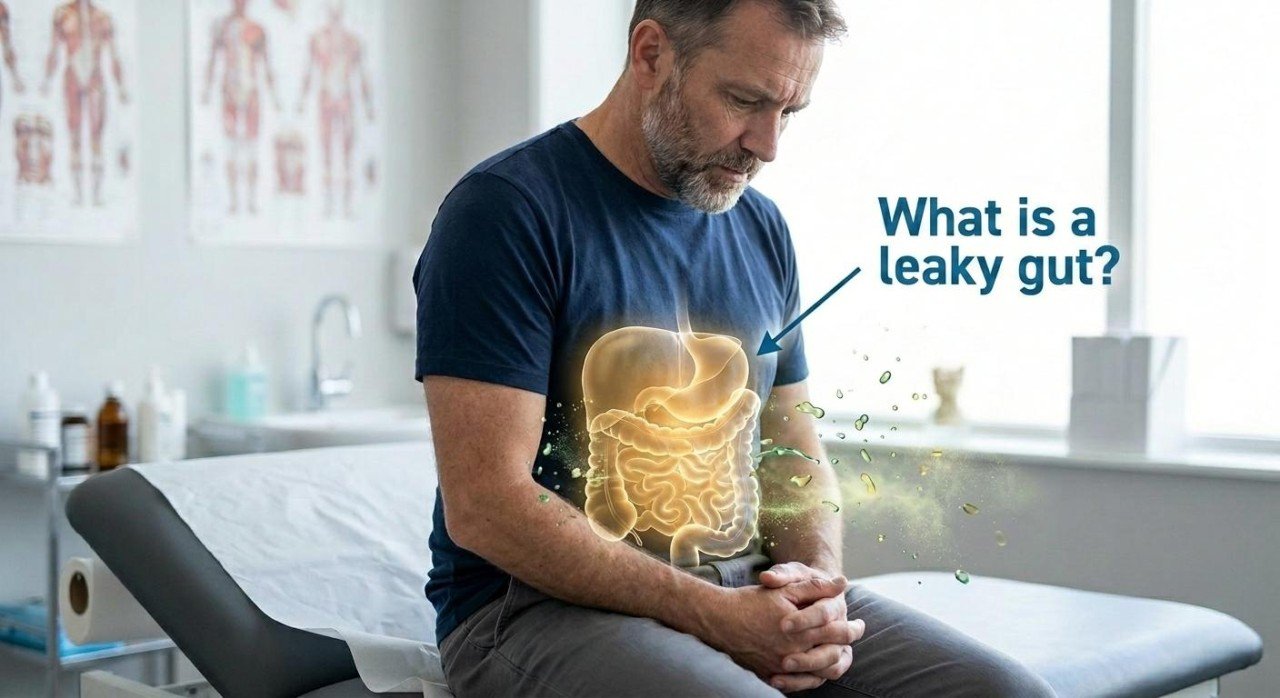
Spend ten minutes on health social media and you will meet "leaky gut." It gets blamed for almost everything — bloating, brain fog, fatigue, joint pain, acne, anxiety, autoimmune disease, stubborn weight. And conveniently, there is always something to sell you: a $90 gut-repair powder, a cleanse protocol, a stool test, a supplement stack to "seal and heal" the intestinal lining.
Here is the frustrating truth: underneath the marketing, there is a real and fascinating piece of biology. Your gut barrier is real, it can become more permeable, and that matters for health. But the polished "leaky gut syndrome" sold online has run far ahead of what the science actually supports. This post separates the two — what is genuinely established, what is still an open question, and what realistically supports your gut barrier without emptying your wallet.
What "Leaky Gut" Actually Means
Your intestinal lining is enormous. According to Harvard Health, it covers more than 4,000 square feet of surface area — and it has a near-impossible job. It has to be open enough to absorb water and nutrients from your food, while staying tight enough to keep bacteria, toxins, and partially digested particles out of your bloodstream. That selective barrier is mostly a single layer of cells, stitched together by structures called tight junctions that act like adjustable gates between the cells.
"Increased intestinal permeability" — the technical term for leaky gut — simply means those gates are opening more than they should, letting things slip through that normally would not. Crucially, this is a spectrum, not an on/off switch. As Harvard puts it, we all have some degree of leaky gut, because the barrier was never meant to be perfectly sealed.
Much of the excitement traces back to a protein called zonulin, discovered in 2000 by Dr. Alessio Fasano and his team. Zonulin is one of the few known molecules that can reversibly loosen those tight junctions. In research from Massachusetts General Hospital, Fasano's group engineered mice to produce excess zonulin; those mice developed more severe colitis and higher mortality, providing a mechanistic link between a leakier barrier and inflammatory disease. It is genuinely interesting science. It is also where the careful story and the marketing story begin to part ways.
The Phenomenon Is Real. The "Syndrome" Is Not.
This is the single most important distinction, and it is one that mainstream medicine is unusually clear about. The Cleveland Clinic states it plainly: intestinal permeability is real, but "leaky gut syndrome" is not a recognized medical diagnosis. In their words, "We know that the condition of having intestinal permeability or a 'leaky gut' is real, but we don't know that it's a disease in itself, or that it causes other diseases."
That gap is where the hype lives. Marketers take a real biological mechanism, package it as a standalone diagnosis with a tidy list of symptoms, and then sell the cure. But no doctor can currently test you, hand you a "leaky gut syndrome" diagnosis, and treat that as the root of your fatigue or your autoimmune condition — because the science does not support that chain of reasoning yet.
What It's Genuinely Linked To
None of this means permeability is irrelevant. It is firmly established in several conditions. Harvard Health notes that increased intestinal permeability plays a role in celiac disease, Crohn's disease, and irritable bowel syndrome. The Cleveland Clinic adds inflammatory bowel disease, plus situations like HIV/AIDS and the gut damage that follows chemotherapy or radiation. These links are not in dispute.
The unsettled part is the direction of the arrow. Does a leaky barrier cause these diseases, or do these diseases cause the barrier to leak? Here the experts lean one way. The Cleveland Clinic is direct: in these conditions, "scientists generally consider it to be a symptom, not a cause." Chronic inflammation erodes the barrier — so the leakiness is often a consequence of the disease, not its origin. Even when permeability shows up early, before a diagnosis, researchers have concluded it "wasn't enough to cause the disease by itself," but was more likely an early sign of trouble already underway.
And for the long list of conditions the internet pins on leaky gut — chronic fatigue, fibromyalgia, arthritis, allergies, asthma, acne, obesity, mental illness — Harvard's assessment is sober: some studies show associations, but "we do not yet have clinical studies in humans showing such a cause and effect." Association is not causation, and a marketing claim is not a clinical trial.
A Cautionary Tale From the Drug World
If sealing the gut barrier were a straightforward fix, you would expect it to work as a treatment. The reality is humbling. A drug called larazotide acetate — a zonulin inhibitor designed to tighten those very tight junctions — was the furthest-along candidate of its kind, reaching a Phase 3 trial for celiac disease. In June 2022, according to the Celiac Disease Foundation, the manufacturer discontinued that trial after an interim analysis concluded it would take a prohibitively large number of additional patients to show a meaningful benefit. The barrier biology is real, but turning "fix the leak" into a reliable therapy has proven far harder than the supplement aisle implies.
How to Be a Skeptical Gut-Health Consumer
Once you understand that "leaky gut syndrome" is a marketing construct layered on top of real biology, the sales pitches become easier to see through. A few things worth knowing:
- "Leaky gut tests" are not diagnostic. Even Harvard points out that it is genuinely difficult to measure the strength of a person's gut barrier, so you cannot reliably know when leaky gut is present or what it means for the rest of your body. Direct-to-consumer zonulin or stool "permeability" tests are not validated tools for diagnosing a syndrome that medicine does not formally recognize.
- No supplement is proven to "seal" your gut. Plenty of products — glutamine, collagen, bone broth powders, assorted botanicals — are marketed for exactly this. Some have early or mechanistic research behind them, but none has the kind of robust human evidence that would justify the confident claims on the label.
- Be wary of any product that promises to fix a long list of unrelated symptoms. A single powder that claims to resolve bloating, fatigue, brain fog, joint pain, and mood is making a marketing claim, not a medical one.
- The best-supported interventions are not for sale in a bottle. They are food and lifestyle — which, unlike supplements, also happen to be free or close to it.
That last point is the genuinely good news, so let us spend the rest of this post there.
What Actually Supports Your Gut Barrier
Set a realistic expectation first. A 2024 systematic review asked whether diet can meaningfully change intestinal barrier permeability in healthy people and found no strong evidence that it dramatically does, mainly because the studies are small, short, and use inconsistent methods. In other words: if your gut is already healthy, you should not expect to feel a barrier "tightening." The realistic goal is not to chase a dramatic fix — it is to give your gut the conditions it needs and avoid the things that demonstrably degrade it. And on that front, the evidence is much more encouraging.
Feed Your Microbes a Diverse Range of Fiber
This is the cornerstone, and the mechanism is well understood. When gut bacteria ferment dietary fiber, they produce short-chain fatty acids — especially butyrate. As a review on fiber, fats, and the intestinal barrier explains, butyrate is the preferred energy source for the cells lining your colon, helps maintain the integrity of those cells, and supports the protective mucus layer that keeps bacteria at arm's length from the gut wall. Your gut bacteria carry over 260 enzymes for breaking down these carbohydrates; your own body has just 17. You are quite literally outsourcing barrier maintenance to your microbes — and fiber is their payment.
The key word is diversity. Different fibers feed different bacteria, so variety matters more than any single "superfood." Think beans and lentils, oats and barley, berries, leafy greens, nuts and seeds, and a broad rotation of vegetables rather than the same two every day.
Eat the Colorful Plants — Polyphenols Help
Polyphenols are the natural compounds that give berries, dark chocolate, green tea, olives, and richly colored produce their pigments — and they appear to support the barrier too. The best human evidence comes from the MaPLE randomized controlled trial, which put older adults who already had increased intestinal permeability on a polyphenol-rich diet (berries, blood orange, pomegranate, green tea, apples, dark chocolate). Roughly doubling polyphenol intake reduced serum zonulin — an indicator of a leakier barrier — particularly in those who started with the highest levels, and also lowered calprotectin, a marker of intestinal and systemic inflammation. Notably, this came from foods, not pills.
Cut Back on Ultra-Processed Food and Emulsifiers
If fiber and polyphenols are the build-up, ultra-processed food is the wear-and-tear. A 2025 review describes how common emulsifiers — additives like carboxymethylcellulose and polysorbate 80 that keep processed foods smooth and shelf-stable — can thin the protective mucus layer, reduce beneficial bacteria such as Faecalibacterium prausnitzii and Akkermansia muciniphila, and increase permeability.
The picture is nuanced rather than alarmist, which is worth being honest about. In a 2024 randomized controlled feeding study in 22 healthy adults, a high-emulsifier diet did not worsen barrier function under normal, calm conditions — it actually looked slightly better. But when researchers added acute stress, the high-emulsifier diet caused intestinal permeability to jump 89%, while the low-emulsifier diet was protective. The practical takeaway is reasonable and undramatic: a diet built mostly on whole foods, with ultra-processed products as the exception rather than the staple, gives your barrier the friendliest conditions — especially during the stressful stretches of life when it may matter most.
Take the Guesswork Out of Eating Well
Eat Well Planner helps you organize your favorite recipes, plan balanced meals, and automatically generate shopping lists — all in one place. Whether you're tracking macros, managing dietary restrictions, or just trying to stop asking "what's for dinner?", we've got you covered.
Our AI-powered tools can adapt any recipe to your dietary needs, help you discover new meals you'll love, and even log your nutrition effortlessly. It's meal planning made simple.
Start Organizing Your Meals — FreeDon't Forget Sleep and Stress
The emulsifier study points to something the supplement industry conveniently ignores: your gut barrier responds to how you live, not just what you swallow. Acute stress measurably increased permeability in that trial. Chronic stress and poor sleep are repeatedly tied to gut dysfunction, and they are exactly the variables no powder can fix. Protecting your sleep and finding workable ways to manage stress are unglamorous, free, and almost certainly more impactful than anything marketed as a "gut repair" protocol.
Making Gut-Friendly Eating the Default
Notice what every evidence-based recommendation has in common: eat a wide variety of plants and fiber, get plenty of polyphenol-rich color on your plate, and lean on whole foods instead of ultra-processed ones. That is not an exotic protocol. It is just... good, varied, real-food eating. The hard part was never knowing what to do — it is doing it consistently when you are busy, tired, and staring into the fridge at 6 p.m. with no plan.
That gap between knowing and doing is exactly where Eat Well Planner is designed to help. Instead of buying your way to gut health, you can build it into your normal week:
- Plan for fiber diversity on purpose. Use AI-assisted meal planning to build a week that rotates through beans, whole grains, berries, leafy greens, nuts, and a wide range of vegetables — so "eat many different plants" becomes an automatic plan rather than a daily decision.
- Make whole foods the path of least resistance. When your meals are planned and the ingredients are already on an auto-generated shopping list, you are far less likely to default to the ultra-processed, emulsifier-heavy convenience foods you reach for when there is no plan.
- Capture and adapt real recipes. Import recipes from any website, Instagram, or YouTube, and use AI recipe chat to nudge them in a gut-friendlier direction — more vegetables, an extra source of fiber, a swap for a heavily processed ingredient.
- See your fiber and variety, not just calories. Nutrition tracking and the food diary let you check whether you are actually getting the diverse, plant-forward intake your microbes need — turning a vague intention into something you can see.
It is the same philosophy the science keeps pointing back to: support your gut with everyday food and habits, and let the consistency — not a supplement — do the work.
The Bottom Line
"Leaky gut" is a real piece of biology wrapped in a lot of marketing. Increased intestinal permeability genuinely exists and is established in conditions like celiac disease, Crohn's, and IBD — but the best evidence suggests it is usually a symptom of those conditions rather than their root cause, and "leaky gut syndrome" as a standalone, testable, sellable diagnosis is not recognized by mainstream medicine. The expensive tests, cleanses, and "seal and heal" supplements are running well ahead of the science.
What is not overhyped is the boring, durable advice: eat a diverse range of fiber, fill your plate with colorful polyphenol-rich plants, keep ultra-processed foods to the edges of your diet, sleep well, and manage stress. None of it is patentable, none of it is for sale in a bottle, and all of it is genuinely good for you — gut barrier included.
If you want to make that kind of eating the easy default instead of a daily struggle, try planning your meals with Eat Well Planner — and let a week of varied, real food do more for your gut than any cleanse ever could.