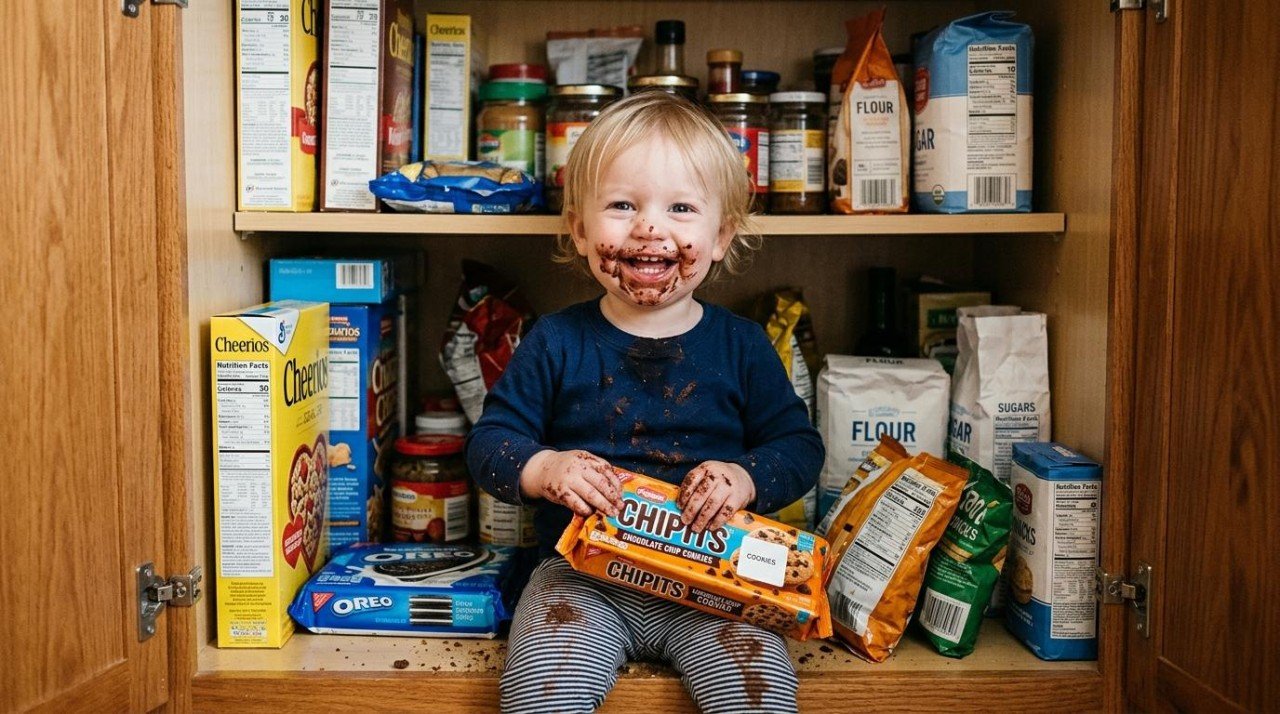
Few topics turn calm, reasonable parents into anxious rule-enforcers quite like sugar. One week you are hiding the Halloween candy on top of the refrigerator and rationing it out like wartime supplies. The next, you are so worn down by the negotiating that you wave a juice box and a granola bar through without a second thought. Somewhere in the back of your mind, a quiet voice wonders whether you are doing any of this right.
Here is the reassuring part: the two loudest approaches — total ban and total free-for-all — are both the wrong answer, and the research is surprisingly clear about why. There is a calm middle ground, it is backed by decades of feeding studies, and it asks less of you than either extreme. Let us walk through what the guidance actually says, where kids' sugar really comes from, and how to handle sweets in a way that does not turn every dessert into a battle.
What the Actual Guidance Says
Start with the numbers, because they anchor everything else. In its scientific statement on added sugars and children, the American Heart Association recommends that kids ages 2 to 18 get less than 6 teaspoons (25 grams) of added sugar per day. For children under the age of 2, the recommendation is simpler and stricter: no added sugar at all.
Two things are worth noticing here. First, this is added sugar — the sugar stirred into foods and drinks during processing or cooking, not the sugar that comes naturally bundled with fiber and nutrients in whole fruit or plain milk. An apple is not the problem. Second, 6 teaspoons is a genuinely generous daily allowance for a treat or two, and yet the typical American child consumes about triple that amount — somewhere around 18 teaspoons a day. That gap tells you the real issue is not the occasional slice of birthday cake. It is the steady, all-day drip most of us never notice.
The World Health Organization lands in the same place from a different direction. It recommends that both adults and children keep "free sugars" — which includes not just table sugar but also honey, syrups, and the sugars in fruit juice — to less than 10% of total daily calories, and ideally below 5% for extra benefit. Notably, the WHO counts fruit juice here, which surprises a lot of parents who think of juice as the healthy choice. A glass of apple juice delivers roughly the same sugar hit as a soda, minus the fiber that would have slowed it down.
Where Kids' Sugar Actually Hides
If you picture the enemy as dessert, you are policing the wrong end of the day. According to USDA analysis of national dietary data, the single largest source of added sugar in American children's diets is sweetened beverages — soft drinks, fruit drinks, sports drinks, and the like — which alone account for roughly a fifth to well over a third of kids' added sugar depending on age. Sweet bakery products come next, then candy and ready-to-eat cereals.
But the sneakiest sugar wears a health halo. Flavored yogurt marketed for kids can carry as much sugar per cup as a bowl of ice cream. Breakfast cereals with cartoon mascots and "whole grain" banners, granola bars stacked by the lunchboxes, flavored milk, sweetened oat and almond drinks, "fruit" snacks that are mostly corn syrup, smoothie pouches — these are the items that quietly stack up teaspoon after teaspoon before your child has even left for school. For the youngest kids, ages 2 to 5, flavored milk and yogurt actually rank among the top contributors to added sugar intake.
This is the genuinely useful reframing: the birthday cake is visible, occasional, and largely harmless in the scheme of a week. The daily breakfast and the everyday drink are invisible, constant, and where the real total accumulates. If you want to make one high-impact change, it is almost never at the dessert table. It is in the cereal aisle and the beverage cooler.
The hard part is that you cannot fix what you cannot see, and added sugar is genuinely hard to eyeball. This is exactly where tracking your family's actual meals pays off. When you log what everyone is really eating — including the after-school yogurt and the juice with lunch — the pattern jumps out fast, and it is almost always the breakfast-and-drinks corner rather than the occasional cookie. From there you can swap the two or three biggest culprits (plain yogurt with real fruit instead of the pre-sweetened tube, water or milk instead of juice) and leave dessert entirely alone.
Eat Well Planner makes that visible without turning it into a spreadsheet chore. Its nutrition tracking and food diary break down where the added sugar in your family's meals is actually coming from, and the plain-language nutrient highlights and at-a-glance nutrition score on every recipe let you spot a sugar-heavy "healthy" breakfast before it becomes a daily habit. You end up fixing the real sources instead of guarding the cookie jar.
Take the Guesswork Out of Eating Well
Eat Well Planner helps you organize your favorite recipes, plan balanced meals, and automatically generate shopping lists — all in one place. Whether you're tracking macros, managing dietary restrictions, or just trying to stop asking "what's for dinner?", we've got you covered.
Our AI-powered tools can adapt any recipe to your dietary needs, help you discover new meals you'll love, and even log your nutrition effortlessly. It's meal planning made simple.
Start Organizing Your Meals — FreeWhy Banning Sugar Backfires
Now to the behavioral half of this, which is where most well-meaning parents go wrong. The instinct, when something seems unhealthy, is to lock it down: no sweets, ever, or only after a long negotiation involving three bites of broccoli. It feels responsible. It reliably produces the opposite of what you want.
In a classic set of experiments, researchers Jennifer Fisher and Leann Birch tested what happens when you restrict children's access to a palatable food. The result was consistent and a little humbling: restricting access actually increased children's behavioral response to that food — they talked about it more, wanted it more, and when it was finally made freely available, they selected and ate more of it than kids who had never had it restricted. Making a food forbidden does not reduce its appeal. It concentrates a child's attention on it and turns it into a prize.
This is not a one-off finding. A broad review of parental feeding practices concluded that restrictive feeding predicts exactly the eating patterns parents are trying to prevent — overeating, "eating in the absence of hunger" (eating simply because the food is there, not because the body needs it), and, in longitudinal studies, greater weight gain over time. Restriction also does quieter damage: it can teach a child that certain foods are so dangerous they cannot be trusted around them, seeding the kind of preoccupation and guilt that follows people into adulthood.
The same review found that the mirror-image tactic — pressuring kids to eat, whether it is vegetables or a "clean plate" — backfires too, making children less responsive to their own hunger and fullness. The theme is consistent: heavy-handed control on either side of the plate teaches kids to stop listening to their bodies.
Why the Free-for-All Fails Too
None of this means the answer is to give up and let sweetness flow. Total permissiveness has its own failure mode. When sugary drinks, snacks, and desserts are always within reach, they stop being an occasional pleasure and become the default background of a child's day — the every-afternoon soda, the constant grazing on sweet snacks, the palate that gets calibrated to expect intense sweetness in everything. The steady 18-teaspoon average is not the product of one indulgent parent saying yes to cake. It is the product of a food environment where sweetness is simply always available.
And here is the key insight that resolves the whole ban-versus-free-for-all dilemma: for kids, the environment does the deciding. Children eat what is around, at the times it is offered. A parent's most powerful tool is not the lecture or the rule — it is what actually lives in the house and shows up on the table. That is a relief, because stocking the kitchen thoughtfully is a one-time decision you make in a calm moment at the store, not a dozen exhausting in-the-moment battles you fight at eye level with a determined four-year-old.
The Calm Middle Ground
So what does the balanced approach actually look like in practice? It rests on a feeding framework that pediatricians widely endorse: Ellyn Satter's Division of Responsibility in Feeding. The idea is a clean split of jobs. The parent decides what food is offered, when, and where. The child decides whether to eat and how much. You control the environment; you do not control the individual bites. Applied to sugar, that principle produces a handful of concrete habits.
Let sweets exist, at predictable times, without drama
Rather than banning dessert or dispensing it as a reward for finishing dinner (which only makes the vegetables look like a toll and the dessert look like treasure), simply build it in. Dessert some nights, served with dinner or right after, no bargaining attached. When sweets are a normal, expected part of life rather than a contraband prize, they lose their forbidden-fruit charge — which, as Fisher and Birch showed, is the very thing that drives kids to overeat them.
Drop the moral language
Words matter more than we think. Calling foods "bad," "junk," or "naughty," or praising a child for being "good" when they skip dessert, quietly teaches them that eating is a question of virtue. A cookie is a cookie. Try neutral, matter-of-fact framing:
- Instead of "no, that is junk," try "we are having that on Friday" — you are not saying never, you are saying when.
- Instead of "you were so good for not having any," try nothing at all — no commentary makes it a non-event.
- At a party, resist narrating the food entirely. Let the cake be cake.
- Instead of "sugar is bad for you," try "we have this sometimes, and we have other things most of the time" — true, calm, and non-scary.
Let the environment do the heavy lifting
Because kids eat what is around, the highest-leverage move is stocking decisions, not mealtime enforcement. Keep the everyday defaults — breakfast, drinks, the snack drawer — genuinely low in added sugar, so the constant background of your child's diet is fresh and simple. Then let the occasional treat be exactly that: occasional, enjoyed, and unremarkable. You are not restricting sweets so much as not making them the default.
The One Place to Hold a Hard Line
If the middle path sounds permissive, here is its firm edge. There is one category where a stricter stance is genuinely warranted, and it is sugary drinks. Liquid sugar is uniquely easy to overconsume — it does not fill you up, it slides past the body's fullness signals, and it delivers a large dose fast. This is why the American Heart Association's guidance on beverages is so much tighter than its guidance on food: it recommends children limit sugar-sweetened drinks to no more than one 8-ounce serving per week.
That is a striking number, and it is the one place where "the environment does the work" really means keeping something largely out of the house. Water and plain milk as the everyday defaults, juice treated as an occasional treat rather than a daily drink, and soda and sports drinks reserved for genuinely rare occasions. Holding the line on drinks is the single most effective sugar decision most families can make — and because it is a shopping choice rather than a mealtime confrontation, it is also one of the easiest to sustain.
Birthday Parties and Grandparents
Two situations undo more parents than any other, so let us be honest about them.
The birthday-party circuit is not a crisis. A weekend party with cake, candy bags, and juice is a spike, not a pattern — and a healthy eater absorbs occasional spikes without issue. The instinct to send your kid off with restrictions, or to hover and monitor the dessert table, tends to do more harm than the cake. It marks the food as special and dangerous, which, as the research shows, is precisely what makes kids fixate. Let the party be the party. What your child eats the other six days of the week is what actually matters.
Grandparents are trickier, because sweets are often how they show love, and a blanket "no sugar" edict rarely survives contact with a doting grandma. Pick your battles. It is usually more productive to hold the line on the thing that matters most — the sugary drinks, or the daily-habit stuff if they are regular caregivers — while letting the occasional extra treat at Grandma's go uncommented. If a grandparent is providing everyday care, a calm conversation about the everyday defaults (what is in the fridge, what the standard breakfast looks like) will accomplish far more than trying to police every cookie. Consistency on the big rocks beats rigidity on the small ones.
The Takeaway
Sugar does not have to be the most stressful part of feeding your family. The evidence points to a middle path that is calmer than either extreme: know the real target (under 6 teaspoons of added sugar a day for kids over 2, none under 2), fix the hidden everyday sources instead of policing dessert, hold a firm line on sugary drinks, and let sweets exist openly and without moral weight so they never become forbidden treasure. Control the environment, trust your kid with the rest, and drop the guilt language entirely.
The practical half of that — seeing where the added sugar actually hides and quietly swapping the biggest sources — is exactly what a little planning makes easy. Eat Well Planner lets you track your family's meals to surface the real sugar sources (almost always breakfast and drinks), plan a week of simple, lower-sugar defaults, and use the nutrition score and Make It Healthier suggestions to upgrade the everyday foods without anyone feeling deprived. Fix the background, and the birthday cake takes care of itself.