Few kitchen gadgets have arrived with as much health buzz as the air fryer. The pitch is irresistible: all the crunch of fried food, a fraction of the oil, and dinner on the table in twenty minutes. Somewhere along the way, "air-fried" started to sound like a nutrition label in its own right.
But here is the thing nobody puts on the box. An air fryer is not a fryer at all. Hong Kong's Centre for Food Safety describes it plainly as "not a deep fryer, but rather a small, countertop convection oven" that blows air at up to about 200°C (roughly 390°F) around your food. Consumer Reports landed on the same description in its own testing years ago.
So is it a health upgrade or just a small oven? The honest answer is "both," and which one depends entirely on what you are comparing it to and what you put in the basket. Let's sort out what the research actually says about oil, acrylamide, and crispness, and then get practical about the foods where an air fryer genuinely earns its counter space.
The comparison that matters: what were you going to do instead?
Most of the confusion about air fryers comes from mixing up two very different comparisons.
- Air fryer vs. deep fryer. Here the air fryer is a real upgrade. You go from submerging food in oil to coating it with a spoonful or a spritz.
- Air fryer vs. oven. Here it is basically the same cooking method in a smaller, faster box. The health difference is small. The convenience difference can be big.
Keep those two in mind, because nearly every claim about air fryers is true for one comparison and shaky for the other.
Oil: the clearest win (against deep frying)
The oil savings are real. In a 2015 study in the Journal of Food Science, researchers made French fries both ways and found that air-fried fries had substantially lower fat content than deep-fried ones, with similar moisture and color. There were trade-offs, though: the air-fried batch took about 21 minutes compared with 9 minutes in the deep fryer, and the two had significantly different texture and sensory qualities.
That oil gap matters more than it might sound. A tablespoon of any cooking oil is roughly 120 calories, and deep-fried foods soak up oil in amounts you never see. Air frying typically uses a teaspoon or two tossed with the food, or a light spray.
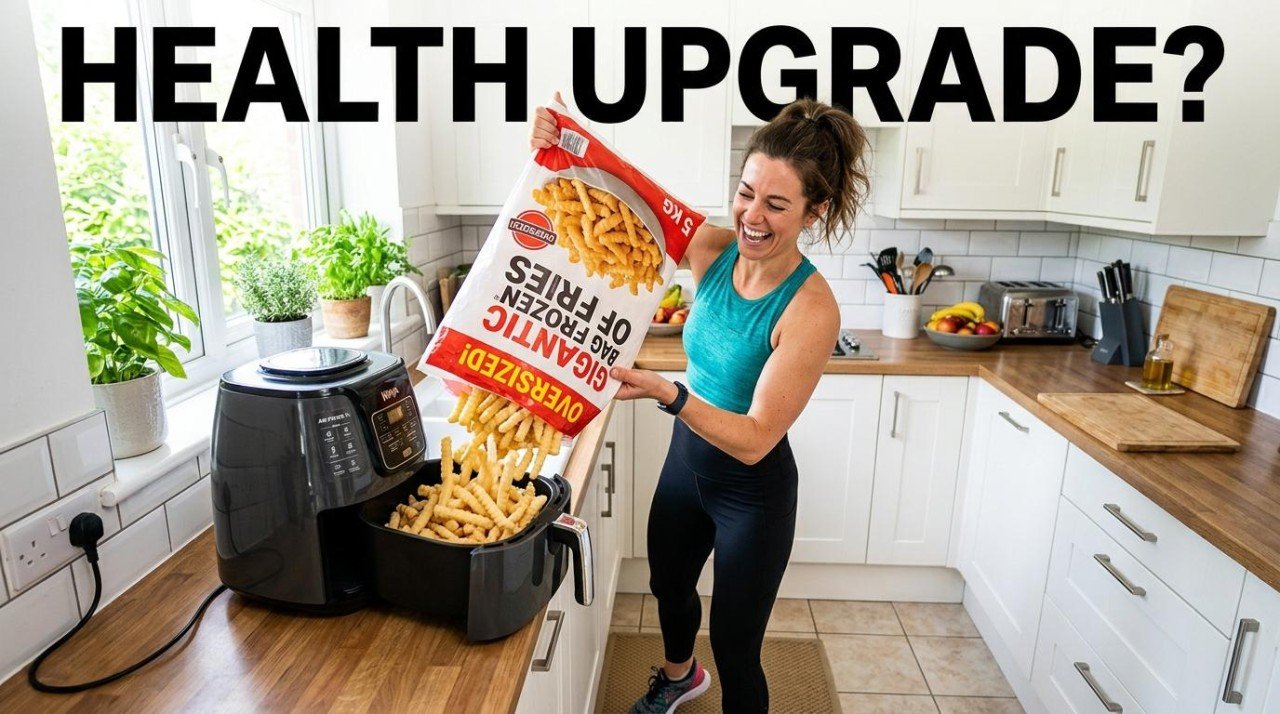
But there is an important asterisk for anyone cooking from the freezer aisle. Most frozen fries, nuggets, and breaded fish have already been fried once at the factory. A Lamb Weston patent describes the standard commercial sequence as blanching, drying, par-frying in oil, and then freezing potato strips, which are later finished in a fryer or reheated in an oven. The oil is already in the bag before you open it.
That shrinks the air fryer's advantage. A 2026 study in Food Science & Nutrition that cooked store-bought frozen fries and potato wedges found air-jet frying reduced oil absorption by 36.2% for fries and 38.8% for wedges compared with deep-fat frying. That is a worthwhile cut, but it is nowhere near the "90% less fat" headlines you see online, because the air fryer can only avoid adding more oil. It cannot remove what the factory put in.
The takeaway: an air fryer saves the most oil when you start with raw, whole ingredients. Cut your own potatoes, bread your own chicken, roast your own chickpeas. Heating up frozen pre-fried foods is better than deep-frying them again, but it is not the same as eating a roasted potato.
Why less frying is worth chasing at all
If fried food were harmless, none of this would matter. The evidence suggests it isn't. A 2021 meta-analysis in the journal Heart by Qin and colleagues pooled 17 observational studies and found that people who ate the most fried food had about a 28% higher risk of major cardiovascular events than those who ate the least, including 22% higher risk of coronary heart disease and 37% higher risk of heart failure. Each extra weekly serving of about 114 grams was linked to a 3% higher risk of a major cardiovascular event.
As the European Food Information Council points out in its review of the study, these were observational studies that relied on memory-based food questionnaires and didn't all account for overall diet, smoking, and exercise. People who eat a lot of fried food also tend to eat a lot of other things along with it, like salty sides and sugary drinks. So fried food is a marker of a pattern as much as a single culprit. Still, if an air fryer helps you swap some of that weekly fried food for something cooked with far less oil, that is a reasonable trade.
Acrylamide: the evidence is more mixed than you've heard
Acrylamide is a chemical that forms when starchy foods like potatoes and bread are cooked at high heat. It is the main reason dark, crunchy fries and burnt toast get flagged by food safety agencies. Hong Kong's Centre for Food Safety notes that it forms in any cooking at 120°C (about 250°F) or above, including in air fryers, and it classifies acrylamide as a probable human carcinogen with no established safe level, so the goal is to keep it as low as reasonably possible.
You will often read that air frying cuts acrylamide by 90%. That number is real, but it comes from one study. Researchers at the Polytechnic University of Valencia found that air frying reduced acrylamide by about 90% compared with deep-oil frying of potatoes at 180°C, even without any pretreatment.
Other research hasn't been so tidy. A 2024 study in Frontiers in Nutrition from Gazi University in Turkey compared air frying, deep frying, and fan-oven cooking of potato sticks and found that the air-fried batches had the highest average acrylamide of the three, though the differences between methods weren't statistically significant. The authors noted that the air inside the fryer reached up to 229°C, hotter than the deep-fryer oil. That study has been criticized, too: a published commentary argued its measured levels were about ten times lower than earlier studies and mostly below the method's own limit of reliable quantification, so its numbers may not be trustworthy either.
Hong Kong's food safety regulator sums it up fairly: some studies find less acrylamide in air-fried potatoes than in deep-fried ones, a few find no significant difference, and the evidence remains inconclusive.
The good news is that how you cook matters more than which appliance you use, and the fixes are the same everywhere. The FDA's guidance on reducing acrylamide at home includes:
- Soak cut potatoes in water for 15 to 30 minutes before frying or roasting, then drain and pat them dry. (Dry potatoes crisp better in an air fryer anyway.)
- Cook to golden yellow, not brown. The darkest, crunchiest edges hold the most acrylamide.
- Don't store potatoes in the refrigerator. Cold storage can increase acrylamide during cooking. A cool, dark pantry is better.
- Toast bread to light brown rather than dark brown.
One air-fryer-specific tip from Hong Kong's Centre for Food Safety: cook in batches instead of overloading the basket, and turn food occasionally so it cooks evenly and no pieces scorch. And a reality check worth keeping in mind: the FDA notes that boiling potatoes or microwaving them whole with the skin on doesn't produce acrylamide at all. No appliance that crisps potatoes will beat that.
Meat and fish: fewer frying byproducts, but heat still matters
High-heat cooking of meat creates other compounds worth limiting, including polycyclic aromatic hydrocarbons (PAHs) and heterocyclic amines (HCAs). Here the air fryer again looks good against deep frying. A 2020 study in Foods found that deep-fried chicken had higher acrylamide and total PAHs than air-fried chicken, with air-fried totals of about 1.96 to 2.71 micrograms per kilogram versus 2.64 to 3.17 for deep-fried.
That doesn't mean the air fryer is a free pass. A 2025 study in Food Science and Biotechnology found that higher temperatures and searing increased HCAs and acrylamide in air-fried meat, especially beef. Marinades helped: soaking chicken in milk or beer cut HCAs by up to 60.6%, and turmeric reduced HCAs in beef by 69.4%, with rosemary and garlic also helping.
Fish has its own wrinkle. A 2017 study in the Journal of Food Science found that air frying sardines increased cholesterol oxidation products from 61.2 to 283 micrograms per gram and reduced their beneficial polyunsaturated fats. The encouraging part: adding parsley and chives to the fish before cooking reduced that oxidation in most samples. This doesn't mean air-fried salmon is bad for you. It means any high, dry heat changes delicate fish fats, and that herbs and gentler cooking help. (If fish in general makes you nervous, our guide to cooking fish without fear covers the gentler methods.)
The practical pattern for all proteins: use moderate temperatures, avoid charring, marinate when you can, and be generous with herbs and spices. That's good cooking advice in any appliance.
Crispness: why it works (and why it isn't quite the same)
An air fryer crisps food the same way a convection oven does: a powerful fan strips away the layer of moist, cool air that clings to the surface of food, so the outside dries and browns faster. Because the basket is small and the fan is close, that effect is stronger than in most full-size ovens, which is why air-fried vegetables and chicken skin often come out crunchier.
But "crisp" isn't the same as "deep-fried." The Reading study found that air-fried and deep-fried fries had significantly different texture and sensory qualities, and a food that's submerged in hot oil will always brown more evenly than one sitting in a basket. If you go in expecting a perfect copy of restaurant fries, you might be disappointed. If you go in expecting the best roasted potatoes you've made at home, you'll probably be happy.
Where an air fryer genuinely beats the oven
Since the health difference between an air fryer and an oven is small, the real case for an air fryer is practical: speed, energy, and convenience. And practical matters, because the cooking method you'll actually use on a busy Tuesday is the one that keeps you eating home-cooked food.
Which?, the UK consumer testing organization, measured energy use including preheating. A roast chicken took 53 minutes and 0.54 kWh in an air fryer versus 76 minutes and 1.157 kWh in a built-in oven, and the air-fried bird actually scored better for juiciness. A baked potato took 48 minutes instead of 68, and a batch of frozen chips took 23 minutes instead of 33, at about a third of the energy.
Here's where that speed and focused heat really pay off:
- Roasted vegetables for one or two people. Brussels sprouts, broccoli, cauliflower, green beans, and carrots get browned edges in 10 to 15 minutes without heating the whole kitchen. If you've struggled to make vegetables appealing, the same principles from our roasting method that converts vegetable haters apply here, just faster.
- Crispy chickpeas and tofu. Both crisp beautifully in a hot, dry air current and make easy protein-rich toppings for salads and bowls. Our guide to cooking tofu and tempeh so it tastes good pairs well with this.
- Chicken thighs, wings, and drumsticks. The fat renders and the skin crisps without any added oil. It's a genuine alternative to deep-fried versions, like the ones we rebuilt in our healthier buffalo wings and healthier fried chicken makeovers.
- Homemade fries and potato wedges. Cut, soaked, dried, and tossed with a teaspoon of oil, they're a real improvement over the deep-fried kind. (We dug into what actually moves the needle in our healthier French fries makeover, and it wasn't only the fryer.)
- Reheating leftovers. Roasted vegetables, pizza, and crispy proteins come back to life instead of going soggy the way they do in a microwave.
- Salmon fillets and fish with a dry coating. Fast and hands-off for a weeknight, ideally with herbs.
Take the Guesswork Out of Eating Well
Eat Well Planner helps you organize your favorite recipes, plan balanced meals, and automatically generate shopping lists — all in one place. Whether you're tracking macros, managing dietary restrictions, or just trying to stop asking "what's for dinner?", we've got you covered.
Our AI-powered tools can adapt any recipe to your dietary needs, help you discover new meals you'll love, and even log your nutrition effortlessly. It's meal planning made simple.
Start Organizing Your Meals — FreeWhere it doesn't (or where the oven still wins)
- Cooking for a crowd. Capacity is the air fryer's biggest weakness. In the Which? test, the basket limited the chicken to about 1.3 kilograms, fit only one baked potato at a time, and the manufacturer advised filling it only halfway with fries. Which?'s own expert noted that the energy savings "soon drop off if you have to cook in batches." For a family-size dinner, a sheet pan in the oven is often simpler. Our guide to sheet pan dinners shows how to get a whole meal on one tray.
- Wet batters. Fresh, wet-battered foods like tempura drip through the basket instead of setting. As Tasting Table puts it, wet-battered foods don't belong in your air fryer. Use a dry coating like panko or seasoned flour instead.
- Light, leafy foods. Spinach and loose greens get blown around by the fan and cook unevenly.
- Boiled, steamed, or simmered foods. Soups, stews, grains, and beans aren't air fryer territory, and they're some of the most nutrient-dense, budget-friendly foods you can make.
The hidden risk: becoming a frozen-snack machine
Here's the part that rarely comes up in air fryer reviews. The appliance is extremely good at one thing in particular: turning frozen, pre-fried, ultra-processed foods into something hot and crunchy in ten minutes. Nuggets, mozzarella sticks, frozen fries, pizza rolls. That's not a crime, and these foods can absolutely fit in a balanced week. But if an air fryer mostly makes it easier to eat more of them, it isn't a health upgrade. It's a faster way to eat the same diet.
The flip side is just as true. If the air fryer makes you more likely to roast a tray of vegetables on a weeknight, cook chicken at home instead of ordering takeout, or turn a can of chickpeas into a crunchy snack, it's a meaningful upgrade, not because of any magic in the hot air, but because it lowers the effort of cooking real food.
How to get the most health out of your air fryer
- Start with whole ingredients. The biggest oil savings come from raw potatoes, raw chicken, and fresh vegetables, not pre-fried frozen products.
- Use a little oil, on purpose. A teaspoon of olive oil helps vegetables brown and adds healthy fat. "No oil" isn't the goal; "a little, not a lot" is.
- Aim for golden, not dark brown. Especially for potatoes and bread, to keep acrylamide down.
- Soak and dry cut potatoes. 15 to 30 minutes in water, then pat dry.
- Marinate and season generously. Herbs, spices, and marinades reduce some high-heat byproducts in meat and fish, and they make everything taste better.
- Don't overcrowd the basket. Food cooks more evenly, crisps better, and scorches less.
- Make vegetables the main event. Use the air fryer's speed to make a vegetable side the easiest part of dinner, not an afterthought.
Planning is what turns a gadget into a habit
An air fryer is a tool. Whether it improves your diet depends on what goes into it, and that's mostly decided before you ever press "start," back when you're figuring out what to make this week and what to buy.
That's where Eat Well Planner helps. You can import air fryer recipes from any website, Instagram reel, or YouTube video, and every recipe gets a Nutrition Score so you can see how healthy it really is, not just whether it says "air-fried" in the title. If a recipe scores lower than you'd like, Make It Healthier suggests specific ingredient swaps and verifies the real nutritional gain before showing them. Add your favorite air fryer meals to a weekly plan, and the app builds the shopping list for you, so the vegetables and whole ingredients are already in your kitchen when the frozen snacks start calling.
The bottom line
Is your air fryer a health upgrade or just a small oven? It's a small oven. That's a good thing, though. Compared with deep frying, it uses far less oil and produces fewer frying byproducts in chicken, which is a real health upgrade. Compared with your regular oven, it's nutritionally about the same but faster, more energy-efficient for small batches, and better at crisping. The acrylamide story is still unsettled, and the same golden-not-brown rules apply no matter what you cook with.
The biggest factor isn't the appliance. It's the food. Fill the basket with vegetables, whole potatoes, chickpeas, and home-seasoned proteins, and your air fryer can make healthy cooking easier than ever. Fill it mostly with frozen pre-fried snacks, and it's simply a quicker route to the same plate.