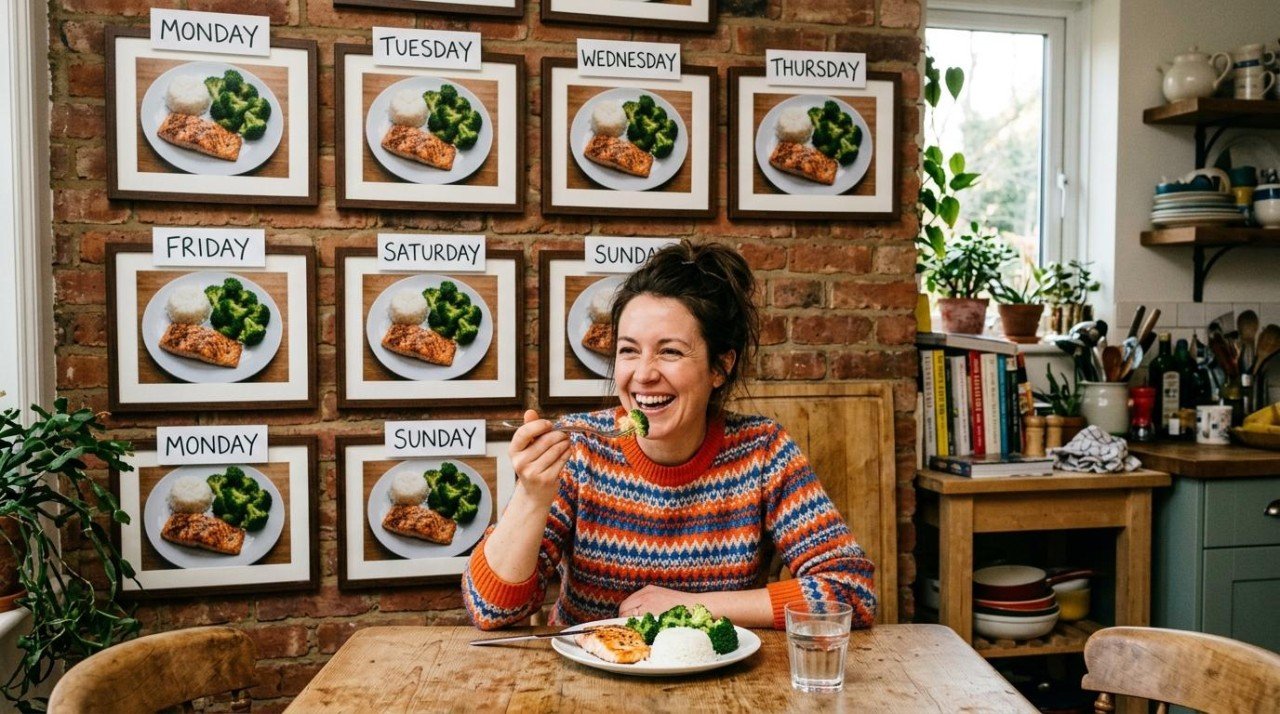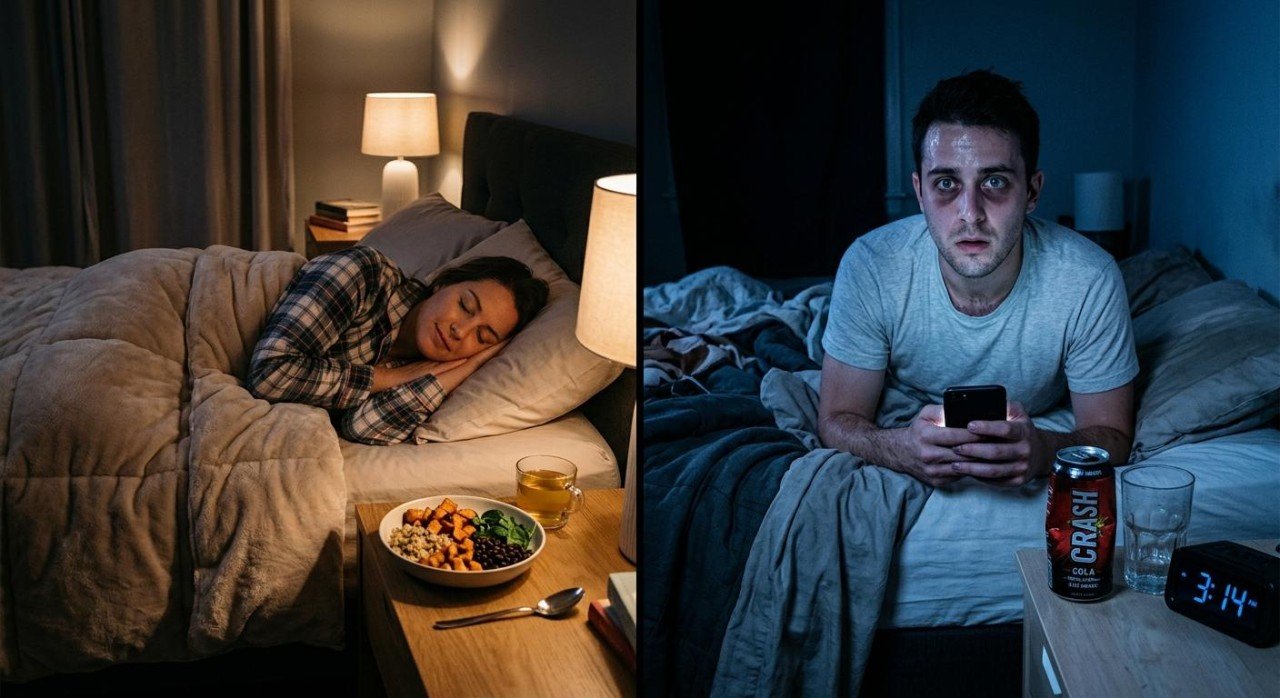
You did everything right. You dimmed the lights, put your phone across the room, kept the bedroom cool. And still you lay there at 1 a.m., wide awake, or you woke at 3 and never really dropped back under. We tend to troubleshoot bad sleep with screens, stress, and mattresses — and almost never with what was on the plate a few hours earlier.
That is a missed opportunity, because the relationship between food and sleep runs in both directions. What you eat, and especially when you eat it, shapes how easily you fall asleep, how deep that sleep goes, and how many times you surface during the night. And poor sleep, in turn, nudges you toward worse food choices the next day. The good news: a few evidence-based tweaks to your evening eating can tilt the odds in your favor — no supplements or special gadgets required.
How Food Talks to Your Sleep
Your body builds its main sleep signal from raw materials you eat. The pathway starts with tryptophan, an amino acid found in protein-rich foods, which your body converts into the neurotransmitter serotonin and then into melatonin — the hormone that tells your brain it is night. According to a narrative review of diet and sleep in the journal Nutrients, tryptophan-enriched foods can shorten the time it takes to fall asleep, while depleting tryptophan reliably worsens sleep.
Here is a counterintuitive wrinkle: tryptophan has to compete with other amino acids to cross into the brain, and a dose of carbohydrate actually helps it win that race. The same review explains that carb-containing meals trigger insulin, which clears competing amino acids from the bloodstream and leaves more tryptophan free to reach the brain. That is the real reason the classic "carbs make you sleepy" idea has some truth to it — and why a little protein paired with a quality carbohydrate is a better evening combination than either one alone.
The same review also flagged two nutrients with opposite effects on deep sleep: eating more fiber was linked to more time in slow-wave (deep) sleep, while more saturated fat was linked to less of it. That single finding quietly endorses exactly the kind of dinner that is good for the rest of you, too — plants, whole grains, and lean protein over a heavy, greasy plate.
The Foods That Help You Sleep
Kiwifruit
It sounds too simple to be real, but kiwi has some of the most charming data in this whole field. In a study from Taipei Medical University, 24 adults with sleep problems ate two kiwifruit an hour before bed every night for four weeks. By the end, they were falling asleep about 35% faster, sleeping roughly 13% longer in total, and spending more of their time in bed actually asleep. Kiwi is naturally rich in serotonin and antioxidants, which researchers think may explain the effect. It is a small, unblinded study — but it is a free, harmless experiment you can run on yourself this week.
Tart Cherries
Tart cherries (and their juice) are one of the few foods that contain a meaningful amount of melatonin directly. In a placebo-controlled pilot study of older adults with insomnia, drinking tart cherry juice twice a day for two weeks extended sleep time by about 84 minutes. Interestingly, the researchers concluded the benefit was probably not the cherries' modest melatonin content alone, but rather their effect on keeping more tryptophan available to the body. Either way, an unsweetened tart cherry drink in the evening is a reasonable, food-first thing to try.
Complex Carbs Paired With Protein
Timing and type of carbohydrate both matter here. In a tightly controlled trial published in the American Journal of Clinical Nutrition, men who ate a carbohydrate meal four hours before bed fell asleep in about 9 minutes, versus 17.5 minutes after a lower-glycemic version — and four hours before bed worked better than eating the same meal just one hour before. So a carb-containing dinner, eaten with enough runway before bed, can genuinely help you drift off.
But do not read that as a license for a bowl of sugary cereal at bedtime — and this is where being honest about the evidence matters. Over the long term, the picture flips. In a large analysis from the Women's Health Initiative, women eating the highest-glycemic-index diets had about a 16% higher risk of developing insomnia over three years, and higher added-sugar intake was linked to more insomnia too. The researchers' recommendation was to swap refined, high-glycemic foods for "whole, fiber-rich carbohydrates." In practice, that means the sleep-friendly move is a quality carb with some protein at dinner — think oats, brown rice, or sweet potato alongside fish, eggs, poultry, or legumes — not a refined-sugar snack right before you turn in.
Magnesium-Rich Foods
Magnesium is involved in the nervous-system pathways that help your body wind down, and many people fall short of the recommended intake. In a double-blind, placebo-controlled trial, older adults with insomnia who took magnesium daily for eight weeks fell asleep faster, slept more efficiently, and showed higher melatonin and lower cortisol (the stress hormone) in their blood. You do not need a pill to get more of it: leafy greens, nuts, seeds, beans, and whole grains are all solid food sources, and they happen to deliver the fiber and tryptophan that help, too.
Take the Guesswork Out of Eating Well
Eat Well Planner helps you organize your favorite recipes, plan balanced meals, and automatically generate shopping lists — all in one place. Whether you're tracking macros, managing dietary restrictions, or just trying to stop asking "what's for dinner?", we've got you covered.
Our AI-powered tools can adapt any recipe to your dietary needs, help you discover new meals you'll love, and even log your nutrition effortlessly. It's meal planning made simple.
Start Organizing Your Meals — FreeThe Foods and Drinks Stealing Your Sleep
If the list above is the offense, this is the defense. Several common evening habits actively sabotage sleep — and some do it more quietly, and for longer, than most people realize.
Caffeine — and Its Surprisingly Long Tail
The problem with caffeine is not just that it is a stimulant; it is how long it sticks around. Caffeine has a half-life of roughly five hours, meaning half the dose from your 3 p.m. coffee is still circulating at 8 p.m. — and in some people it lingers far longer. In a controlled study, a 400 mg dose of caffeine (about three to four cups of coffee) taken six hours before bed still cut objectively measured sleep by more than an hour. The participants did not necessarily notice — but the sleep monitors did. The takeaway: an afternoon coffee that feels harmless can be quietly costing you sleep that night. If you sleep poorly, try moving your last caffeine to the morning or early afternoon, and remember that tea, soda, energy drinks, and chocolate all count.
Alcohol — the Sleep Aid That Backfires
A nightcap is the great sleep illusion. Alcohol genuinely helps you fall asleep faster, which is exactly why people reach for it — but it wrecks the second half of the night. As research on alcohol and sleep explains, drinking suppresses REM sleep early on, then triggers a "rebound" later in the night, fragmenting your sleep with more awakenings as the alcohol clears. The result is the all-too-familiar pattern: out like a light, then bolt awake at 3 a.m. The sedation is short-lived; the disruption is not. If you drink, keeping it earlier and lighter — and leaving a few hours before bed — softens the hit.
Heavy, Fatty, and Spicy Late Meals
A big, rich meal right before bed asks your digestive system to do its hardest work exactly when your body wants to power down. According to the Sleep Foundation, eating high-fat or heavy meals close to bedtime can lengthen the time it takes to fall asleep and increase nighttime awakenings, and lying down soon after eating lets stomach contents press against the esophageal valve — triggering acid reflux and heartburn that jolt you awake. Spicy foods add a second problem: they can raise your core body temperature right when it needs to drop to initiate sleep. If you are reflux-prone or sensitive to spice, the evening meal is the one to keep moderate.
Sugary Evening Snacks and Blood-Sugar Swings
That bowl of ice cream or sleeve of cookies before bed sets up a blood-sugar spike followed by a crash, and that crash can surface as a middle-of-the-night wake-up. It lines up with the long-term data above: in the Women's Health Initiative analysis, it was specifically added sugars — not carbohydrates in general — that tracked with higher insomnia risk. If you genuinely need a bedtime snack, reach for something that combines a little protein with a slower carb (a few nuts and a piece of fruit, plain yogurt, or a slice of whole-grain toast with nut butter) rather than straight sugar.
Timing: The Other Half of the Equation
Notice how often when mattered as much as what. The carbohydrate meal worked best four hours before bed, not one. Caffeine did damage six hours out. Late meals invited reflux. Your body runs on a circadian clock, and your digestion is part of it — it is simply better at handling food earlier in the evening than right before you lie down.
A simple, realistic evening game plan looks like this:
- Set a caffeine curfew. If you sleep badly, make it lunchtime. Most people can push it to early afternoon at the latest.
- Eat your main meal earlier. Aim to finish dinner two to three hours before bed so digestion is well underway by the time you lie down.
- Build a sleep-friendly plate. A quality carbohydrate (whole grains, sweet potato, legumes) plus lean protein, plenty of vegetables for fiber, and not too much saturated fat.
- Keep alcohol earlier and lighter — or skip it on nights that matter.
- If you snack, snack smart. Protein plus a slow carb, not sugar. A kiwi or a small unsweetened tart cherry drink is a fair experiment.
The Two-Way Street — and How to Find Your Own Triggers
Here is the part that makes all of this worth the effort: sleep and diet feed each other. Sleep poorly and you wake up with more appetite, stronger cravings for sugary and high-fat food, and less willpower to resist them — which sets up another night of poor sleep. Eat to support sleep, and you wake up steadier, which makes the next day's good choices easier. It is a loop you can push in either direction.
The catch is that the specifics are personal. Caffeine clears quickly in some people and lingers for ten hours in others. One person's late curry is another person's 3 a.m. heartburn. The only way to find your pattern is to pay attention — to notice that the nights you slept worst tended to follow an afternoon coffee, a late heavy dinner, or that "harmless" glass of wine. That connection is almost impossible to spot from memory alone, but it jumps out when it is written down.
This is exactly where a little structure helps. With Eat Well Planner, you can plan sleep-supportive evening meals around the foods above — building dinners that pair quality carbs with protein and lean on magnesium-rich vegetables, then generating a shopping list so the right ingredients are actually in the house when 6 p.m. rolls around. And because you can log what you eat (including by voice), you can look back and connect your worst nights to what and when you ate, turning a vague suspicion into a pattern you can actually act on. When the sleep-friendly choice is already planned and shopped for, it stops being the harder option.
You will not fix your sleep with a single kiwi or wreck it with one cup of coffee. But over a week of evenings, the cumulative effect of eating — and timing — with sleep in mind is real. Start with one change: a caffeine curfew, an earlier dinner, or swapping the bedtime cookies for something steadier. Then notice how you feel at 3 a.m.
Ready to eat in a way that helps you actually rest? Try planning your meals with Eat Well Planner — and start connecting what is on your plate to how you sleep.