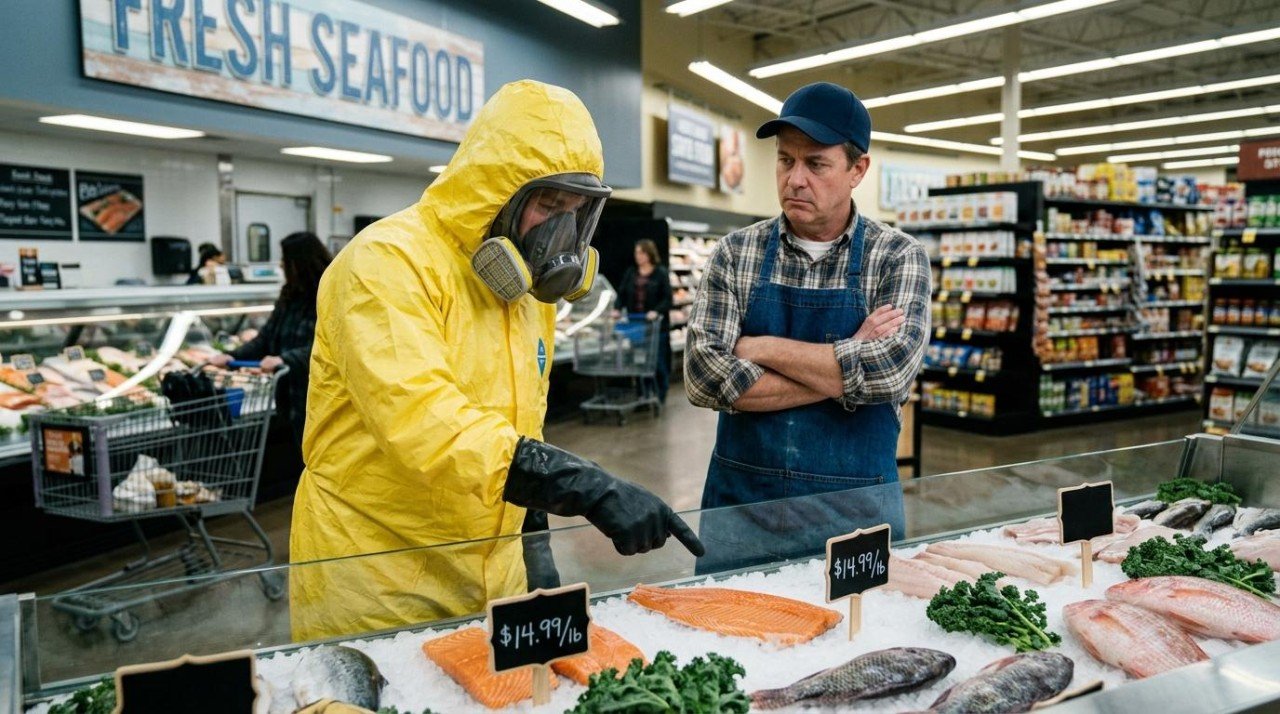
Fish is one of the few foods that US health agencies actively want you to eat more of. The Dietary Guidelines ask for at least 8 ounces a week, which works out to two servings. Almost nobody hits it. In 2013 to 2016, just 20.1% of American adults and 5.6% of kids aged 2 to 19 ate seafood twice a week — and the trend was moving the wrong way, with the adult figure falling from 26.0% to 19.2% between 2005-2006 and 2015-2016.
Ask people why and you usually get two answers: it costs too much, and isn't there mercury in it?
Both objections deserve a straight answer, and both are more solvable than they look. The mercury question has a numeric answer that most people have never actually seen. The price question has shifted meaningfully in the last six years, in a direction that helps you. And there is a third issue nobody warns you about — the cheapest fish and the most nourishing fish are often not the same fish. That last one is the part that will change what goes in your cart.
The mercury picture, in actual numbers
Mercury enters the water from both natural sources and human activity. Once there, microorganisms convert it into methylmercury, which builds up in fish and shellfish. The EPA is explicit about what determines how much any given fish carries: what it eats, how long it lives, and how high it sits in the food chain. The highest concentrations turn up in large, long-lived fish that eat other fish.
That one sentence explains almost everything. A sardine lives a couple of years and eats plankton. A swordfish lives for years and spends all of them eating other fish that ate other fish. They are not remotely the same risk, and treating "fish" as a single category is what keeps people stuck.
The FDA publishes average mercury concentrations by species, measured in parts per million. Here is the spread from its testing data:
- Shrimp — 0.009 ppm
- Sardine — 0.013 ppm
- Tilapia — 0.013 ppm
- Canned salmon — 0.014 ppm
- Anchovies — 0.016 ppm
- Fresh or frozen salmon — 0.022 ppm
- Pollock — 0.031 ppm
- Cod — 0.111 ppm
- Canned light tuna — 0.126 ppm
- Canned albacore (white) tuna — 0.350 ppm
- Bigeye tuna — 0.689 ppm
- King mackerel — 0.73 ppm
- Shark — 0.979 ppm
- Swordfish — 0.995 ppm
Swordfish averages roughly 76 times the mercury of a sardine, and about 45 times that of fresh salmon. The gap between the top and the bottom of that list is not a rounding difference — it spans two orders of magnitude. And the fish at the bottom happen to be the ones sitting in the canned aisle for a couple of dollars.
The FDA and EPA turn this data into a chart that sorts 62 species into three buckets. There are 36 fish on the "Best Choices" list — salmon, sardines, anchovies, cod, tilapia, pollock, canned light tuna, shrimp, catfish, herring, Atlantic mackerel, trout, flounder, haddock, clams, crab, oysters and more. Nineteen more are "Good Choices," meaning one serving a week. Only seven sit in the avoid column: shark, swordfish, king mackerel, marlin, orange roughy, tilefish from the Gulf of Mexico, and bigeye tuna.
Look at that avoid list again. Unless you have an unusual dinner routine, you are almost certainly not eating any of them. The entire mercury worry, for most American households, comes down to seven fish that rarely appear in an ordinary grocery cart.
The one genuine gotcha: tuna
Tuna is the exception worth knowing, because "tuna" covers several very different fish. The FDA notes that albacore (white) tuna typically contains about three times more mercury than canned light tuna, which the testing data bears out: 0.350 ppm against 0.126 ppm. Canned light tuna — usually skipjack — is a Best Choice you can eat two to three times a week. Albacore is a Good Choice, meaning one serving that week and no other fish. Bigeye is on the avoid list entirely.
Which is convenient for anyone on a budget, because canned light tuna is the cheap one.
Do the benefits actually outweigh the risk?
This is the question the mercury conversation usually skips, and it has been studied head-on. A landmark review in JAMA by Dariush Mozaffarian and Eric Rimm weighed the omega-3 benefits against the contaminant risks and found that modest fish consumption — one to two servings a week, especially of species higher in EPA and DHA — was associated with a 36% lower risk of coronary death and 17% lower total mortality. Their conclusion was blunt: for major health outcomes among adults, the benefits of fish intake exceed the potential risks. They put the intake that appears sufficient for primary prevention at roughly 250 mg a day of EPA plus DHA, the two long-chain omega-3s that essentially only come from seafood.
The pregnancy evidence points the same way, and it surprised people when it landed. A study of almost 9,000 British families published in The Lancet compared mothers' seafood intake during pregnancy with their children's development up to age 8. Compared with children whose mothers ate more than US guidelines advised at the time, children of mothers who ate no fish were 28% more likely to have poor communication skills at 18 months, 44% more likely to have poor social behavior at seven, and 48% more likely to have a relatively low verbal IQ at eight. The lead researcher's assessment was that the cautious advice had produced "exactly the opposite of what was assumed."
Honesty requires the complication, though. A large 2021 pooled analysis of 191,558 people from 58 countries, published in JAMA Internal Medicine, found that among people without existing cardiovascular disease, eating 350 g of fish a week or more was not associated with lower risk of major cardiovascular events or death. Among people who already had vascular disease, it was: risk was lowest at intakes of at least 175 g a week — roughly two servings — with no further benefit above that. Fish higher in omega-3s drove the association; other fish were neutral.
So the honest summary is not "fish is a miracle food." It is closer to this: two servings a week of oily, omega-3-rich fish is a well-supported target, the benefit is clearest when fish displaces less healthy protein, and there is no good evidence that pushing far beyond two servings buys you more. The American Heart Association's advisory lands in the same place, recommending two 3.5-ounce servings of non-fried fish a week. Rimm, who chaired the group that wrote it, framed the risk-benefit balance this way: "For adults eating a serving or two of fish a week, the benefits of fish are likely at least fiftyfold more than any concerns over other compounds that may be in the fish."
The price objection has quietly weakened
When the USDA's Economic Research Service looked at why Americans eat so little seafood, it listed "higher retail prices on average when compared with meat and poultry" among the main factors, alongside unfamiliarity with cooking methods and concerns about food safety. At that point Americans were eating about 2.7 ounces of fish and shellfish a week — roughly a third of the 8-ounce weekly minimum.
That price gap has been closing, and quickly. In Bureau of Labor Statistics Consumer Price Index data, between July 2020 and July 2026 the index for fish and seafood rose about 23%. Over the exact same stretch, beef and veal rose about 48% — more than double the rate. And the slowest-rising seafood category of all was processed fish and seafood, the canned and frozen stuff, up about 22%.
Put differently: the protein you are mentally comparing fish against is not cheap anymore either. In July 2026, BLS average price data put uncooked ground beef at $7.12 a pound and boneless chicken breast at $4.15 a pound. Against that backdrop, a can of pink salmon or a tin of sardines is not the luxury item people assume it is.
The FDA is unusually direct on this point. Its updated advice states that "canned, frozen, and fresh fish all count and provide options that are affordable and convenient." And in its Q&A, asked directly about eating a lot of canned light tuna because it is affordable, the agency answers yes, that is fine, then suggests trying other affordable Best Choices such as canned salmon, sardines, frozen fish, or fresh fish that happens to be marked down.
The trap: cheap fish and nourishing fish are not the same fish
Here is the thing that almost never makes it into "eat more fish" advice, and for most people it matters more than the mercury question.
The health benefit tied most tightly to fish is EPA and DHA. But different fish carry wildly different amounts, and the difference does not track price at all. Using USDA FoodData Central values, here is roughly what a 4-ounce serving — the FDA's adult serving size — delivers in combined EPA plus DHA:
- Farmed Atlantic salmon, cooked — about 2.4 g
- Canned anchovies, drained — about 2.3 g
- Atlantic mackerel, cooked — about 1.4 g
- Canned pink salmon, drained — about 1.2 g
- Canned sardines in oil, drained — about 1.1 g
- Canned albacore (white) tuna in water — about 1.0 g
- Alaska pollock, cooked — about 0.38 g
- Canned light tuna in water — about 0.31 g
- Cod, cooked — about 0.18 g
- Tilapia, cooked — about 0.15 g
Now run two servings a week against that 250 mg-a-day benchmark, which comes to 1,750 mg a week. Two servings of canned pink salmon gets you roughly 2,400 mg — comfortably over. Two servings of sardines, about 2,200 mg. Two servings of salmon fillet, nearly 4,900 mg.
Two servings of tilapia? About 310 mg for the entire week. Two servings of cod, around 360 mg. Two servings of canned light tuna, roughly 610 mg — about a third of the target.
This is not an argument against tilapia, cod, pollock or light tuna. They are excellent lean protein, they are genuinely low in mercury, they are cheap, and a fish taco made with pollock is a far better dinner than no fish at all. But if you have been dutifully eating fish twice a week and it has all been mild white fish and light tuna, you have been meeting the letter of the guideline while missing most of the reason for it.
The fix costs almost nothing: make sure at least one of your two weekly servings is an oily fish. Canned pink salmon, sardines, anchovies, Atlantic mackerel or herring will all do it, and every one of them sits on the FDA's Best Choices list at the very bottom of the mercury range. Canned pink salmon is a particularly quiet overachiever — a 4-ounce serving carries around 320 mg of calcium from the soft, edible bones and roughly 660 IU of vitamin D, which is more vitamin D than most people get from anything else on their plate.
One caveat on anchovies: they are magnificent on omega-3s and brutal on sodium, at roughly 3,700 mg per 100 g. Use them the way they are meant to be used — a few fillets melted into a sauce or dressing — rather than as the serving itself.
Take the Guesswork Out of Eating Well
Eat Well Planner helps you organize your favorite recipes, plan balanced meals, and automatically generate shopping lists — all in one place. Whether you're tracking macros, managing dietary restrictions, or just trying to stop asking "what's for dinner?", we've got you covered.
Our AI-powered tools can adapt any recipe to your dietary needs, help you discover new meals you'll love, and even log your nutrition effortlessly. It's meal planning made simple.
Start Organizing Your Meals — FreeFarmed salmon is not the compromise you think
The reflexive assumption is that wild is nutritionally superior and farmed is the budget concession. On omega-3s specifically, the data says otherwise. USDA figures put cooked farmed Atlantic salmon at about 2.15 g of EPA plus DHA per 100 g, against about 1.84 g for cooked wild Atlantic salmon. The AHA advisory makes the same observation: some types of farm-raised salmon and trout actually have higher omega-3 amounts than their wild counterparts.
Farmed salmon also sits on the FDA Best Choices list at 0.022 ppm mercury, the same as wild. As for the contaminant concern that dominated headlines two decades ago, the JAMA review concluded that levels of dioxins and PCBs in fish are low and that their potential effects "are outweighed by potential benefits of fish intake and should have little impact on choices or consumption of seafood."
There are real sustainability and farming-practice debates around aquaculture, and they are worth caring about. But "farmed salmon is nutritionally inferior" is not the reason to skip it.
Frozen is not the consolation prize
Most of what sits behind the fresh counter was frozen at some point anyway. Modern processors flash-freeze seafood down to -42°F in six hours or less, which locks in taste and texture and limits the exposure of fatty acids to air — the actual cause of the "fishy" smell people dislike. Washington Sea Grant's summary is that frozen is a great option, not a fallback.
Two practical consequences follow. First, the frozen aisle is where the price advantage lives, and it lets you buy fish on a Tuesday for a Thursday you have not planned yet. Second, many types of seafood can be cooked straight from frozen, which quietly removes the single biggest logistical barrier to a weeknight fish dinner: remembering to thaw something.
Getting it past a fish-skeptical household
Most people who say they hate fish mean they hate strong-tasting or overcooked fish. A few things move the needle:
- Start mild, not virtuous. Cod, tilapia, pollock, haddock and flounder taste like almost nothing. They are the gateway, even though they are not the omega-3 workhorses.
- Use a familiar format. Fish tacos, fish sandwiches, breaded oven-baked strips, salmon patties made from a can, a tuna melt, salmon stirred through pasta. Nobody has to sit down in front of a naked fillet.
- Cook hot and fast. The biggest single cause of unpleasant fish is overcooking. High heat and a short time beats low and slow.
- Finish with acid. Lemon, lime, vinegar or a yogurt sauce cuts through any residual richness and makes fish taste cleaner.
- Hide the oily fish rather than showcasing it. Canned salmon disappears into fishcakes, chowder, pasta bakes and sandwich fillings. This is how you get the omega-3s into a household that would refuse a sardine on a plate.
A realistic two-servings-a-week template
The pattern that actually survives a busy week is one pantry meal and one cooked meal. The pantry serving is the one that never gets skipped, because it needs no planning and no thawing. The cooked serving is the one you look forward to.
A four-week rotation might look like this:
- Week 1 — Canned pink salmon patties with a lemon-yogurt sauce; sheet-pan salmon fillet with potatoes and green beans.
- Week 2 — Sardines on toast with lemon, olive oil and chili flakes; frozen cod fish tacos with slaw.
- Week 3 — A tuna melt made with canned light tuna; pan-seared trout with capers and browned butter.
- Week 4 — Canned salmon stirred into a creamy pasta with peas; frozen shrimp and pollock chowder.
Every one of those uses Best Choices fish. Every week includes at least one oily-fish serving, so the omega-3 target is genuinely met rather than nominally met. And roughly half the meals come out of cans and the freezer, which is where the savings are.
This is also exactly the kind of thing that falls apart without a plan. Nobody decides at 6pm to make salmon patties. The reason "eat fish twice a week" stays theoretical for four out of five American adults is not that people disagree with it — it is that the decision has to be made days earlier, at the store. If two fish meals are already on the plan, the ingredients land on the shopping list, and the pantry serving is a can that has been in the cupboard since last month, the habit stops depending on willpower. That is precisely the gap Eat Well Planner is built to close: slot two fish meals into the weekly plan, let the shopping list build itself, and use the nutrition breakdown and "good source of" highlights to confirm your week is actually delivering the omega-3s and not just the fish.
Who does need to be careful
The relaxed version of this advice applies to most adults. Two groups should follow the chart more literally:
- People who are pregnant or breastfeeding. The FDA and EPA recommend 8 to 12 ounces a week — two to three 4-ounce servings — from the Best Choices list. The problem in practice is the opposite of what people expect: the FDA reports that on average, people who are pregnant eat only 4.2 ounces of fish a week and those breastfeeding only 7 ounces, both well under the recommendation.
- Children. Two servings a week from Best Choices, sized to age: about 1 ounce at ages 1 to 3, 2 ounces at 4 to 7, 3 ounces at 8 to 10, and 4 ounces at 11 and up.
For both groups, the avoid list is a real avoid list, and albacore tuna counts as that week's single Good Choices serving. One more thing that catches people out: fish caught by family or friends is a different question from fish bought at a store. The FDA advises checking local fish and shellfish advisories, and if there is no advisory, eating only one serving that week and no other fish.
The short version
The mercury worry that keeps most households out of the seafood aisle applies to seven fish, none of which you were likely buying. The price worry is aimed at the fresh counter, while the canned and frozen aisles have been rising in price more slowly than beef for six straight years. And the thing that actually deserves your attention — whether your fish carries meaningful omega-3s — is the one nobody mentions, and it is fixed by making one of your two weekly servings an oily fish that costs about two dollars.
Two servings. One from a can, one from the pan. It is a smaller change than it has been made to sound.
Plan your week with Eat Well Planner — build two fish meals into your plan, get the shopping list automatically, and see exactly what your week is delivering.