Americans are rethinking their drinks. In 2025, Gallup found that just 54% of U.S. adults say they drink alcohol — the lowest figure in nearly 90 years of polling — and for the first time, a majority (53%) said that even moderate drinking is bad for your health. Among adults 18 to 34, the drinking rate fell from 59% in 2023 to 50%.
Maybe you're part of that shift, or maybe you're just curious what would happen if you swapped a few of your weeknight glasses of wine for something else. Either way, the obvious question is: what actually changes in your body, and how fast?
The internet is full of tidy timelines promising that on day 3 your skin glows, on day 7 your liver is "detoxed," and by day 30 you're a new person. The real research is messier — and in some ways more encouraging. Here's what the evidence actually shows, roughly in the order you'd notice it, plus some genuinely good drinks to reach for instead.
A Quick Honesty Note Before the Timeline
There isn't a well-controlled study that tracks every body system week by week after people cut back. What we have is a patchwork: lab studies of single nights of drinking, wearable data from tens of thousands of people, a widely cited one-month abstinence study, and meta-analyses of blood pressure trials. So the "timeline" below is an evidence-based sketch, not a guarantee.
Two other things matter a lot:
- How much you drank to begin with. Most of the dramatic measured changes come from people who were drinking well above one or two drinks a day. If you have a glass of wine twice a week, your blood work probably won't transform — though your sleep on those nights may.
- Cutting back vs. stopping. Many studies look at full abstinence for a month. Cutting back still helps, but the effects scale with how much you actually reduce.
One important safety point: if you drink heavily every day, stopping suddenly can cause withdrawal, which can be dangerous. Talk to a doctor before quitting cold turkey if that's you.
The First Nights: Your Sleep Gets More Restful
This is the change most people notice first, and it's backed by solid science. Alcohol is sedating, so a drink or two can make you feel like you fall asleep more easily. But the rest of the night tells a different story.
In adults, alcohol has a well-documented two-phase effect. As researchers summarize in a 2013 sleep lab study in Alcoholism: Clinical and Experimental Research, alcohol's most consistent effect is "an increase in SWS coupled with a decrease in REM sleep in the first half of the night" — more deep sleep early, less REM. Then, as your body metabolizes the alcohol, the second half of the night becomes more fragmented, with more time spent awake and lower sleep efficiency. In that study of young adults given alcohol before bed, total REM sleep went down and sleep in the second half of the night was disrupted compared with a placebo drink.
Real-world wearable data points the same way. A 2026 study in PLOS Digital Health analyzed more than 5 million days of data from 20,968 adults wearing WHOOP straps. When people drank more than their usual amount, their resting heart rate during sleep went up, their heart rate variability (a marker of how well the body is recovering) went down, and they slept less. Even one extra drink compared with one fewer was linked to measurable changes, and the effects grew with each additional drink. They were generally larger in women and in younger adults. (Worth knowing: the authors work for WHOOP and the study was funded by the company, and many of the individual effects were small.)
The flip side is what matters here: when you skip the evening drink, you skip those effects that same night. Lots of people who cut back report waking up feeling more rested within the first week or two, and that lines up with what the sleep research would predict.
Better sleep has a knock-on effect on your eating, too. As we covered in Sleep Deprived and Starving, short sleep reliably pushes people toward eating more the next day — so better nights can quietly make healthier days easier.
The First Few Weeks: Fewer Empty Calories (and Fewer Late-Night Snacks)
Alcohol carries a surprising number of calories for something most of us don't think of as "food." According to MedlinePlus from the National Library of Medicine:
- A 12-ounce regular beer has about 153 calories, and a higher-alcohol craft beer can run 170 to 350.
- A 5-ounce glass of red wine has about 125 calories; white, about 121.
- A 4-ounce margarita has about 168 calories, and a 7-ounce piña colada about 380.
- As the page puts it, "Going out for a couple of drinks can add 500 calories, or more, to your daily intake."
Two glasses of wine a night works out to roughly 1,700 calories a week — about what many people eat in a day. Those calories also come with very little nutrition, and drinking tends to lower our resolve around the snacks that often come with it.
That said, be realistic about the scale. In the one-month abstinence study we'll get to next, participants who stopped drinking lost about 1.5% of their body weight on average. That's meaningful, but it's not a dramatic transformation, and if the evening drink gets replaced by a soda and chips, the math changes fast. What you drink and snack on instead matters as much as what you cut.
Around One Month: Measurable Changes in Blood Work and Blood Pressure
The most cited study on short-term abstinence comes from researchers at the Royal Free Hospital and University College London. Published in BMJ Open in 2018, it followed 94 moderate-to-heavy drinkers who chose to stop drinking for a month and 47 who kept drinking as usual. On average, the abstinence group had been drinking about 258 grams of alcohol a week at the start — around 18 U.S. standard drinks (each standard drink has about 14 grams of alcohol).
After one month without alcohol, the abstinence group saw, on average:
- Insulin resistance down about 26% (measured by HOMA score, the study's main outcome)
- Systolic blood pressure down about 6.6% — a median drop from 136 to 125 mm Hg — and diastolic down about 6.3%
- Body weight down about 1.5%
- Total cholesterol down about 13%
- GGT, a liver enzyme often elevated by drinking, down about 29%
- VEGF and EGF, two growth factors that have been associated with cancer progression, significantly lower
The group that kept drinking showed no significant changes in these measures. It's a striking set of results, but the authors are clear about the limits: participants weren't randomly assigned (they chose their group), the volunteers came from hospital staff and science magazine readers who may have been more health-motivated than average, and the abstinence group may have made other lifestyle changes the questionnaires didn't fully capture. It's also one month — the study can't tell us how long those improvements last.
Blood pressure: the bigger picture
For blood pressure, there's stronger evidence from pooled trials. A 2017 meta-analysis in The Lancet Public Health combined 36 trials with 2,865 participants. People drinking six or more drinks a day who cut back by about half saw systolic blood pressure fall by an average of 5.5 mm Hg and diastolic by about 4 mm Hg. Smaller but significant drops were seen at lower intakes above two drinks a day.
But here's the nuance that rarely makes headlines: for people drinking two or fewer drinks a day, cutting back wasn't associated with a significant drop in blood pressure in those trials. The authors describe an apparent threshold effect at around two drinks a day. So if your goal is lower blood pressure and you're a light drinker, alcohol probably isn't your biggest lever — sodium, potassium-rich foods, activity, and weight likely matter more.
Your Liver: Often Quick to Bounce Back at the Early Stage
The liver gets most of the attention in "what happens when you quit" articles, and with good reason. Alcohol-related liver disease usually starts with fat building up in the liver, often with no symptoms. According to the NHS, at that first stage "the liver can usually recover if you stop drinking." At the next stage, alcohol-related hepatitis, the liver "may be able to recover from some of the damage," while the scarring of cirrhosis "cannot usually be reversed."
That drop in GGT in the BMJ Open study is consistent with the liver responding within a month, though a liver enzyme test isn't the same thing as a full picture of liver health. And you'll notice there's no talk here of "detoxing" — your liver doesn't need a cleanse. It simply has less to process when you drink less.
If you've been drinking heavily for a long time, it's worth asking your doctor about liver tests. Fatty liver often causes no symptoms at all, which is exactly why it's easy to miss.
Take the Guesswork Out of Eating Well
Eat Well Planner helps you organize your favorite recipes, plan balanced meals, and automatically generate shopping lists — all in one place. Whether you're tracking macros, managing dietary restrictions, or just trying to stop asking "what's for dinner?", we've got you covered.
Our AI-powered tools can adapt any recipe to your dietary needs, help you discover new meals you'll love, and even log your nutrition effortlessly. It's meal planning made simple.
Start Organizing Your Meals — FreeYour Gut: Less Strain on the Barrier
There's growing interest in how alcohol affects the gut, though most of the human evidence comes from heavier drinkers. A 2015 review in Alcohol Research: Current Reviews from the National Institute on Alcohol Abuse and Alcoholism concludes that "alcohol consumption leads to quantitative and qualitative dysbiosis in the intestinal microbiota of rodents and humans," and that alcohol can disrupt the tight junctions that keep the intestinal lining sealed, letting inflammatory bacterial products like endotoxin reach the liver.
The honest caveat: the review notes that human data are limited, and it doesn't establish how quickly the gut recovers after cutting back. Still, if you're working on your gut health with more fiber and more plant variety, it makes sense that easing off a known gut irritant would only help.
The Long Game: Lower Cancer Risk Over Time
Not every benefit shows up on a scale or a sleep tracker. In January 2025, the U.S. Surgeon General issued an advisory on alcohol and cancer risk, and the National Cancer Institute's alcohol and cancer fact sheet lays out the science: alcohol is linked to cancers of the mouth, throat, voice box, esophagus, liver, breast, and colorectum, and it was linked to about 5% of U.S. cancer cases in 2019. NCI notes that "even light drinkers can be at increased risk of some cancers."
The encouraging part, per the same fact sheet: stopping drinking is linked to lower risks of oral cavity and esophageal cancers, and possibly throat, breast, and colorectal cancers. It may take years for risk to fall to the level of people who never drank, but as NCI puts it, "it is never too late to stop drinking."
Official dietary advice has gotten less specific, not more. The 2025–2030 Dietary Guidelines for Americans, released in January 2026, dropped the long-standing numeric limits (up to two drinks a day for men and one for women) and now simply advise people to drink less for better overall health. Whatever you make of that change, the direction of the advice is the same: less is better.
Does a Month Off Actually Stick?
A fair worry is that a dry month just leads to a rebound. The research from the University of Sussex, which has studied Dry January participants for years, is reassuring. As summarized by Alcohol Change UK, the charity behind Dry January, a 2019 survey of more than 6,000 participants found that 86% said they'd saved money, 70% were sleeping better, 66% had more energy, and 54% had lost weight. Earlier research found rebound drinking afterward was negligible.
Two caveats keep this honest. These are self-reported benefits, not measured ones. And a 2020 study by the same researchers in Alcohol and Alcoholism compared 1,192 Dry January participants with 1,549 drinkers from the general population and found that the improvements in well-being and drinking were seen in people who completed the challenge — not in drinkers who didn't attempt it. Dry January also tends to attract people who drink more than average, which is exactly the group with the most to gain.
The takeaway: a deliberate break seems to help people reset their habits, especially if they set it up intentionally rather than just hoping it happens.
What to Drink Instead (Without Feeling Left Out)
Much of the reason we drink at the end of the day isn't the alcohol. It's the ritual: a cold glass, something with flavor, a signal that work is over. The trick to cutting back is keeping the ritual and changing what's in the glass.
Non-alcoholic beer, wine, and spirits
Non-alcoholic options have improved enormously, and many now taste like the real thing. A few things to know:
- "Non-alcoholic" doesn't always mean zero. Under federal labeling rules from the Alcohol and Tobacco Tax and Trade Bureau, a malt beverage labeled "non-alcoholic" must state that it "contains less than 0.5 percent alcohol by volume," while "alcohol free" may be used only on products with no alcohol at all. If you're pregnant, in recovery, or avoiding alcohol entirely for medical reasons, look for "alcohol free" or 0.0%.
- Check the label for sugar. Some non-alcoholic beers and many alcohol-free spirits and premixed mocktails add sugar to replace the body that alcohol provides. It varies a lot by brand.
Easy drinks to build your own ritual around
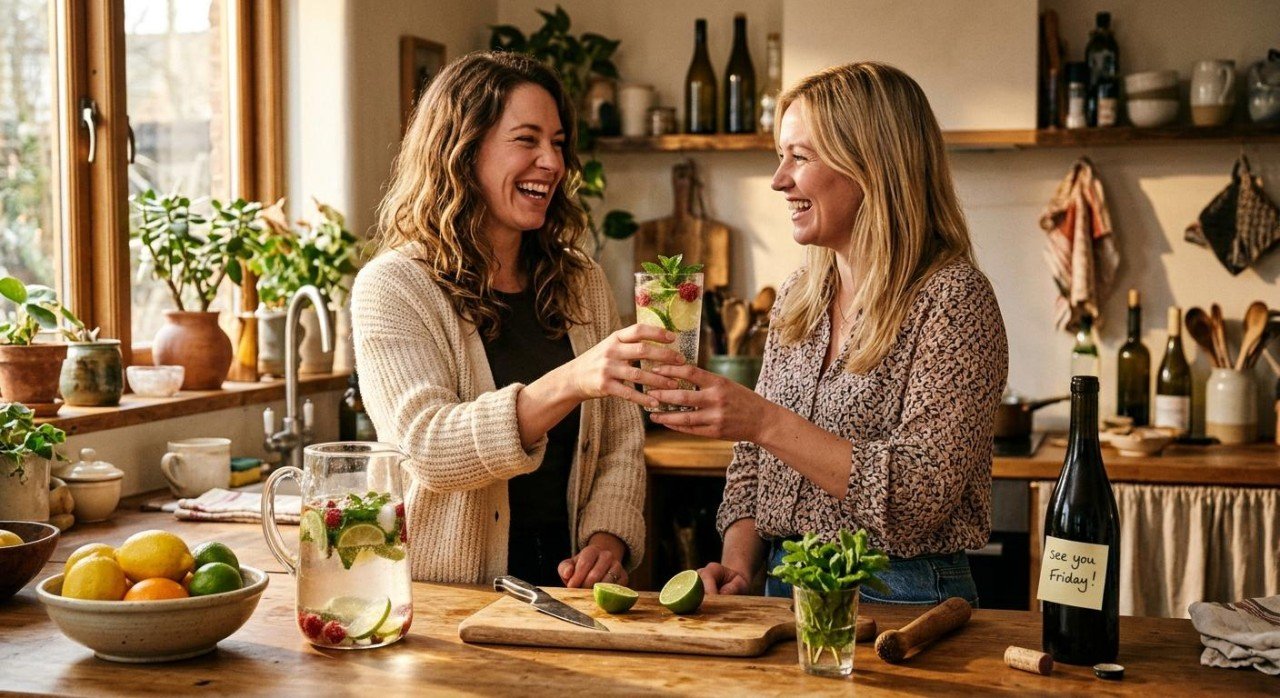
- Sparkling water with real fruit and herbs: muddled berries with mint, cucumber with lime, or grapefruit with a sprig of rosemary. It looks like a cocktail and costs pennies.
- A splash of tart juice in soda water: a couple of ounces of tart cherry, pomegranate, or cranberry juice topped with sparkling water gives you color and bite with a fraction of the sugar of a full glass of juice.
- Shrubs (drinking vinegars): a spoonful of fruit-and-vinegar syrup in sparkling water has the sharp, grown-up edge that a lot of people miss from wine.
- Iced or hot herbal tea: hibiscus, ginger, or chamomile makes a good evening wind-down, especially if your goal is better sleep.
- Kombucha: tangy and fizzy, though it can contain small amounts of alcohol and varying sugar, so read labels. We dug into the claims behind the fizzy gut drink trend in Prebiotic Sodas: Gut Health or Marketing Fizz?
Making It Easier to Stick With
Cutting back is mostly a planning problem disguised as a willpower problem. A few practical moves help:
- Pick your drink-free days in advance instead of deciding each evening. A decision made on Sunday is easier to keep than one made at 6 p.m. on a Wednesday.
- Put your alternatives on the shopping list. If the sparkling water, limes, and herbal tea are already in the fridge, they become the easy default.
- Plan dinners you look forward to. A lot of evening drinking is filling the gap of a "meh" dinner or a stressful scramble about what to cook. A satisfying, planned meal takes some of the pull away.
- Watch what replaces the drink. If the 9 p.m. glass of wine turns into a 9 p.m. bag of chips, the calorie and blood sugar math doesn't change much.
This is where Eat Well Planner can quietly do some heavy lifting. Build a weekly meal plan with dinners you're genuinely excited about, and the shopping list is generated automatically — just add your sparkling water, citrus, and tea while you're at it. The food diary lets you log what you eat (by voice, if you'd rather not type) so you can see how your evenings actually look once the drink is gone, and the Nutrition Score on each recipe helps make sure the meals replacing those empty calories are pulling their weight on fiber, protein, and micronutrients.
The Bottom Line
When you cut back on alcohol, the first changes are usually in your sleep, often within days. Over a few weeks you take in fewer empty calories, and in moderate-to-heavy drinkers, one month off has been linked to meaningful drops in insulin resistance, blood pressure, cholesterol, and liver enzymes. Over the long haul, cancer risk falls too, though slowly.
How much you'll notice depends heavily on how much you were drinking. If that was a couple of glasses a week, expect subtle changes — better sleep on the nights you skip — rather than a dramatic transformation. If it was a couple of drinks every night, the research suggests your body has a lot to gain, and it starts responding faster than you might think.
You don't have to quit forever to benefit. Choose some alcohol-free days, stock your fridge with drinks you actually enjoy, and plan meals that make the evening feel like a treat on their own. If you want help with that last part, try planning your week with Eat Well Planner — it's free.