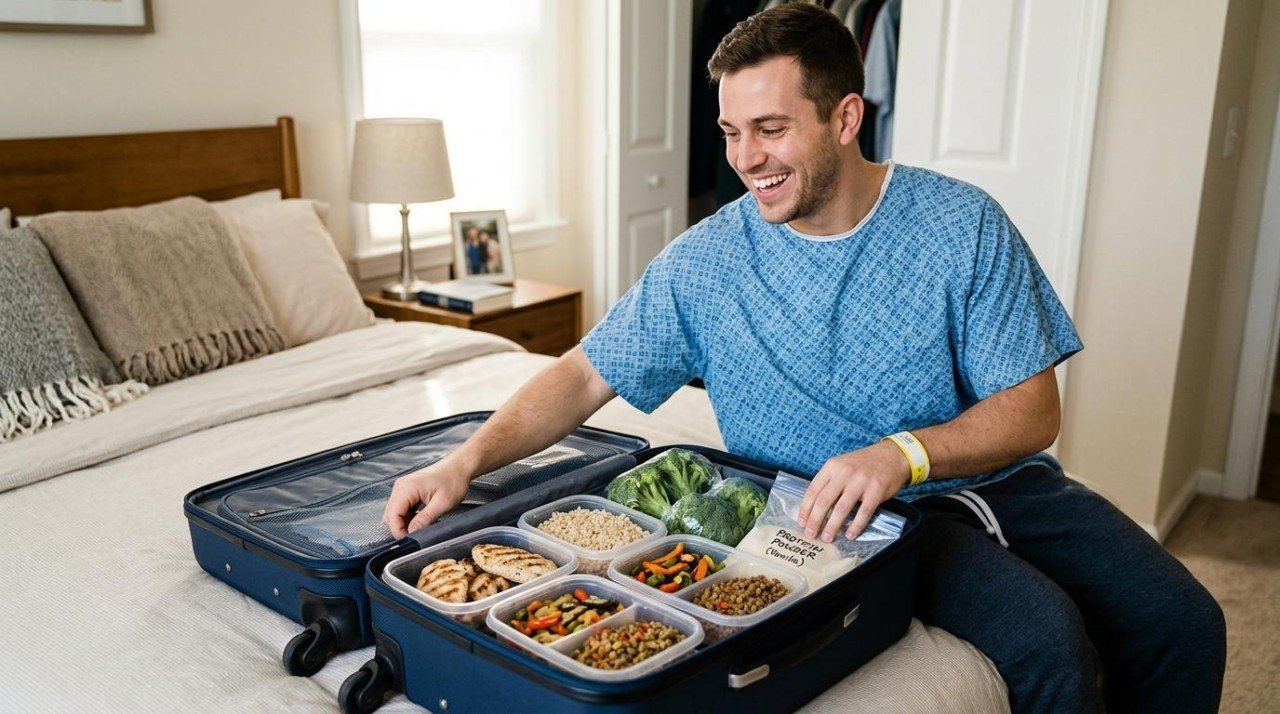
Most of us prepare for surgery by filling out forms, arranging a ride home, and maybe stocking the freezer with something easy. What almost nobody does is prepare their body. Yet a scheduled operation — a knee replacement, a hysterectomy, a hernia repair, a gallbladder removal — is a planned physical trauma. Your tissues have to knit themselves back together, your immune system has to fend off infection, and your muscles have to hold up through days or weeks of reduced movement. All of that runs on nutrients.
The encouraging part is that surgery is one of the few medical events you can genuinely see coming. You usually have weeks of notice — a window to go in stronger and come out steadier. Here is what the evidence actually says about eating to heal, laid out across the practical arc: the weeks before, the hard first days after, and the recovery stretch that follows.
Why surgery raises the nutritional stakes
After an operation, your body shifts into a stress state. It breaks down muscle to supply amino acids for healing, inflammation ramps up, and appetite often craters at exactly the moment your needs are highest. The current ESPEN guideline on clinical nutrition in surgery (2025 update) — the main European clinical consensus, spanning 44 recommendations — is blunt about the risk: "malnutrition and underfeeding are risk factors for postoperative complications." Going into surgery undernourished, or failing to eat enough afterward, is associated with more infections, slower healing, and longer hospital stays.
The flip side is the opportunity. The nutrients your body draws on to repair a surgical wound are the same ones you can bank ahead of time and keep supplying afterward. You do not need a special "surgery diet" or a cabinet full of supplements — mostly you need more of the good, ordinary stuff, eaten deliberately.
Protein is the headline
If you remember one thing, make it protein. Wound healing, immune function, and muscle preservation all depend on it, and surgical needs are well above everyday recommendations. The standard adult RDA is 0.8 grams of protein per kilogram of body weight per day. After surgery, ESPEN puts the target at roughly 1.5 grams per kilogram per day to preserve muscle mass and support recovery — nearly double.
For a 155-pound (70 kg) adult, that is about 105 grams of protein a day. And here is the sobering reality: in a study of patients after major abdominal surgery, actual intake averaged just 0.61 g/kg/day — only 41% of the recommended amount — and 90% of patients fell short of the target. The gap between what recovery requires and what people actually eat is enormous.
Closing it does not mean living on protein shakes. Real food, spread across the day in roughly 25-to-30-gram doses, does the job:
- Three eggs at breakfast (about 18 grams) alongside Greek yogurt (around 17 grams per cup)
- A 3-ounce chicken breast, salmon fillet, or serving of canned tuna at lunch (about 22 to 26 grams)
- Cottage cheese, a glass of milk, or a handful of edamame between meals
- Lentils, beans, tofu, or ground meat at dinner
Spreading protein across every meal and snack matters more than loading it all at dinner, because your body can only use so much at once for muscle repair. If appetite is poor and solid food is hard, that is when a protein shake or high-protein oral supplement earns its place — as a backup to hit the target, not the whole plan.
The weeks before: prehabilitation and the "window of opportunity"
The idea that you should optimize your nutrition before surgery — not just after — has a name: prehabilitation. Researchers describe the presurgical stretch as a "window of opportunity to enhance the individual's resilience", building a buffer of physical reserve to draw on when the surgical stress hits. The logic is simple: it is easier to hold onto muscle and nutrient stores you already have than to rebuild them while injured and inflamed.
The payoff shows up in outcomes. A 2025 network meta-analysis of 27 trials and 2,946 colorectal cancer surgery patients found that multimodal prehabilitation — combining exercise, nutrition, and stress management — was the only approach that significantly reduced postoperative complications (odds ratio 0.47) and shortened hospital stays by more than a day, while improving how far patients could walk before surgery. Notably, nutrition or exercise alone did not move the needle nearly as much as the combination.
This matters most for older adults, where the starting point is often worse than anyone realizes. Sarcopenia — age-related loss of muscle mass and strength — is common and frequently underdiagnosed, affecting an estimated 1% to 29% of community-dwelling older people and up to 33% in long-term care. Someone can look perfectly healthy, even carry extra weight, and still walk into surgery with depleted muscle reserves and inadequate protein intake. For healthy older adults, the same research recommends at least 1.0 to 1.2 g/kg/day of protein; for those at risk of malnutrition, 1.2 to 1.5 g/kg/day. The weeks before surgery are the time to hit those numbers, not the week after.
The building blocks of new tissue: vitamin C and zinc
Protein supplies the raw material for repair, but a few micronutrients act as the tools that assemble it. Vitamin C is a required cofactor for the enzymes (prolyl and lysyl hydroxylase) that build and cross-link collagen — the scaffolding your body lays down to close a wound. Without enough of it, fibroblasts simply cannot produce sturdy connective tissue. Zinc plays a parallel role in protein synthesis, cell division, and immune defense.
Here is the honest nuance, though: correcting a deficiency clearly helps healing, but megadosing these nutrients when you are already well-nourished has not been shown to speed recovery. The same systematic review notes that promising results in animal models "do not replicate" in human clinical trials to date, and very high doses of vitamin C may not be benign. The takeaway is not to buy the biggest bottle — it is to make sure you are genuinely getting enough from food:
- Vitamin C: bell peppers, citrus fruit, strawberries, kiwi, broccoli, and tomatoes
- Zinc: beef, shellfish (oysters are especially rich), pumpkin seeds, chickpeas, cashews, and yogurt
A colorful, plant-heavy plate with adequate protein covers both without any pills. If your surgeon or dietitian identifies a specific deficiency, that is a different conversation — but for most people, food is the reliable route.
Iron: the one to check before you go in
If your operation carries a risk of meaningful blood loss, iron deserves attention weeks ahead of time. Preoperative anemia is strikingly common — it affects roughly a third of patients undergoing major surgery (about 39% in one large meta-analysis), and nearly two-thirds of those cases are iron-deficiency anemia. It is not a trivial finding: preoperative anemia is associated with more transfusions, higher rates of infection and acute kidney injury, longer hospital stays, and increased mortality.
The good news is that it is treatable, and the fix works best with lead time — international consensus recommends treating iron-deficiency anemia ideally 3 to 4 weeks before surgery. This is exactly why preoperative bloodwork exists. Iron-rich foods (red meat, lentils, beans, spinach, fortified cereals) support your stores, and pairing plant sources of iron with vitamin C improves absorption — but if you are actually anemic, food alone is usually not enough or fast enough. Ask your surgical team whether your hemoglobin has been checked and whether iron supplementation or an infusion is warranted. This is a medical decision, not a DIY one.
The first days after: small, protein-dense, and easy
Modern surgical care has moved away from the old "starve before, starve after" approach. Enhanced Recovery After Surgery (ERAS) protocols now favor eating and drinking sooner, and ESPEN emphasizes that "early oral feeding is the preferred mode of nutrition for surgical patients." But willpower rarely matches the science in those first days — nausea, fatigue, and a flat appetite are the norm.
The strategy for this stretch is to make every bite count rather than eating more volume. Think small, frequent, protein-dense, and gentle:
- Greek yogurt, cottage cheese, and kefir
- Scrambled eggs, soft omelets
- Blended soups with added lentils, beans, or shredded chicken
- Smoothies with milk or yogurt, nut butter, and fruit — easy to sip when chewing feels like effort
- Oatmeal made with milk, topped with nut butter
This is where planning ahead pays off the most. When you are exhausted and sore, the meals that get eaten are the ones already in the freezer or already on the list. Batch-cooking protein-rich soups, stews, and portions before your surgery date turns "I can't face cooking" into "I just need to reheat this."
Take the Guesswork Out of Eating Well
Eat Well Planner helps you organize your favorite recipes, plan balanced meals, and automatically generate shopping lists — all in one place. Whether you're tracking macros, managing dietary restrictions, or just trying to stop asking "what's for dinner?", we've got you covered.
Our AI-powered tools can adapt any recipe to your dietary needs, help you discover new meals you'll love, and even log your nutrition effortlessly. It's meal planning made simple.
Start Organizing Your Meals — FreeThe recovery weeks: keep the protein up, and mind the fiber
Healing does not stop when you leave the hospital. Protein needs stay elevated for weeks as your body rebuilds tissue and reverses the muscle loss that comes with reduced activity. Keep hitting those spread-out protein targets even as your appetite returns.
There is also a distinctly unglamorous problem to plan for: constipation. If you are prescribed opioid pain medication, this is not a maybe — opioid-induced constipation affects an estimated 40% to 60% of patients taking these drugs. Opioids slow the gut, increase fluid absorption from the intestine, and harden stool. Combined with reduced movement and dehydration, it is a recipe for genuine misery on top of an already tough recovery.
The non-medication backbone of prevention, per the clinical literature, is dietary fiber, fluid, and gentle movement. Aim for the general 25-to-30-grams-of-fiber-a-day range from fruits, vegetables, legumes, and whole grains — prunes, pears, berries, beans, and oats are classic helpers. One important caveat: fiber only works with enough water. Bumping up fiber (especially bulk fiber supplements) without drinking plenty of fluid can actually make constipation worse. And because opioids are a strong trigger, ask your surgical team in advance about starting a stool softener proactively rather than waiting for a problem — food helps, but it may not be enough on its own here.
What to clear with your surgical team
Nutrition around surgery is one area where "more is better" is exactly the wrong instinct, and where your surgical team's instructions override everything in this article. A few non-negotiables:
- Fasting instructions always win. If your team tells you when to stop eating and drinking, follow that to the letter — it is an anesthesia safety issue. That said, the rules are more humane than they used to be: modern ERAS guidance generally allows solid food up to about 6 hours and clear fluids up to about 2 hours before surgery, and often recommends a carbohydrate drink beforehand rather than a long fast. A meta-analysis of 43 studies and 2,609 patients found preoperative carbohydrate loading modestly shortened hospital stays compared with fasting. But never freelance this — do exactly what your specific team instructs.
- Tell them about every supplement you take. Several common ones increase bleeding risk during surgery. UT Southwestern's surgical guidance lists garlic, ginkgo, ginseng, and vitamin E among supplements to stop — many surgeons advise pausing them (along with high-dose fish oil) roughly one to two weeks before an operation. Others, like St. John's wort and kava, interfere with anesthesia. Bring a complete list of everything you take, including vitamins and herbal products.
- Ask about iron and protein specifically. If you are anemic or at risk of malnutrition, your team can order the right tests and, if needed, prescribe iron or refer you to a dietitian well before the date.
Putting it on a plate
Reading a list of targets is easy; hitting 105 grams of protein a day while nauseated and sore is not. The difference between good intentions and actual recovery nutrition almost always comes down to planning — deciding what you will eat before you are in the thick of it, and having it ready to go.
This is exactly the kind of situation Eat Well Planner is built for. You can plan and batch-cook your recovery weeks in advance — building a week of protein-rich, fiber-friendly meals and generating an organized shopping list so the ingredients are in the house before your surgery date. The nutrition tracking and food diary make the elevated protein target concrete instead of a guess: you can see whether you actually hit 105 grams today, even when appetite is low and every meal feels like a negotiation. Each recipe's nutrition score and "good source of" highlights make it easy to spot the protein-dense, fiber-rich options at a glance, and the meal-prep tools turn a pre-surgery cooking session into a guided checklist rather than a scramble. For the recovery weeks, tracking your plant and fiber intake — through tools like Plant Points — helps keep things moving when opioids are working against you.
Surgery asks a lot of your body. The weeks around it are a rare, predictable chance to give it the raw materials to heal well — a little protein-forward planning now can mean a smoother, stronger recovery later. Talk to your surgical team, and get your kitchen ready before you get your date.
This article is for general information and is not medical advice. Always follow the specific guidance of your surgeon, anesthesiologist, and care team, especially regarding fasting, supplements, and any prescribed nutrition plan.