There's a particular kind of quiet that settles in when you're stirring a pot of sauce on a Sunday afternoon. The radio's on, the kitchen smells like garlic and tomatoes, and for once your brain isn't running its usual loop of deadlines and unanswered messages. It just feels good — not in a vague, self-help-poster way, but in a way you can actually feel in your shoulders.
For a lot of people, though, cooking is the opposite of that. It's the 6 p.m. scramble, the fridge that contains four sad ingredients and no plan, the mental math of what everyone will and won't eat. When cooking is a chore you're behind on, calling it "therapy" sounds a little precious.
Both things are true, and the difference between them is not personality. It's conditions. There is real psychology behind why making dinner can steady your head — and there are real reasons it sometimes does the opposite. Let's take the science seriously, and then talk about how to tilt the odds toward the good version.
It's not just you: cooking fits a proven mental-health template
One of the most established behavioral treatments for depression is deceptively simple. It's called behavioral activation, and the core idea is that when people feel low, they withdraw from activity, which removes the small rewards and sense of momentum that ordinarily keep mood afloat — which makes them feel worse, which makes them withdraw more. Behavioral activation breaks that spiral by deliberately scheduling structured, meaningful, rewarding activities back into the day.
This isn't a fringe idea. A meta-analysis of 20 studies with more than 1,300 participants found behavioral activation produced a moderate, statistically robust improvement in well-being (an effect size of 0.52) compared to control conditions, with similar benefits for people with and without elevated depression symptoms. Larger clinical trials have found behavioral activation can hold its own against full cognitive behavioral therapy for depression.
Cooking fits the template almost perfectly. It's structured (there are steps, in order). It has a clear beginning and end. It produces a visible, usable result. And it gently pulls you into contact with something rewarding — warmth, smell, taste, and often other people. No one is claiming a stir-fry is a substitute for treatment. But if you've ever felt fractionally more like yourself after making a meal instead of ordering one, that's not your imagination. It's the same mechanism clinicians use on purpose.
The mastery effect: you finished something you can see
Modern life is full of work that never visibly ends. You answer the emails and more arrive. You clear the to-do list and it regenerates overnight. Psychologists talk about self-efficacy — your felt sense that you can act on the world and produce a result — and a lot of us are quietly starved of it.
A meal is the antidote precisely because it's finite and concrete. You started with raw ingredients; twenty minutes later there is a real dinner on a real plate that you made. That small, complete arc of "I set out to do a thing and the thing exists now" is a hit of competence you rarely get from a spreadsheet.
The research on cooking programs points the same direction, if modestly. A 2018 systematic review by researchers at the National Institutes of Health screened 377 studies and found 11 that met their criteria; across them, cooking interventions were associated with positive influences on self-esteem, confidence, socialization, and mood. The authors were careful — the evidence base is still preliminary, with small samples and few randomized designs — but the pattern that keeps showing up is that watching yourself produce a finished dish builds a sense of "I can do this," and that feeling generalizes.
Clinical settings are starting to use this deliberately. In one pilot study of 45 psychiatric inpatients — most of them being treated for depression — a single three-hour cooking workshop led to significant improvements in mood, sadness, hopelessness, and tiredness (all at p < 0.001 for overall mood). Ninety percent said they'd do it again. One workshop. That's how immediate the "I made something" lift can be.
Why chopping quiets a racing mind
The other half of cooking's effect is about attention. Anxiety and rumination are, mechanically, attention problems — your mind is time-traveling into the future or relitigating the past, running scenarios that aren't happening right now.
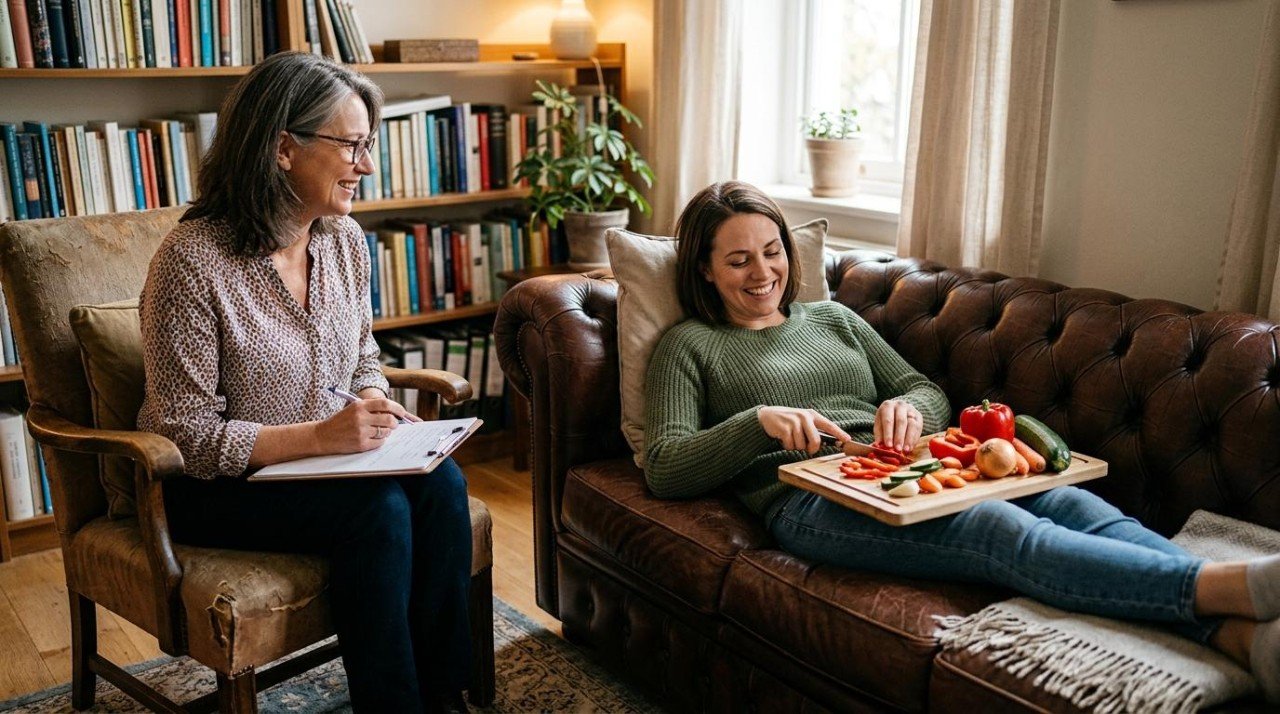
Cooking is unusually good at yanking attention back to the present because it demands your senses. You have to watch the onion so it doesn't burn, feel when the dough stops sticking, smell when the spices bloom, hear the pan change pitch as it heats. This is why occupational therapists and some mental-health programs use kitchen tasks as structured, grounding activities: chopping and stirring act as anchors for attention in the same way the breath does in formal meditation, except the task itself keeps pulling you back so you don't have to work at it.
You don't need to call it mindfulness for it to function like it. When your hands are busy and your senses are occupied with something concrete, there's simply less bandwidth left over for the worry loop. A repetitive, low-stakes task — kneading, peeling, whisking — is close to ideal: engaging enough to hold you, easy enough that you can let your guard down.
There may even be a creative dividend that outlasts the cooking itself. In a study that followed more than 650 young adults through 13 days of daily diaries, people who did more everyday creative activities than usual on one day reported more enthusiasm and "flourishing" — a sense of meaning, energy, and engagement — the next day. The researchers didn't isolate cooking specifically, but they list it among the small, hands-on creative acts worth building into a week. A weeknight dinner isn't a symphony, but improvising with what's in the fridge is a genuine creative act, and apparently your brain files it as one.
The double dividend: the meal feeds the brain that made it
Here's where cooking does something no other coping strategy can. Going for a run helps your head, but it doesn't leave a plate of food behind. Cooking helps your head and produces the thing that feeds the brain doing the coping. The activity and its output both point the same way.
That second half matters more than it used to, because the field of nutritional psychiatry has spent the last decade building real evidence that what you eat shapes how you feel. The landmark study is the 2017 SMILES trial, the first randomized controlled trial designed to test whether improving diet could treat depression. Sixty-seven adults with moderate-to-severe depression were split into two groups; one received support from a dietitian to adopt a modified Mediterranean diet over 12 weeks, the other received an equal amount of social support. By the end, about a third of the dietary group (32%) had reached remission, compared with 8% of the control group. The takeaway isn't "food cures depression" — it's that the quality of what you eat is a genuine, modifiable lever on mental health, not a footnote.
The catch is that eating this way — more vegetables, legumes, whole grains, fish, olive oil, and fewer ultra-processed foods — mostly requires cooking. You can't order a modified Mediterranean diet through an app in one tap. The activity that's good for your head on a Sunday afternoon is also the mechanism that gets those brain-supporting foods onto your plate the rest of the week. Cook, and you collect both dividends at once.
The honest caveat: cooking under pressure is not therapy
All of this comes with a large asterisk, and pretending otherwise would be exactly the wellness-fluff this topic deserves better than.
Cooking is restorative when it's low-stakes and unhurried. It is emphatically not restorative when you're doing it exhausted, running late, with a toddler melting down at your ankles, no idea what you're making, and half the ingredients missing. Under those conditions cooking is just another source of stress — the pot boils over, you snap at someone, and the whole thing confirms your suspicion that cooking is a chore to be survived.
The difference between "kitchen therapy" and "kitchen ordeal" usually isn't the cooking. It's everything wrapped around it: the deciding, the missing ingredient that forces a second store trip, the time panic, the sense that you're improvising under a clock. Those are the parts that spike stress. The chopping and stirring — the part that's actually good for you — gets buried underneath them.
So the goal isn't to romanticize cooking. It's to strip away the stressful scaffolding so the genuinely restorative part is what's left.
How to make cooking feel restorative again
A few adjustments do most of the work:
- Lower the stakes. Not every dinner is a performance. On a hard day, beans on toast with a fried egg and some greens is a complete, nourishing meal and nobody is grading you. Save the ambitious recipe for a day you actually have the energy to enjoy it.
- Do one thing at a time. The therapeutic version of cooking is single-tasking. If you're cooking while on a work call, refereeing homework, and doom-scrolling between stirs, you've kept the labor and thrown away the calm. Put the phone in another room and let the task have you.
- Set the scene. Music or a podcast on, decent lighting, a clean-ish counter to start. Small environmental cues tell your nervous system this is downtime, not another sprint.
- Keep a short list of easy wins. Have a handful of five-ingredient, low-effort meals you can make half-asleep. On low days you want recipes that ask almost nothing of your decision-making.
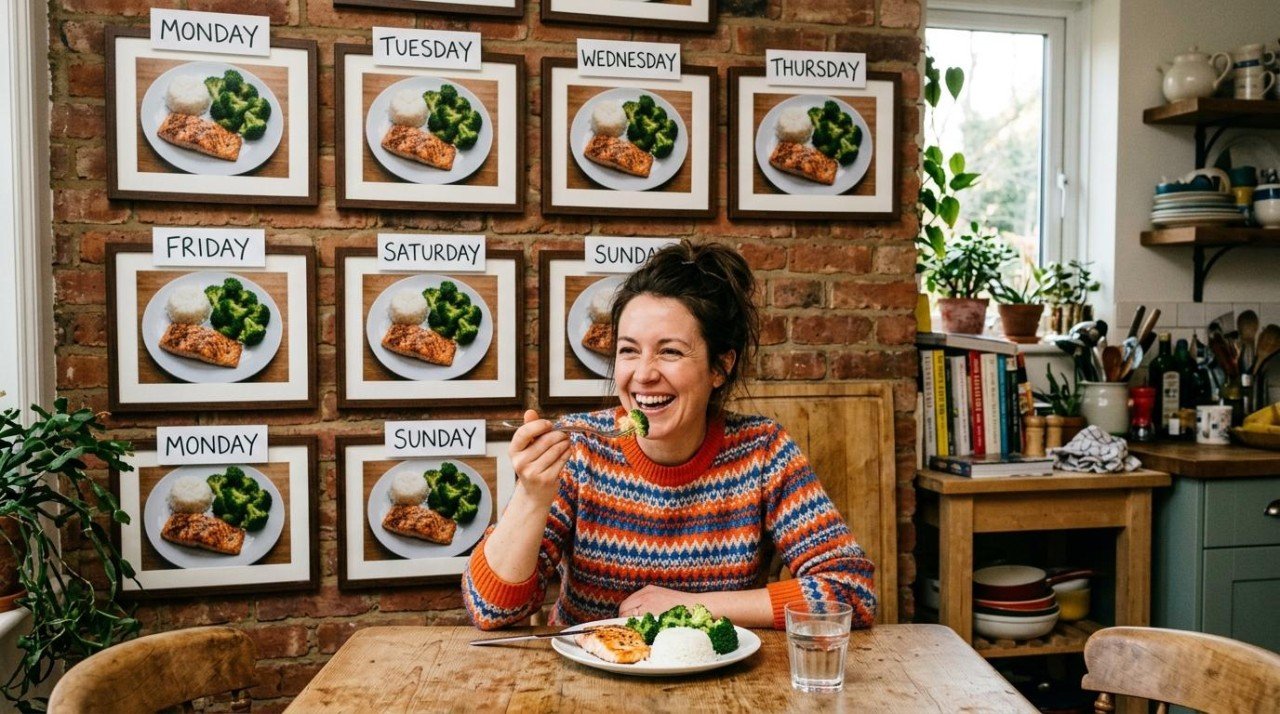
- Decide before you're hungry and tired. Almost all the stress of weeknight cooking is front-loaded into the moment you're standing in the kitchen at 6 p.m. with no plan. Move the deciding and the shopping to a calmer moment, and the actual cooking gets to be the nice part.
That last point is the whole game, and it's worth dwelling on. The reason cooking so often feels like a chore is that we ask ourselves to plan, decide, shop, and cook all at once, while stressed and depleted. Separate those jobs and cooking transforms. When the week's meals are already chosen and the ingredients are already in the fridge, standing at the stove stops being a problem to solve and becomes something closer to what it was on that Sunday afternoon — a task with a beginning, a middle, and a warm, edible end.
This is exactly the friction Eat Well Planner is built to remove. You can save recipes from anywhere — a website, an Instagram reel, a YouTube video — into one organized recipe book, then let the app build a balanced weekly meal plan and turn it into a single, organized shopping list automatically. The deciding, the "what's for dinner," the did-we-run-out-of-garlic panic — the app absorbs the stressful scaffolding so that when you finally get to the kitchen, the only thing left is the cooking itself. And because it scores each recipe's nutrition and can suggest verified swaps to make a meal healthier, the food you're cooking is quietly feeding your brain, too — the double dividend, handled.
Take the Guesswork Out of Eating Well
Eat Well Planner helps you organize your favorite recipes, plan balanced meals, and automatically generate shopping lists — all in one place. Whether you're tracking macros, managing dietary restrictions, or just trying to stop asking "what's for dinner?", we've got you covered.
Our AI-powered tools can adapt any recipe to your dietary needs, help you discover new meals you'll love, and even log your nutrition effortlessly. It's meal planning made simple.
Start Organizing Your Meals — FreeMaking dinner, on purpose
None of this means you have to love cooking, or that a good roast will fix a hard season of life. If you're struggling with your mental health, cooking is a support, not a substitute for real help.
But it's a support with unusually good credentials. It's a structured, rewarding activity of the kind clinicians prescribe for low mood. It hands you a small, visible win when the rest of your day refuses to end. It anchors your attention in your senses when your mind wants to spin. And it produces, as a bonus, the kind of food that a decade of nutritional-psychiatry research suggests actually helps your brain.
The trick is to protect the good part from the stressful parts around it. Lower the stakes, cook one thing at a time, put some music on, and — most of all — do your deciding and your shopping when you're calm, so the cooking itself gets to be the reset it's capable of being. Then stir the pot, and let it.