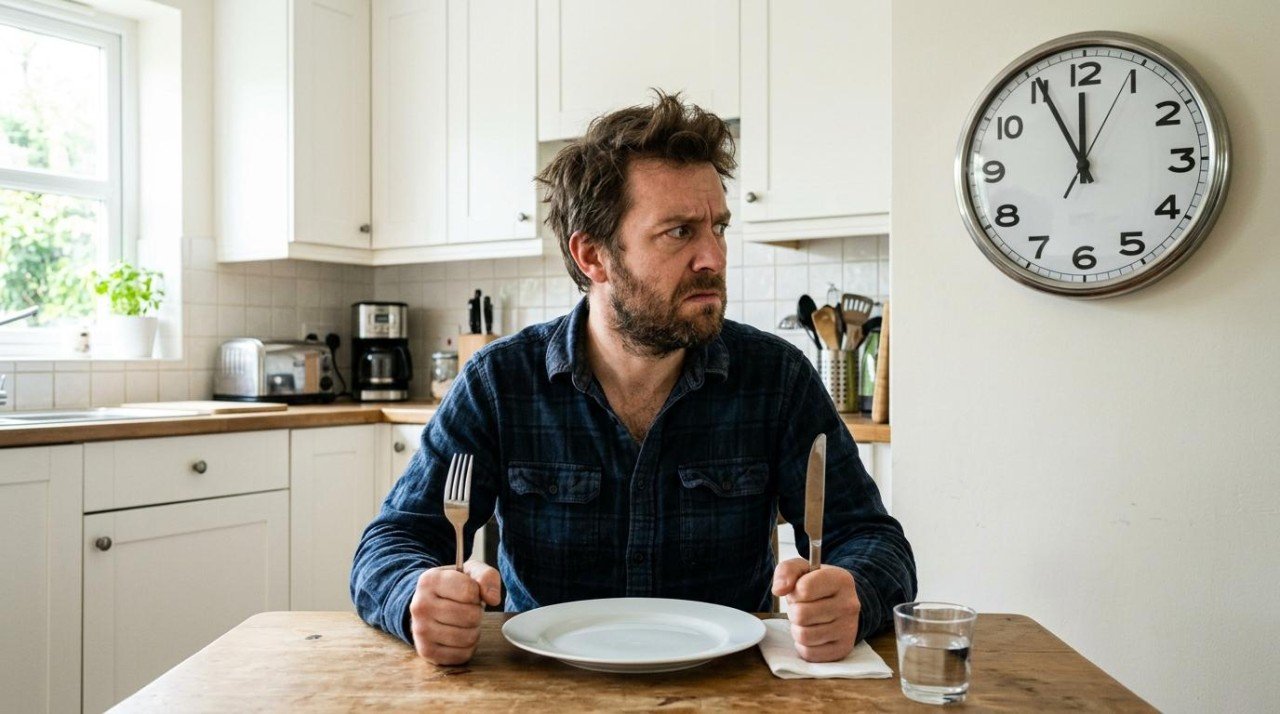
Somewhere along the way, a lot of us picked up the same piece of advice: eat five or six small meals a day to "keep your metabolism stoked." The image is appealing — your body as a wood stove, and every little snack a fresh log that keeps the fire roaring. Skip a meal and the flames die down; graze all day and you burn hotter. It sounds intuitive, it's been repeated by trainers and magazines for decades, and it's the reason a lot of people nibble from breakfast until bedtime even when they're not especially hungry.
Here's the problem: the metabolic part of that story doesn't hold up. When researchers actually measure what happens when people eat the same number of calories spread across many small meals versus a few larger ones, the needle on total calorie burn barely moves. Meal frequency is not a metabolism lever. Worse, for some people, constant grazing quietly makes eating harder to manage — they never feel fully satisfied, they snack on autopilot, and they lose track of how much they've actually eaten.
Let's walk through what metabolism really is, why the "small meals stoke the fire" idea took hold, what the science says, and how to build an eating rhythm that fits your actual appetite and schedule instead of a myth.
What "metabolism" actually means
Your metabolism is just the sum of all the energy your body uses in a day, and it has three main parts. The biggest by far is your basal metabolic rate (BMR) — the energy it takes to keep you alive at rest: pumping blood, breathing, running your brain, maintaining body temperature. For most people, this is roughly 60% of the calories you burn, and you have very little day-to-day control over it.
The second piece is physical activity — everything from a structured workout to fidgeting, walking to the mailbox, and standing instead of sitting. This is the most variable part and the one you can genuinely influence.
The third piece is the thermic effect of food (TEF), sometimes called diet-induced thermogenesis. This is the energy your body spends digesting, absorbing, and processing what you eat. According to Rutgers Cooperative Extension, TEF usually accounts for about 10% of the calories in a mixed, balanced diet — so out of a 2,000-calorie day, you might spend around 200 calories just handling the food itself.
The whole "small meals boost metabolism" idea lives entirely inside that 10% slice. And as we'll see, slicing your food into more pieces doesn't make the slice bigger.
The thermic effect of food is proportional, not magical
Here's the key fact the myth gets wrong. The thermic effect of food is proportional to how much you eat. A bigger meal produces a bigger thermic bump; a smaller meal produces a smaller one. The percentage stays roughly the same regardless of how you divide your daily total.
Run the math and the myth falls apart almost immediately. As Healthline's review of meal-frequency research lays out, eating six 500-calorie meals and eating three 1,000-calorie meals both total 3,000 calories — and at an average TEF of about 10%, you burn roughly 300 calories processing food either way. Six small thermic bumps or three larger ones, the sum is the same. You don't get extra credit for adding more eating occasions; you just spread the same effect across the day.
The International Food Information Council puts it the same way: the temporary metabolic boost from eating is directly proportional to how much and what type of food you consume, so three larger meals produce a similar overall effect to six small ones. They also point out that the 2020 Dietary Guidelines Advisory Committee reviewed the evidence and found it insufficient to link meal frequency with body composition or obesity risk at all.
One nuance worth knowing: what you eat changes TEF more than how often you eat. Protein has by far the highest thermic effect — it raises metabolism by roughly 15–30% of the protein calories consumed, compared with about 5–10% for carbohydrates and just 0–3% for fat, per the Rutgers figures. So a protein-rich plate genuinely costs your body a little more to process than a buttery, refined-carb one of the same calorie count. That's a real lever. The number of times you sit down to eat is not.
What the studies actually found
This isn't just theory — researchers have tested it directly, including in tightly controlled settings.
Back in 1991, a study published in the American Journal of Clinical Nutrition fed people the same total calories either as one large meal or split into multiple small meals and measured their thermic response. Dividing the food into more frequent small meals did not increase the total thermic effect of food — if anything, the larger, concentrated meal produced a slightly greater thermogenic response. Splitting calories into more eating occasions simply did not buy extra burn.
Zoom out to long-term outcomes and the picture is the same. A 2015 meta-analysis by Schoenfeld, Aragon, and Krieger pooled 15 studies on eating frequency and body composition. At first glance the data hinted that eating more often was linked to less fat — but when the researchers ran a sensitivity analysis, that entire signal came from a single outlier study. Remove it, and the apparent benefit of frequent meals vanished. Their conclusion was to interpret any body-composition advantage of frequent eating "with circumspection" — scientist-speak for "don't bank on it."
A more recent systematic review and meta-analysis of randomized trials, published in 2023, compared restricted eating (three or fewer meals a day) with unrestricted eating (four or more) across 16 trials. The verdict was blunt: "There was no discernible advantage to eating in a high- or low-frequency dietary pattern for cardiometabolic health." Weight, BMI, fat mass, blood glucose, insulin, triglycerides, cholesterol — none of it meaningfully favored eating more often. The authors couldn't recommend either pattern over the other for metabolic health.
The takeaway across decades of research is consistent: when total calories and food quality are held steady, how many times you eat them just doesn't move your metabolism in any way that matters.
One thing that does matter: regularity
There's an interesting wrinkle here. While the number of meals doesn't reliably change your metabolism, the consistency of your eating pattern might.
In a crossover trial published in the British Journal of Nutrition, healthy lean women ate either a regular pattern (six meals a day, on schedule) or an irregular one (anywhere from three to nine meals, varying day to day) with similar average calorie intake. After the irregular pattern, the thermic effect of food was significantly lower than after the regular pattern. The researchers suggested that chaotic, unpredictable eating may actually reduce the energy spent processing food over time.
That's a meaningful distinction from the grazing myth. The benefit, if there is one, comes from predictability — your body seems to handle food more efficiently when meals arrive on a reasonably consistent rhythm — not from cramming in as many eating occasions as possible. A steady three or four meals at roughly the same times beats erratic all-day nibbling that changes every day.
Why grazing all day can quietly backfire
So if frequent small meals don't hurt your metabolism, what's the harm? For plenty of people, nothing — if it genuinely suits them. But grazing has some real-world downsides that have nothing to do with metabolic rate and everything to do with how humans actually behave around food.
- You never feel truly full. Small snacks often aren't substantial enough to flip the body's fullness switches, especially if they're light on protein and fiber. Protein is the most satiating macronutrient, and a 200-calorie handful of crackers does far less to quiet hunger than a 600-calorie plate built around protein, vegetables, and whole grains. Graze on small bites and you can spend the whole day pleasantly un-full, always a little hungry, always thinking about the next nibble.
- Snacking becomes mindless. When eating is a near-constant background activity, it stops being a decision. You reach for food out of boredom, habit, or proximity rather than hunger. Distinct meals create natural start and stop points; a steady drip of snacks erases them.
- It's much harder to track what you ate. Three or four defined meals are easy to recall and account for. A dozen little grazing moments — a few nuts here, a couple of crackers there, a bite of someone's leftovers — add up invisibly. Most people dramatically underestimate the calories from grazing precisely because no single instance feels like "a meal."
- It can keep blood sugar bouncing. Constant eating means your digestive and insulin response rarely gets a quiet stretch. Structured meals, especially ones anchored by protein and fiber, tend to produce steadier energy and fewer of the crash-and-crave cycles that drive more snacking.
None of this means snacking is bad. A well-built snack at a genuine hunger point is completely fine. The trouble is eating constantly on the false promise that it's revving your metabolism — when really it may just be leaving you under-satisfied and harder to keep track of.
The fix isn't a rigid rulebook. It's matching your eating to your real hunger and your real schedule. And that's a lot easier when your meals are planned in advance instead of decided in the moment.
Take the Guesswork Out of Eating Well
Eat Well Planner helps you organize your favorite recipes, plan balanced meals, and automatically generate shopping lists — all in one place. Whether you're tracking macros, managing dietary restrictions, or just trying to stop asking "what's for dinner?", we've got you covered.
Our AI-powered tools can adapt any recipe to your dietary needs, help you discover new meals you'll love, and even log your nutrition effortlessly. It's meal planning made simple.
Start Organizing Your Meals — FreeWhat actually supports a healthy metabolism
If meal timing is a dead end, where should your energy go? The levers that genuinely matter are less exciting than a clever eating schedule, but they're the ones that work:
- Build and keep muscle. Muscle is metabolically active tissue, so more of it nudges your resting metabolic rate up. Strength training and adequate protein are the real "metabolism boosters" — not snack timing.
- Move more throughout the day. Since activity is the most variable slice of energy expenditure, this is where you have the most leverage. Walking, taking the stairs, standing, and general everyday movement add up far more than people expect.
- Prioritize protein and whole foods. Because protein carries the highest thermic effect and the strongest satiety punch, building meals around it gives you both a small metabolic edge and better appetite control. Fiber-rich vegetables, fruits, legumes, and whole grains round it out and keep you full longer.
- Mind the total, not the schedule. Total daily intake and overall food quality are what shape your weight and health — not whether that food arrived in three deliveries or seven.
Finding a meal rhythm that fits you
Here's the freeing part: since meal frequency is mostly metabolically neutral, you get to choose whatever pattern actually fits your appetite and your life. Some people feel best with three solid meals and no snacks. Others do better with three meals plus a planned afternoon snack to bridge a long gap before dinner. A few genuinely prefer smaller, more frequent eating — and that's fine too, as long as it's a deliberate choice, not a reaction to never feeling full.
The questions worth asking aren't "how many meals burns the most calories?" but rather:
- When am I actually hungry, and when am I just eating out of habit?
- Does my eating pattern leave me satisfied, or constantly half-hungry?
- Does it fit realistically around my workday, my family, and my energy levels?
- Is it consistent enough day to day that I'm not winging every meal?
Answer those honestly and you'll land on a rhythm that beats any one-size-fits-all rule.
This is exactly where a little planning pays off. When your meals are decided in advance, you eat on a rhythm that fits your hunger and schedule instead of grabbing whatever's nearby the moment a craving hits. Eat Well Planner is a free app built to take the guesswork out of that. You can save and organize recipes from anywhere — a website, an Instagram reel, a YouTube video — and its AI builds a balanced weekly meal plan from the foods you actually like to eat, structured around real meals rather than all-day grazing.
Because each recipe comes with a full nutrition breakdown, it's easy to make sure your meals are anchored by enough protein and fiber to keep you genuinely full between them — the thing that quietly does more for appetite than any snacking schedule. The auto-generated shopping list means the right ingredients are already in your kitchen, so reaching for a planned, satisfying meal becomes the path of least resistance instead of defaulting to a handful of whatever's in the cupboard. And if you want to see how your eating pattern is actually playing out, the food diary lets you log meals — by voice, if you like — so a day of real meals is easy to track in a way a dozen scattered nibbles never is.
The bottom line
Eating small meals all day will not "stoke your metabolic fire." The thermic effect of food is proportional to how much you eat, so dividing the same calories into more meals just spreads the same metabolic effect thinner — it doesn't add to it. Decades of studies, from controlled thermic-effect experiments to recent meta-analyses of randomized trials, keep landing in the same place: meal frequency is not what drives your metabolism or your weight.
What does the work is the boring, durable stuff — total intake, food quality, protein, muscle, and daily movement — plus a reasonably consistent eating rhythm that leaves you satisfied. So stop watching the clock and counting your eating occasions. Eat real meals when you're genuinely hungry, build them around foods that fill you up, and let go of the grazing-for-metabolism myth for good.
Ready to plan meals around your real hunger and schedule instead of a metabolism myth? Try organizing your meals with Eat Well Planner — it's free to start.