If you have ever tried to lose weight, you have probably gotten the same advice on repeat: eat less. Smaller portions. Fewer calories. More willpower. And if you have ever tried to eat less, you also know how that story usually ends — hungry by mid-morning, irritable by mid-afternoon, and elbow-deep in the snack cabinet by 9 p.m.
Here is the part nobody mentions: the problem usually is not your willpower. It is your menu. Two meals can have the exact same number of calories and leave you feeling completely different — one keeps you satisfied for hours, the other leaves you hunting for more within the hour. Once you understand why, you can stop fighting your appetite and start working with it. The goal is not to eat less food. It is to eat food that does more for you per calorie.
Why "Eat Less" Backfires
Appetite is not a character flaw you can override indefinitely. It is a biological signaling system, and it is very good at its job. When you simply cut portions of the same foods you already eat, you get smaller meals that are just as easy to overeat later — because nothing about those foods changed how full they make you feel. You are relying on conscious restraint to fight an unconscious drive, and the unconscious drive does not get tired.
This is why so many calorie-cutting diets feel like white-knuckling through the day. The deprivation is real, and so is the rebound. A more durable approach flips the question. Instead of "how do I eat less of these foods?", ask "which foods make me feel full on fewer calories?" That property has a name, and researchers have actually measured it.
Satiety Per Calorie: The Metric That Actually Matters
Back in 1995, researchers at the University of Sydney ran a now-classic experiment. They fed people identical 240-calorie portions of 38 different common foods, then tracked how full each one made them feel over the next two hours and how much they ate afterward. They used white bread as the baseline and gave it a score of 100, then ranked everything else against it. They called it the Satiety Index.
The results were striking. Calorie for calorie, the foods varied enormously in how full they left people. Boiled potatoes topped the chart at 323 — more than three times as filling as white bread, and about seven times as filling as the food at the bottom of the list, the humble croissant at 47. Same calories. Wildly different fullness. The foods that scored highest tended to share three traits: they were higher in protein, higher in fiber, and higher in water content. The foods that scored lowest were energy-dense, fatty, and easy to eat quickly.
This is the core idea behind eating smarter instead of eating less. If you build your meals around high-satiety foods, you naturally eat fewer calories — not because you are restricting yourself, but because you genuinely are not hungry. The portion on your plate did the work, so your willpower does not have to.
The Protein Leverage Hypothesis: Why You Keep Eating
So why does protein matter so much for fullness? One of the most compelling explanations comes from Australian researchers David Raubenheimer and Stephen Simpson, who developed what they call the protein leverage hypothesis. The idea is that humans, like many other animals, have a strong, prioritized appetite for protein specifically. We will keep eating until we hit our protein target — even if that means consuming far more total calories than we need to get there.
Picture the implication. If your diet is rich in protein, you hit your protein target relatively quickly and your appetite winds down. But if your diet is diluted with low-protein, calorie-dense foods, your body keeps the hunger signals firing in search of protein, and you overshoot on calories along the way. Protein, in this model, acts like a dial that turns your overall appetite up or down.
This matters more than ever because the modern food supply is engineered in exactly the wrong direction. According to the CDC, ultra-processed foods now make up about 55% of the calories Americans eat — around 53% for adults and nearly 62% for kids and teens, based on the most recent national nutrition survey. These foods tend to be energy-dense and notably low in protein and fiber. In other words, the typical Western plate is practically designed to keep you eating: lots of calories, not much of the nutrient your appetite is actually chasing.
Protein Does Double Duty
The appetite effect of protein is not just theory. In a tightly controlled study published in the American Journal of Clinical Nutrition, researchers had participants increase protein from 15% to 30% of their calories while keeping carbohydrates constant. Then they let people eat as much or as little as they wanted. Without being told to cut back, participants spontaneously ate about 441 fewer calories per day and lost an average of nearly 11 pounds over 12 weeks. No portion policing. No calorie counting. They just felt full sooner and stopped.
Protein has a second trick, too. Your body actually burns more energy digesting and processing protein than it does with carbs or fat — a phenomenon called the thermic effect of food. In a frequently cited review, the energy cost of metabolizing protein came in at roughly 20 to 30% of the calories it contains, compared with about 5 to 10% for carbohydrates and just 0 to 3% for fat. A more recent meta-analysis confirmed that protein is the most thermogenic macronutrient, with higher-protein meals producing a measurably bigger calorie burn than lower-protein ones. The effect is modest, but it points in the right direction: more of the calories in a high-protein meal get spent just handling the meal itself.
The practical takeaway is not to chase extreme protein numbers or live on chicken breast. It is simply that most people eating a typical modern diet are running short on protein relative to their calories — and nudging that balance up tends to make hunger easier to manage almost automatically.
The catch is knowing where your gaps actually are. Most people have no idea whether they are getting 60 grams of protein a day or 110, or how much fiber they are really eating. This is exactly where a little tracking changes the game — not to obsess over numbers, but to see the pattern.
Take the Guesswork Out of Eating Well
Eat Well Planner helps you organize your favorite recipes, plan balanced meals, and automatically generate shopping lists — all in one place. Whether you're tracking macros, managing dietary restrictions, or just trying to stop asking "what's for dinner?", we've got you covered.
Our AI-powered tools can adapt any recipe to your dietary needs, help you discover new meals you'll love, and even log your nutrition effortlessly. It's meal planning made simple.
Start Organizing Your Meals — FreeFiber: The Slow-Burn Fullness
If protein is the appetite dial, fiber is the brake on how fast a meal hits you. Fiber adds bulk without adding many digestible calories, it slows down how quickly your stomach empties, and certain types form a gel that keeps food in your system longer. The result is steadier blood sugar and a slower return of hunger after you eat.
It is worth being honest about the nuance here, because the research is not a blanket endorsement of every fiber. A systematic review of soluble fiber supplements found that effects on appetite and calorie intake varied a lot depending on the type and dose — some fibers meaningfully reduced how much people ate, while others did little. The authors concluded that "soluble fibres are not all created equal." The honest reading is that a fiber pill is not a magic bullet.
But whole foods that are naturally high in fiber bring the whole package — fiber plus water plus volume plus, often, protein. That combination is what made beans, vegetables, fruit, and whole grains cluster near the top of the satiety rankings. You do not need to micromanage grams of soluble versus insoluble fiber. You need to eat more of the foods that come with it built in.
Volume and Water: Eat More, Weigh Less
The third lever is the simplest, and arguably the most powerful: energy density, or how many calories are packed into each bite. This is the life's work of Penn State researcher Barbara Rolls, and the central finding is almost too tidy to believe.
People tend to eat a remarkably consistent weight of food day to day, fairly independent of how many calories that food contains. So if you lower the calorie density of what is on your plate — mostly by adding water-rich ingredients like vegetables and fruit — people spontaneously eat fewer calories while eating the same satisfying amount of food. The effect shows up even in young children. Crucially, the water has to be in the food. A glass of water on the side empties from your stomach quickly; water bound up in a soup, a stew, or a pile of roasted vegetables sticks around and contributes to fullness.
This is why a big bowl of vegetable-and-bean chili can leave you more satisfied than a small candy bar with the same calories. One fills your stomach with volume; the other is gone in four bites and barely registers. Eat more food, take in fewer calories — no contradiction, just physics and biology working in your favor.
Concrete Swaps That Cut Calories and Add Fullness
Theory is nice, but this only works if it changes what lands on your plate. The beautiful thing about the satiety approach is that almost every swap is an addition or an upgrade, not a sacrifice. Here are some that put all three levers — protein, fiber, and volume — to work:
- Start with the egg, not the pastry. Trade a croissant or muffin breakfast for eggs with vegetables, or Greek yogurt with berries. You move from the bottom of the satiety chart toward the top, and you front-load protein when it sets the tone for the whole day.
- Make half the plate vegetables before anything else. This is the energy-density lever in one move. The vegetables crowd out denser foods by volume, so you eat a full plate for fewer calories.
- Add beans or lentils to whatever you are already making. Stir them into soups, salads, pasta sauces, and tacos. You get protein, fiber, and volume in a single cheap ingredient.
- Choose the whole version over the refined one. Whole oats over sugary cereal, intact whole grains over white bread, a whole orange over orange juice. The fiber and structure that processing strips out are exactly what slow you down and fill you up.
- Build snacks around protein and fiber. Apple with a handful of nuts, cottage cheese with fruit, hummus with raw vegetables — instead of crackers or chips that vanish without a trace.
- Lead the meal with soup or salad. A broth-based vegetable soup or a simple salad before the main course adds volume up front and tends to reduce how much you eat overall.
- Reach for whole potatoes. The food that topped the satiety index is not exotic. A simply prepared baked or boiled potato is genuinely one of the most filling things you can eat per calorie — it is the deep-fried, ultra-processed versions that flip the script.
Notice what is missing from that list: hunger. None of these swaps ask you to eat less and tough it out. They ask you to eat differently, and the lower calorie intake comes along for the ride.
How to Build a High-Satiety Plate
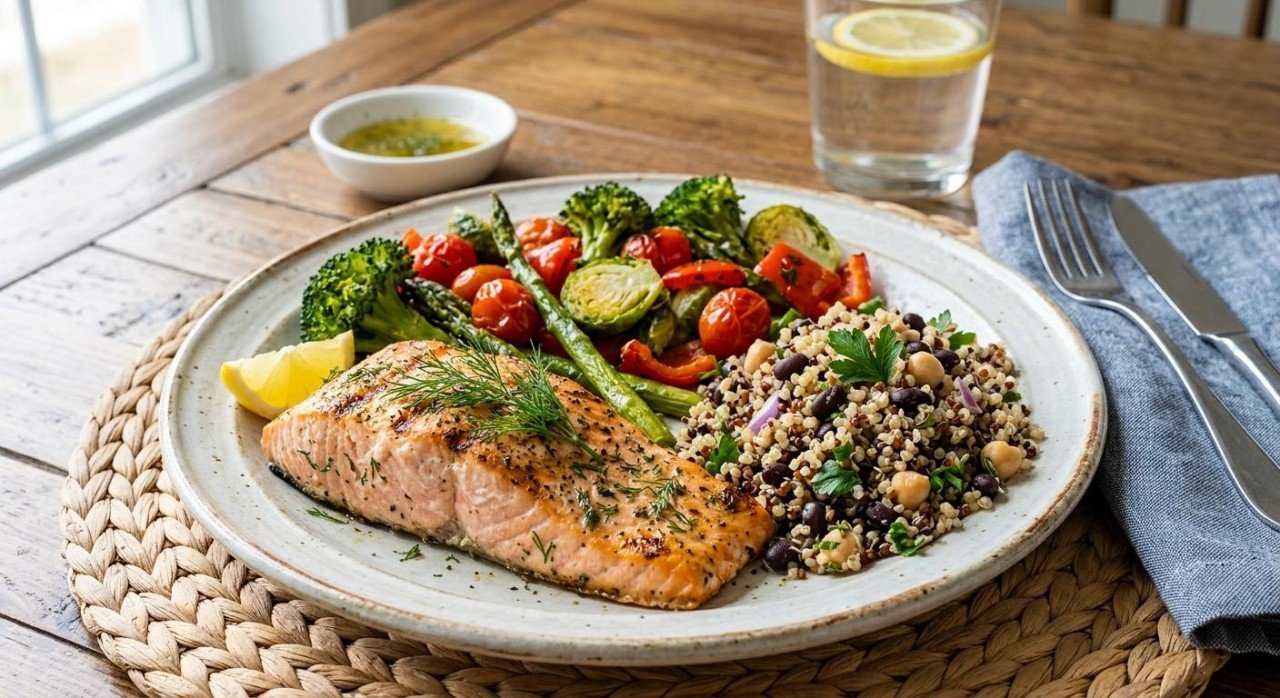
If you want a simple mental template, aim for every main meal to hit three marks: a solid source of protein, plenty of fiber, and real volume from water-rich plants. A piece of grilled fish or chicken (or beans and tofu), a generous pile of vegetables, and a portion of an intact whole grain or potato checks all three boxes. That plate is naturally lower in calorie density, naturally higher in protein and fiber, and naturally more filling than the ultra-processed alternative — without a single number being counted at the table.
The reframe is the whole point. "Eat less" pits you against your own biology and asks you to lose that fight every single day. "Eat this instead" puts biology on your side. When your meals are built from filling, nutrient-dense foods, eating the right amount stops being a battle of willpower and starts being the natural result of feeling satisfied. You are not depriving yourself. You are just giving your appetite what it is actually asking for.
That is the quiet shift behind sustainable weight management: you do not have to want food less. You just have to choose food that wants to fill you up.