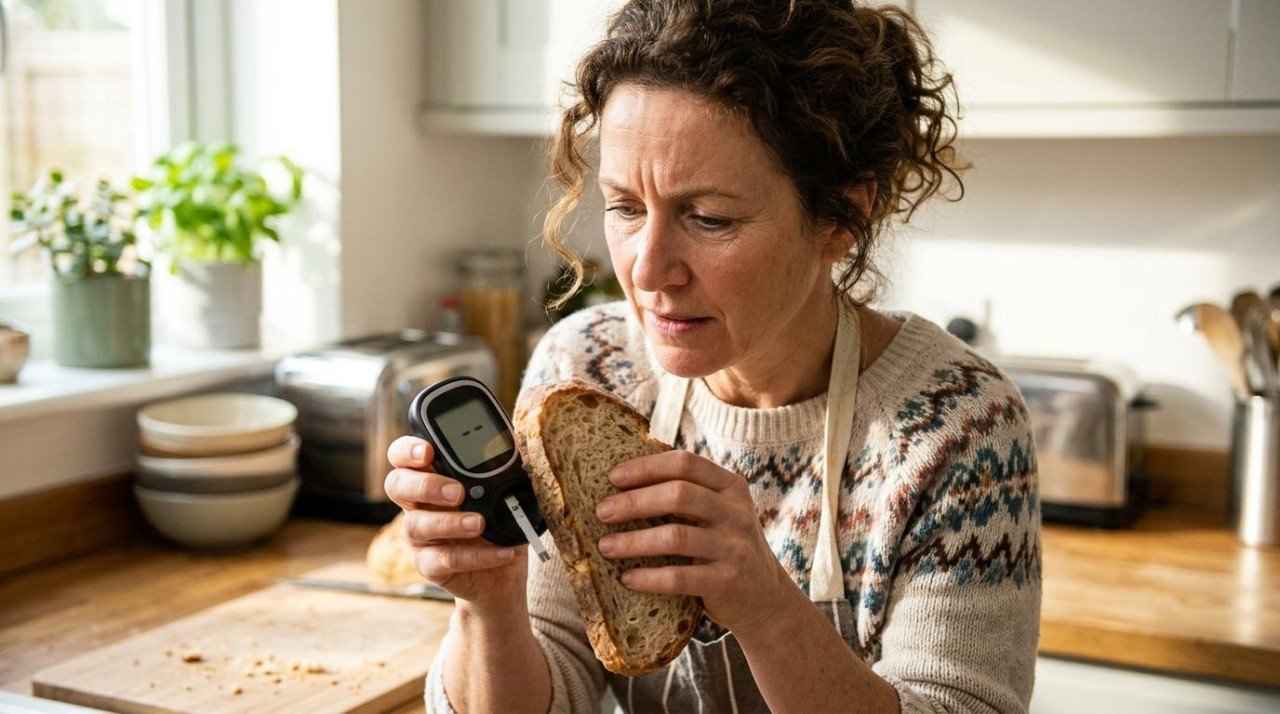
Sourdough has quietly become the darling of the bread world. It shows up in wellness feeds, on restaurant menus, and stacked in the bakery section with a price tag that says "this one is special." And along with the hype comes a specific promise you have probably heard: sourdough is gentler on your blood sugar than ordinary bread. For anyone who loves toast but watches how carbs hit them, that is a genuinely appealing idea.
So does it hold up? Mostly yes — but with more nuance than the headlines admit. Real, slow-fermented sourdough does tend to produce a smaller blood-sugar rise than standard white bread, and there are believable reasons why. But the effect is more modest and less certain than the internet suggests, a lot of the "sourdough" sold in supermarkets is not fermented long enough to earn any of these benefits, and at the end of the day it is still bread. Let's separate what the science actually supports from what got oversold.
What Real Sourdough Actually Is
The difference between sourdough and regular bread is not an ingredient — it is a process. Conventional bread is leavened with commercial baker's yeast, a single fast-acting organism that puffs the dough up in a couple of hours. Sourdough is leavened with a living starter: a stable community of wild yeasts and lactic acid bacteria (the same family of microbes that ferment yogurt and sauerkraut) that the baker keeps alive by regularly feeding it flour and water.
When that starter goes to work in the dough, fermentation runs slowly — often 12 to 48 hours instead of two. Over those long hours, the microbes do three things that matter nutritionally:
- They produce organic acids, mainly lactic acid and acetic acid, which give sourdough its signature tang and drop the dough's pH.
- Their enzymes partially break down starch and gluten proteins before you ever take a bite.
- The acidity activates enzymes that dismantle phytic acid, a compound in whole grains that normally locks up minerals.
Those three changes are the source of nearly every health claim made about sourdough. The catch — and we will come back to this — is that all of them depend on a long, genuine fermentation actually happening. Speed the process up or skip it, and the chemistry never occurs.
The Blood Sugar Question: What the Evidence Shows
Here is the honest version. Several studies do find that authentic sourdough produces a lower glycemic and insulin response than yeast-raised white bread. In one 2023 clinical trial, women — including those with gestational diabetes — got 9.6% less first-hour blood glucose and 45.5% less insulin after eating a whole-grain sourdough breakfast than after a refined white-bread one. That is a meaningful gap.
But notice the confound: that study compared whole-grain sourdough against refined white, so some of the benefit comes from the whole grain, not the fermentation alone. Once you control for that and look across all the research, the picture gets muddier. A comprehensive review in Frontiers in Nutrition found that roughly half of the human studies testing sourdough's effect on glycemic index showed no significant difference versus regular yeast bread. And in a randomized crossover study of overweight and obese men, sourdough was not the winner at all — sprouted-grain bread produced the best glucose and insulin profile, and in one arm of the study sourdough actually produced the highest glucose response of the breads tested.
So the fair takeaway is this: real sourdough tends to be gentler on blood sugar than plain white bread, and it is very unlikely to be worse — but the size of the effect varies a lot with the flour, the recipe, the length of fermentation, and the person eating it. It is a nudge in the right direction, not a magic trick that cancels out the carbs.
Take the Guesswork Out of Eating Well
Eat Well Planner helps you organize your favorite recipes, plan balanced meals, and automatically generate shopping lists — all in one place. Whether you're tracking macros, managing dietary restrictions, or just trying to stop asking "what's for dinner?", we've got you covered.
Our AI-powered tools can adapt any recipe to your dietary needs, help you discover new meals you'll love, and even log your nutrition effortlessly. It's meal planning made simple.
Start Organizing Your Meals — FreeWhy It Works (When It Works)
When sourdough does blunt the glucose response, the organic acids appear to be doing most of the work. Classic research by Swedish scientists Helena Liljeberg and Inger Björck showed that simply adding lactic acid to bread lowered the rate at which its starch was broken down in the gut, and that sourdough baking improved the "nutritional features" of the starch. The leading explanation is that the acids and the acidic conditions encourage starch and acid to form complexes that are physically more resistant to amylase, the enzyme that chops starch into glucose. Slow the breakdown of starch, and glucose trickles into your blood instead of flooding in.
You will also see it claimed that sourdough's acids "slow gastric emptying" — that the food leaves your stomach more gradually, spreading out the glucose hit. There is some evidence for this with certain organic acids, but it is genuinely contested. Other well-designed studies found no difference in gastric emptying at all, and one randomized human trial found that sourdough actually left the stomach faster than baker's-yeast bread — yet still produced a lower blood-glucose peak. In other words, the slower-glucose effect is real in many studies, but "it sits in your stomach longer" is probably not the main reason. The starch chemistry is the sturdier explanation.
Beyond Blood Sugar: Minerals and Digestion
Two other benefits get attached to sourdough, and both are more solid in the lab than in real life.
Better mineral availability
Whole grains contain phytic acid, which binds minerals like iron, zinc, magnesium, and calcium so your body cannot fully absorb them. Sourdough's acidity activates an enzyme called phytase that dismantles a large share of that phytic acid, and test-tube and short-term studies consistently show minerals becoming more available as a result. But a 2026 systematic review in Frontiers in Nutrition delivered a useful reality check: while the mechanism is well established and short-term absorption improves, longer human trials did not reliably translate that into better iron status — in a few, iron markers even dropped. The mineral advantage is real chemistry, but do not count on sourdough to fix a deficiency on its own.
Easier to digest
This one has some of the better everyday evidence. Because lactic acid bacteria partially break down gluten proteins during the long ferment, sourdough arrives in your gut pre-processed. In a double-blind trial of 36 healthy volunteers, traditional long-fermented sourdough was measurably easier to digest than baker's-yeast bread, moving through the system efficiently while delivering a steadier release of amino acids into the blood. Many people who feel bloated after regular bread find genuine sourdough sits better — a plausible effect, not just a placebo.
One critical caveat: this does not make sourdough safe for people with celiac disease. The immune-triggering fragments of gluten are stubbornly resistant to breakdown, and as the Frontiers review flatly noted, there is no evidence that ordinary sourdough is safe for celiac disease or reduces the risk of developing it. "Easier to digest for some" is not the same as "gluten-free." If you have celiac disease, sourdough from a normal bakery is still off the table.
The Part Nobody Tells You: Most Store "Sourdough" Is Fake
Here is where the hype quietly falls apart. Every benefit above depends on a real, slow fermentation by wild yeast and lactic acid bacteria. But because that takes a day or more and careful handling, many commercial bakers cheat: they make ordinary bread with fast commercial yeast and then add vinegar, acids, or "sourdough flavor" to fake the tang. It tastes vaguely sour, but it never underwent the fermentation that lowers the glycemic response, frees up minerals, or pre-digests the gluten. You are paying a premium for white bread in a costume.
The good news is that you can spot the real thing in about five seconds by flipping the loaf over and reading the ingredient list. According to registered dietitian Stephanie Kay, authentic sourdough is almost comically simple:
- What real sourdough contains: flour, water, and salt. That is it. The label may also say "culture," "starter," or "levain," which is just the natural leaven. A genuine loaf can be made from those few things and nothing else.
- Red flags that mean it is not real sourdough: "yeast" or "baker's yeast" in the ingredients; any added sugar or sweetener (real fermentation does not need it); or vinegar, ascorbic acid, or generic "sourdough flavoring" bolted on to fake the tang.
- The shelf-life tell: real food spoils. If the "sourdough" has a best-by date weeks away and a list of preservatives, it was not made the traditional way.
Where you shop matters too. Your best odds of finding true long-fermented sourdough are at a local bakery, a farmers' market, or a specialty shop rather than the mass-produced bread wall — though more real options are showing up in good grocery stores as demand grows. When in doubt, the ingredient list never lies.
It Is Still Bread — Here Is How to Eat It Well
Even the best sourdough is a carbohydrate-rich food, and a big pile of it will still raise your blood sugar. The fermentation softens the response; it does not erase it. So the same sensible habits that help with any bread apply here:
- Mind the portion. A slice or two as part of a meal is very different from half a loaf. The glycemic edge of sourdough is easy to eat right past.
- Never eat it naked. Pairing carbohydrates with protein, healthy fat, and fiber reliably flattens the blood-sugar curve of the whole meal. Sourdough toast with eggs and avocado, or a slice alongside a lentil soup, behaves very differently than toast with jam alone.
- Notice your own response. People react to the same food differently. The bread that suits your body is something you learn by paying attention over time, not from a label claim.
Frame sourdough for what the evidence actually supports: a bread that, when it is the real, slow-fermented thing, is a bit gentler on blood sugar, easier on many people's digestion, and no worse than — and often better than — standard white bread. That is a solid reason to choose it. It is not a reason to treat bread as a health food.
Making the Better Choice the Easy Choice
Knowing that sourdough is gentler on your blood sugar is one thing; actually working it into balanced meals, week after week, is another. That is where a little planning does the heavy lifting. With Eat Well Planner, you can save the recipes you actually eat — sourdough toast breakfasts, grain-and-protein lunches, soups that pair well with a slice — and see the full nutrition breakdown for each, so you can spot at a glance whether a meal has the protein, fat, and fiber to balance out the carbs.
From there, the app builds balanced weekly meal plans from your saved recipes and turns them into an organized shopping list automatically, which makes it far easier to keep genuine, whole-food ingredients in the house instead of defaulting to ultra-processed convenience bread. And if you want to adapt a recipe — swap in more vegetables, add a protein, adjust it for how a food affects you — the built-in AI recipe chat can help you tweak it on the spot. The point is not to obsess over a single slice of bread, but to make the pattern of your week quietly work in your favor.
Sourdough earns a spot on that plate. Just make sure it is the real thing — and give it good company.