Ask a room full of health-conscious people to name the nutrients they pay attention to, and you will hear the usual roll call: protein, fiber, iron, vitamin D, maybe omega-3s. Almost no one says choline. Yet this little-known nutrient sits at the center of how your brain makes memories, how your cells hold themselves together, and how your liver keeps fat from piling up where it should not. It is essential — meaning your body cannot make enough on its own, so you have to eat it — and by most estimates, roughly 9 out of 10 Americans fall short of the recommended amount.
That gap is not because choline is exotic or hard to find. It is mostly because we stopped talking about it. Choline was only formally recognized as an essential nutrient by the National Academies' Food and Nutrition Board in 1998 — decades after vitamins like C and the B-complex became household names. It has been playing catch-up ever since. Here is what it does, why so many of us run low, and how to fix that with food you already recognize.
What Choline Actually Does
Choline is a quiet multitasker. It shows up in several of the body's most fundamental processes, and a shortfall touches each of them.
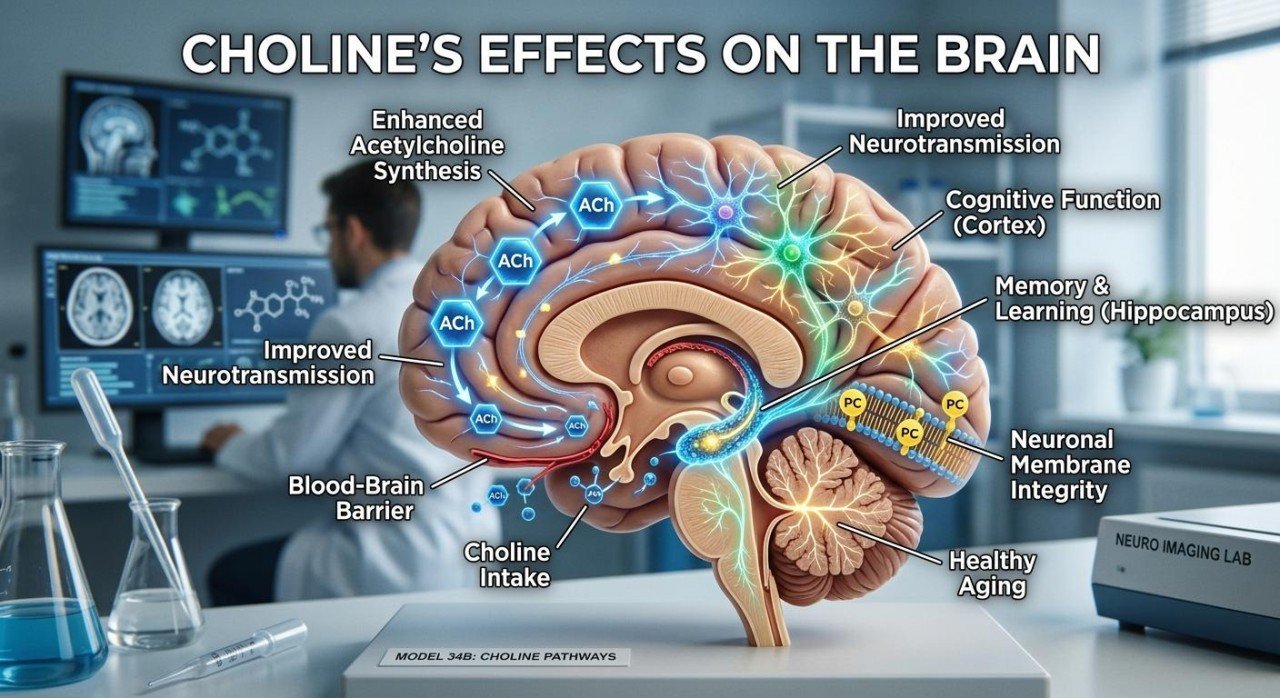
It builds a key memory chemical. Choline is the direct precursor to acetylcholine, a neurotransmitter your brain uses for memory, learning, attention, and mood — and that your muscles use to contract. Researchers note that the cognitive benefits seen with choline have largely been attributed to enhanced cholinergic signaling in the hippocampus, the brain's memory hub. When there is not enough raw material, the body has less to work with for this messaging system.
It helps build every cell. Choline is a backbone ingredient of phosphatidylcholine, a phospholipid that forms part of the membrane wrapping every cell in your body. Without it, cells literally cannot maintain their structure and signaling properly. This is not a niche role — it is foundational maintenance happening trillions of times over.
It is a methyl donor. Choline donates methyl groups, the small chemical tags involved in regulating which genes switch on and off and in clearing homocysteine, an amino acid that, at high levels, is linked to cardiovascular and cognitive risk. It works alongside folate and vitamin B12 in this system, which is part of why choline matters so much during pregnancy, when cells are dividing and differentiating at a furious pace.
It keeps fat moving out of your liver. Choline helps package and export fat from the liver. When intake is too low, fat accumulates where it should not, and this is one recognized contributor to nonalcoholic fatty liver disease. In fact, the recommended intake for choline was set in part using a depletion study: healthy adult men put on a low-choline diet developed signs of liver damage, which reversed once choline was added back.
Why So Many of Us Come Up Short
The numbers are striking. One widely cited analysis found that only about 10% of Americans — and just 8% of pregnant women — meet the recommended intake for choline. The recommendation itself is not extreme: an Adequate Intake of 550 mg per day for men, 425 mg for women, 450 mg during pregnancy, and 550 mg during breastfeeding. Most people simply drift well below it without any idea they are doing so.
A few things drive the gap. First, the richest sources — egg yolks and liver — have spent years in the doghouse over cholesterol fears, so a lot of people quietly cut back on exactly the foods that deliver the most choline. Second, choline rarely appears on nutrition labels, so it is invisible in a way that calories, sugar, and even fiber are not. You cannot manage what you never see.
Some groups run especially low. Premenopausal women average around 319 mg per day, roughly 71% of their target, even though their needs rise sharply if they become pregnant. Vegetarians and vegans tend to be lowest of all — one estimate put average intake among vegetarians near 192 mg per day — because the densest sources are animal foods. And a meaningful slice of the population carries common genetic variations that increase how much choline they need, making a marginal diet more likely to tip into true insufficiency.
The tricky part is that a mild shortfall does not announce itself. You will not feel a "choline deficiency" the way you feel a stubbed toe. The effects are slow and systemic — the kind of thing that only becomes obvious in a lab test or, worse, years down the road. That is exactly why it helps to know roughly where your intake lands rather than assuming a generally healthy diet has it covered.
Take the Guesswork Out of Eating Well
Eat Well Planner helps you organize your favorite recipes, plan balanced meals, and automatically generate shopping lists — all in one place. Whether you're tracking macros, managing dietary restrictions, or just trying to stop asking "what's for dinner?", we've got you covered.
Our AI-powered tools can adapt any recipe to your dietary needs, help you discover new meals you'll love, and even log your nutrition effortlessly. It's meal planning made simple.
Start Organizing Your Meals — FreeCholine and the Developing Brain
If there is one life stage where choline matters most, it is pregnancy. The developing fetal brain draws heavily on choline to build neurons and wire up the hippocampus, and the supply has to come from the mother. This is also the stage where the typical shortfall is most concerning, since the vast majority of pregnant women fall below the target.
The research here has grown genuinely compelling. In a controlled trial run through Cornell, pregnant women who consumed roughly double the recommended amount of choline (about 930 mg per day versus 480 mg) had children who showed faster information processing — with reaction times averaging about 22 milliseconds quicker than children in the comparison group. The researchers described it as among the first randomized human evidence that extra choline during pregnancy can measurably benefit a child's developing attention.
Choline also appears to work hand in hand with omega-3s. A later Cornell study, published in the American Journal of Clinical Nutrition in 2022 and led by nutritional scientist Marie Caudill, found that choline supplementation helped pregnant women's bodies more efficiently release DHA — the omega-3 fat critical for fetal brain and eye development — from the liver into the bloodstream, where it can reach the baby. In other words, getting enough choline may help the omega-3s you eat actually do their job.
None of this means anyone should start megadosing supplements during pregnancy without medical guidance. But it does make a strong case for prioritizing choline-rich foods before and during pregnancy, and for asking your prenatal care provider about it — especially since many standard prenatal vitamins still contain little or no choline.
It Is Not Just for Pregnancy
Choline's brain role does not clock out once you are an adult. In the long-running Framingham Heart Study, researchers tracked the diets and cognition of 1,391 adults aged 36 to 83 and found that those with higher current choline intake performed better on tests of verbal and visual memory. Higher choline intake earlier in life was also associated with less white-matter damage visible on brain scans. It is observational research, so it cannot prove cause and effect, but it fits neatly with everything we know about choline's role in the acetylcholine system.
For most adults, the practical takeaway is simple: getting enough choline is one more modifiable piece of the long game of protecting your brain — alongside sleep, movement, and an overall plant-rich, minimally processed diet.
The Best Food Sources (and How to Hit Your Target)
Here is the good news: closing the choline gap is very doable with everyday foods, and a couple of standouts do a lot of the heavy lifting. Amounts below are approximate per typical serving.
- Beef liver — around 350 mg per 3-ounce serving. Pound for pound, liver is the single densest source on the planet. Even once a week moves the needle dramatically.
- Eggs (with the yolk) — about 147 mg in one large egg. The yolk is where the choline lives, so this is not the place to order an egg-white omelet. Two eggs at breakfast cover a big chunk of the day's target.
- Salmon and other fish — roughly 187 mg per 3-ounce serving of salmon, with the bonus of omega-3s that choline helps your body use.
- Chicken and other poultry — about 72 mg in a 3-ounce chicken breast; chicken liver is far higher, near 247 mg.
- Soybeans — roughly 214 mg per cup of roasted soybeans (edamame), the standout plant source and a key one for vegetarians.
- Beans and legumes — around 54 mg in a cup of cooked kidney beans, plus fiber and plant protein.
- Cruciferous vegetables — broccoli and Brussels sprouts land near 30 mg per serving. Not huge on their own, but they add up across a plant-rich week.
A realistic day might look like two eggs at breakfast (around 290 mg), a chicken or salmon lunch (70 to 190 mg), and a dinner built around beans, tofu, or edamame with cruciferous vegetables on the side. Stack those and you are at or above the target without any exotic shopping. For vegetarians and vegans, soybeans, tofu, edamame, cruciferous vegetables, wheat germ, and beans become the core of the strategy — and it is the one case where a supplement conversation with a clinician is most worth having.
Because choline almost never appears on a food label, the realistic way to know whether you are getting enough is to look at your overall pattern over a week, not to chase a number meal by meal. This is exactly the kind of invisible nutrient where a little planning beats willpower. Eat Well Planner can help you build a week of meals around choline-rich foods you actually enjoy — importing recipes for egg-based breakfasts, salmon dinners, or tofu-and-broccoli stir-fries from anywhere on the web, then turning them into an organized shopping list so the right ingredients are already in your kitchen. Its nutrition tracking and food diary make it easy to see whether lesser-known nutrients like choline are showing up in your week, instead of leaving you to guess. When eating well is already planned and shopped for, hitting a target like this stops being a chore and starts being the default.
The Bottom Line
Choline is one of the most important nutrients almost nobody talks about. It underpins memory and mood through acetylcholine, holds your cells together, helps regulate your genes, and keeps fat from accumulating in your liver — and during pregnancy, it helps build a brand-new brain. Yet roughly 90% of us fall short, largely because the foods richest in it spent years out of fashion and because it hides from nutrition labels.
You do not need a supplement cabinet to fix this. A few eggs, the occasional serving of fish or liver, and a steady rotation of soybeans, beans, and cruciferous vegetables will carry most people past the line. The hardest part is simply remembering to build those foods in — and that is a planning problem, not a willpower one.
Try organizing your meals with Eat Well Planner and make nutrients like choline a built-in part of your week rather than an afterthought.