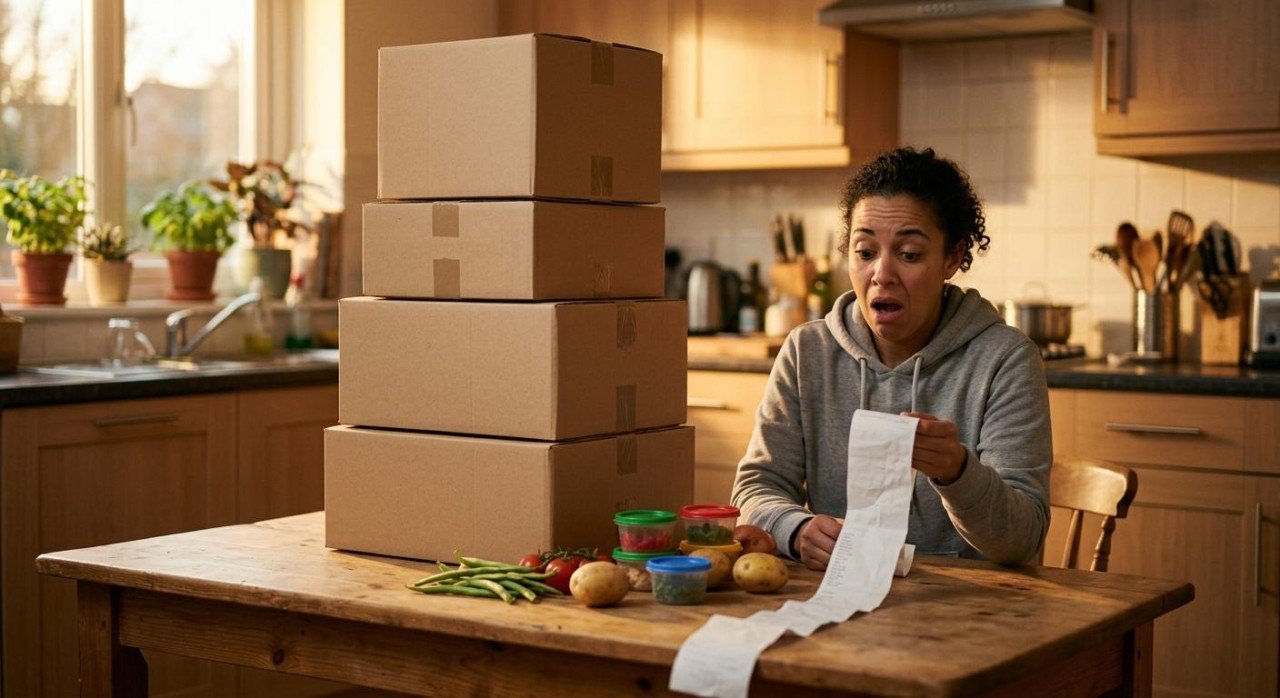
There is a specific moment that makes people question their meal kit subscription. It is not a bad dinner. It is the bank statement, where the boxes stop being three pleasant Tuesdays and start being a number with a comma in it.
So let's do the math honestly. That means giving meal kits real credit for the problems they genuinely solve, correcting the criticism of them that turns out to be mostly wrong, and then looking clearly at what you are actually buying. The conclusion is not that kits are a scam. It is that the most valuable thing in the box is the part that costs nothing to reproduce.
First, the case for meal kits
Meal kits took off because they solved something real. If you have ever stood in front of an open fridge at 6:15 p.m. with no idea what dinner is, you understand the appeal of a box that has already answered the question.
They also do a few things better than most people manage on their own:
- They eliminate the decision. The recipe is chosen, the quantities are right, and there is no scrolling.
- They teach portioning. A lot of subscribers report learning what a reasonable serving of protein or pasta actually looks like, which is genuinely hard to eyeball.
- They build cooking skills. The recipe cards walk you through techniques step by step, and repeated practice builds confidence. In a 2020 randomized controlled trial in Nutrients, adolescents given a short cooking course followed by six weeks of recipe-and-ingredient meal bags improved significantly in cooking self-efficacy, attitude toward cooking, and diet quality compared with a control group -- though a year later, only the confidence gains still held.
- They waste almost nothing. You get two tablespoons of the sauce, not a jar you will find fossilized next spring.
- They displace takeout. For someone whose realistic alternative is delivery four nights a week, a kit is both cheaper and better food.
That last point deserves emphasis, because Americans now spend more eating out than eating in. USDA Economic Research Service data put total US food spending at $2.51 trillion in 2025, of which $1.41 trillion went to food away from home and $1.10 trillion to food at home. If a meal kit moves nights out of the first bucket and into the second, it is doing something useful.
The packaging argument is the weakest one against them
The most common criticism of meal kits is all that plastic: the individually bagged shallot, the tiny tub of honey, the ice packs. It feels indefensible. The research says otherwise.
Researchers at the University of Michigan's Center for Sustainable Systems ran a life-cycle comparison of five two-person meals -- salmon, cheeseburger, chicken, pasta, and salad -- prepared both from a meal kit and from grocery store ingredients. Published in Resources, Conservation and Recycling in 2019, the study found that meal kits averaged 6.1 kg of CO2 equivalent per meal versus 8.1 kg for the grocery store version, roughly 33 percent lower. Emissions tied to household food waste were higher for the grocery meals in all five cases. The pre-portioning, it turns out, saves more carbon than the packaging costs.
It is worth noting the study's assumptions: it modeled a shopper making trips for individual meals and wasting a typical amount of food at home. A disciplined planner who shops once a week and actually uses what they buy closes much of that gap. But the honest takeaway stands. If you want to argue against meal kits, do not lead with the packaging. Lead with the price.
Now the math
Meal kit pricing clusters in a fairly narrow band. As of mid-2026, NerdWallet puts HelloFresh at $10.99 to $12.49 per serving depending on how many meals you order, with shipping and tax on top. When Consumer Reports tested five major services with 30 volunteers, cost per serving on a four-person plan ran from about $6 to $12 before shipping, with budget services like Dinnerly anchoring the low end and premium services like Sun Basket the high end.
Hold that next to what a household actually spends on groceries. The Bureau of Labor Statistics Consumer Expenditure Survey for 2024 found that the average US consumer unit spent $6,224 a year on food at home, with an average household size of 2.4 people. That is about $120 a week, covering every meal and every snack for everyone in the house.
Run the comparison and it gets uncomfortable:
- A three-recipe box for a family of four is 12 servings. At $11 a serving, that is $132 before shipping.
- The average American household spends roughly $120 a week on all of its groceries.
- So three kit dinners can cost more than a typical household's entire weekly food-at-home budget.
- Per person per day, those same BLS numbers work out to about $7 for all food eaten at home. One kit serving is a day and a half of that, for a single meal.
None of this makes a kit irrational. It makes the premium visible. You are paying somewhere in the neighborhood of double for the same dinner, and the extra money is not buying better ingredients. It is buying the decision, the measuring, and the delivery.
The nutrition reality is more mixed than either side admits
Meal kits are often accused of being vegetable-light. The data does not really support that part.
A 2019 analysis in Nutrients examined 12 recipes from each of five meal kit services and found they delivered 2.3 to 3.1 serves of vegetables per serving -- respectable by most dietary guidelines, and better than a lot of what people cook unassisted.
The real issues are sodium and fat. The same analysis found sodium ranging from 723 to 1,426 mg per serving, fat supplying 39.5 to 59.6 percent of energy, and saturated fat between 6.0 and 22.2 grams per serving. Consumer Reports found individual dishes that were worse: a Blue Apron poke bowl at 2,130 mg of sodium per serving, and two HelloFresh recipes at 27 grams of saturated fat each. Their testers also noted that recipe cards routinely instruct you to salt the food several times over the course of one dish.
For context, the FDA sets the Daily Value for sodium at less than 2,300 mg, and Americans already average around 3,400 mg. A single kit dinner at 1,400 mg uses most of the day's headroom. Consumer Reports also found that between a third and two thirds of the recipes they reviewed fell short of a full cup of vegetables per serving, so those encouraging averages hide real variation between individual dishes.
The practical point: a meal kit recipe is a recipe. It deserves the same scrutiny you would give anything else you cook. Some are excellent. Some are a restaurant entree with a nutrition label you did not read.
The subscription is the business model, not a convenience
Here is the part that rarely makes it into the pros-and-cons lists. Meal kits are sold as a subscription because subscriptions earn money from people who are not paying attention.
Economists Liran Einav, Benjamin Klopack, and Neale Mahoney studied automatic renewals across ten subscription products using data from a payment card network covering roughly 30 percent of subscribers. Their finding, published in the American Economic Review, is that cancellations spike sharply in the months when a customer's card is replaced and the renewal suddenly requires an active decision. They estimate that consumer inattention raises seller revenues by between 14 percent and more than 200 percent compared with a world where everyone cancels the moment they stop wanting the product.
Meal kits have a version of this built into the weekly rhythm. You can skip a week, and skipping is genuinely useful -- but it requires you to remember, before a cutoff, on a schedule the company sets. Forget once and a box shows up during the week you were traveling.
The regulatory picture is in flux. The FTC's "click to cancel" Negative Option Rule, which would have required a simple cancellation mechanism for online subscriptions, was vacated by the Eighth Circuit on July 8, 2025 on procedural grounds, days before it was due to take effect. Existing law still applies, and the FTC has moved to revive the rule, but for now the burden of remembering sits with you.
The companies are fairly candid that the model runs on habit. HelloFresh's Q1 2026 results reported orders down 11.6 percent year over year to 24.94 million and meals down 12.1 percent, while average order value rose 4.2 percent -- part of a deliberate strategy of serving fewer, longer-tenured, higher-spending customers. Fewer people are subscribing, and the ones who stay are paying more.
What you are actually paying for is the planning
Strip a meal kit down and the box holds two things: ingredients, and a set of decisions already made. The ingredients you can buy for roughly half the price. The decisions are what you are really paying for -- and they are the part that genuinely works.
That is not just a hunch. In a study of 40,554 adults in the French NutriNet-Sante cohort, researchers found that people who planned meals had greater food variety, better adherence to national dietary guidelines, and lower odds of obesity. Fifty-seven percent of participants planned at least occasionally. The study is observational, so it cannot prove planning causes the difference. But it lines up with what every kit subscriber will tell you: the week goes better when dinner is decided in advance.
Planning is also what prevents waste, which is where the grocery-versus-kit gap really lives. The EPA estimates that 30 to 40 percent of the US food supply is never eaten, and per-person food waste rose from 328 pounds in 2016 to 349 pounds in 2019, moving away from the national goal of cutting it in half by 2030. A kit sidesteps that by portioning for you. A shopping list built from actual recipes does the same thing for free.
So the real question is not "kit or groceries." It is whether you can get the planning without paying the markup for it.
Take the Guesswork Out of Eating Well
Eat Well Planner helps you organize your favorite recipes, plan balanced meals, and automatically generate shopping lists — all in one place. Whether you're tracking macros, managing dietary restrictions, or just trying to stop asking "what's for dinner?", we've got you covered.
Our AI-powered tools can adapt any recipe to your dietary needs, help you discover new meals you'll love, and even log your nutrition effortlessly. It's meal planning made simple.
Start Organizing Your Meals — FreeA four-week plan for leaving your kit
Quitting cold turkey usually fails, because the subscription was covering a real gap. Replace the function first, then cancel.
Week 1: Keep the box, steal the recipes
Do not cancel yet. Instead, save the recipes you have actually liked over the past few months. Most services keep your cooking history in your account. These are proven winners for your household, which is worth more than any recipe you find by searching. Save them somewhere you will find them again -- a recipe app, a folder, anywhere that can turn them into a shopping list.
Week 2: Run a parallel week
Skip one box. Pick three dinners from your saved recipes, build one shopping list from all three at once, and shop it in a single trip. Keep the receipt. That is your real number, and it is usually the moment the decision makes itself.
Two things make the first parallel week go smoothly. Deliberately overlap ingredients: pick three recipes that share an herb, an aromatic, or a protein, so you are not buying a whole bunch of dill for one tablespoon. And prep the way the kit does -- chop and portion when you unpack the groceries, not at 6 p.m. on a Wednesday.
Week 3: Fix the sodium while you are at it
If you are rebuilding the recipes anyway, this is a free upgrade. Salt once at the end rather than at every step, lean on acid and herbs for the flavor the salt was carrying, and add a vegetable to the dishes that were thin on them. Kit recipes are tuned to taste impressive on the first bite. Your version can be tuned for how you feel at 9 p.m.
Week 4: Cancel deliberately
Cancel through your account settings, screenshot the confirmation, and check your next statement. Then put your planning session on the calendar as a recurring 15-minute appointment. That appointment is the thing the subscription was doing for you, and it is the only part you need to keep.
How Eat Well Planner replaces the box
This is precisely the gap Eat Well Planner was built for. You can import the recipes you already like from any website, Instagram reel, or YouTube video, and the AI pulls out the ingredients, instructions, and nutrition automatically -- so the winners from your kit history become your own recipe book. The AI meal planner then builds a week from those recipes based on your profile and goals, and the shopping list generates itself, consolidated and organized, so you make one trip instead of three.
The nutrition side is where you can beat the kit rather than just match it. Every recipe gets a nutrition score, so you can see at a glance whether a dish is as good as it tastes, and Make It Healthier proposes specific ingredient swaps with the nutritional gain verified by a calculator before it suggests them -- useful for exactly the sodium and saturated fat problems the research keeps turning up in kit recipes. If your household is cooking for different needs, multiple profiles let the plan account for that. It is free, and there is nothing to skip before a Wednesday cutoff.
When a meal kit is still the right call
There are situations where paying the premium is a good decision, and pretending otherwise would be dishonest:
- You genuinely do not cook. If your baseline is takeout or cereal for dinner, a kit is an upgrade in both nutrition and cost. Learn on the kit for a few months, then transition.
- You are in a hard season. A new baby, a health crisis, a brutal stretch at work, a recent move. Buying back decision-making capacity for a few months is a legitimate use of money.
- You have limited grocery access. Thin local selection or unreliable transportation changes the math considerably.
- You are breaking a takeout habit. The comparison that matters is against what you were actually doing, not against an idealized version of yourself who shops on Sundays.
What does not hold up is staying subscribed for years out of inertia, skipping half the weeks, and paying restaurant-adjacent prices for groceries you could plan yourself in a quarter of an hour.
The bottom line
Meal kits are not a rip-off, and they are not the environmental villain they get made out to be. They are a well-designed product that solves decision fatigue, and they charge roughly double for the privilege. The nutrition is decent on vegetables and frequently poor on sodium and saturated fat, which means kit recipes deserve the same scrutiny as any other recipe.
The valuable ingredient in the box is not the pre-measured soy sauce. It is the fact that someone decided what you were eating and made sure you had exactly what you needed. That is planning, and planning is free. Build the habit, keep the recipes you loved, and put the difference somewhere better than a subscription you keep forgetting to skip.