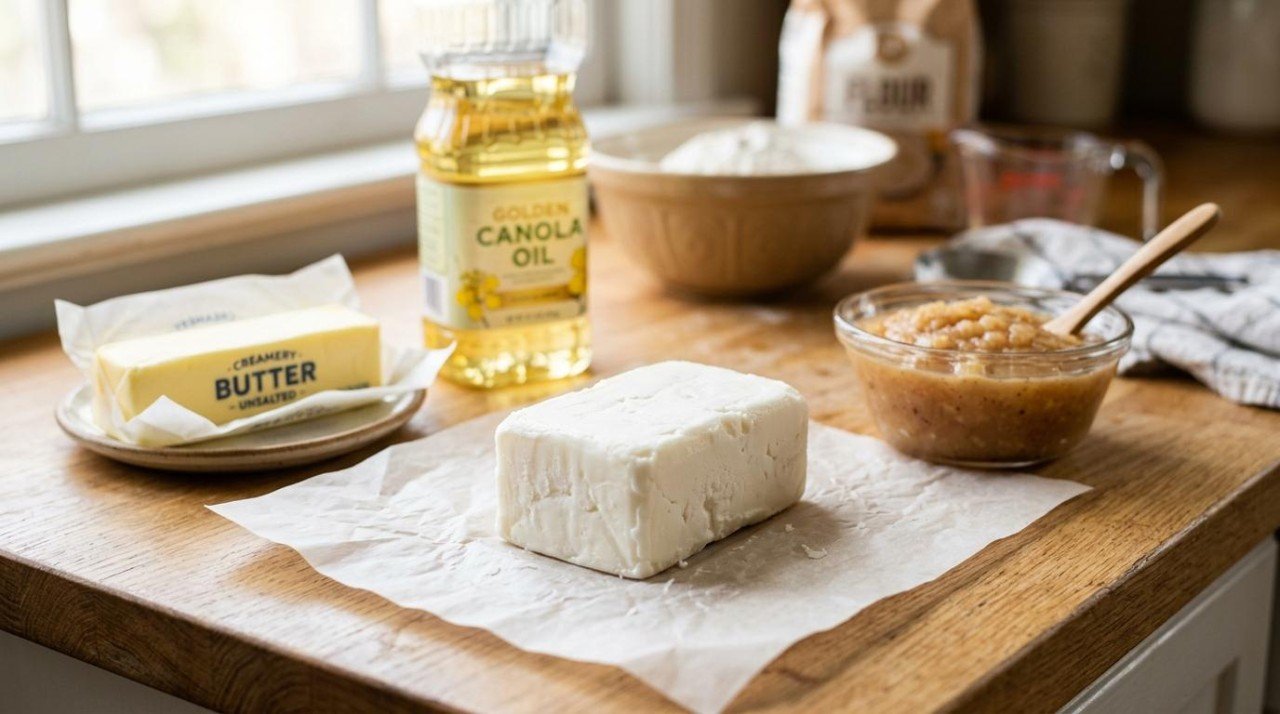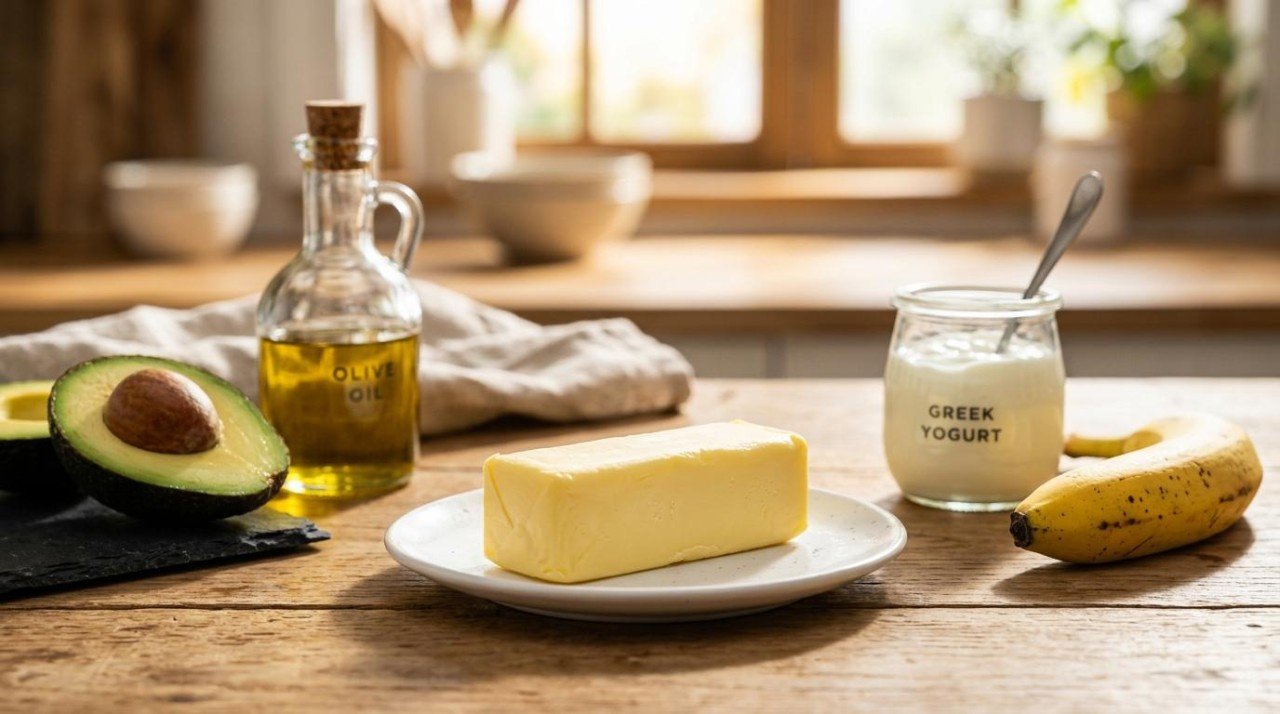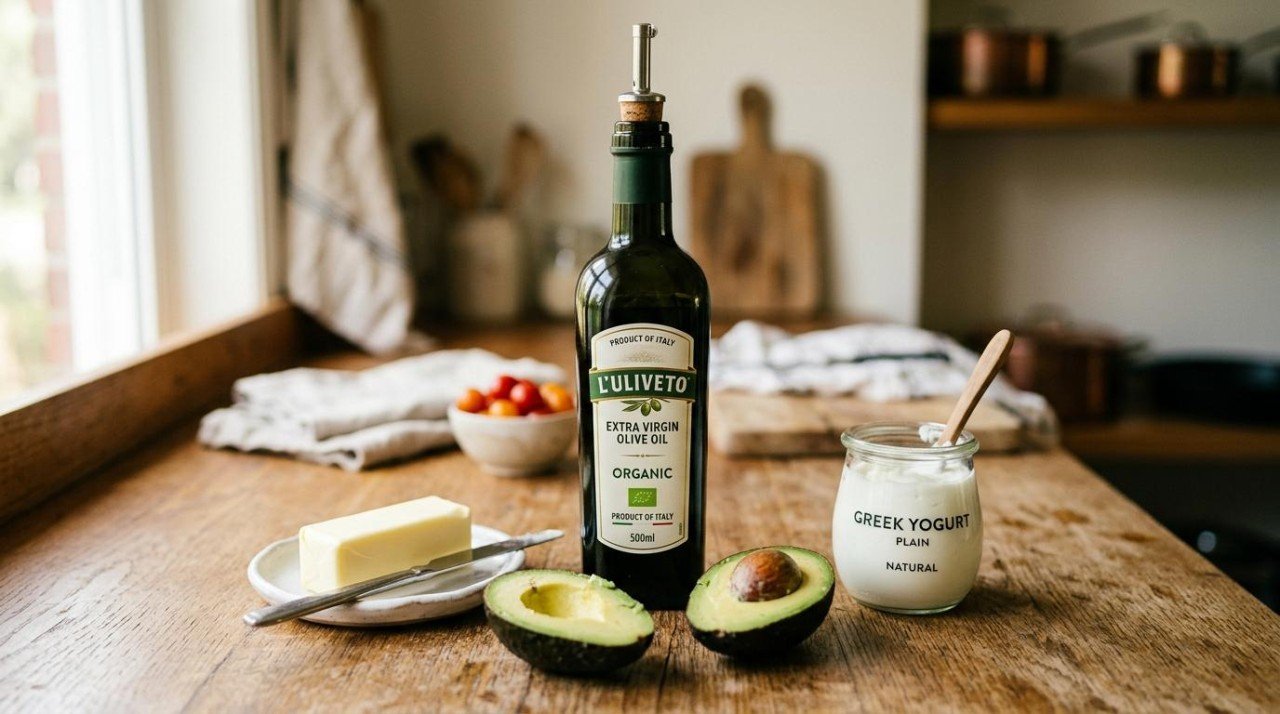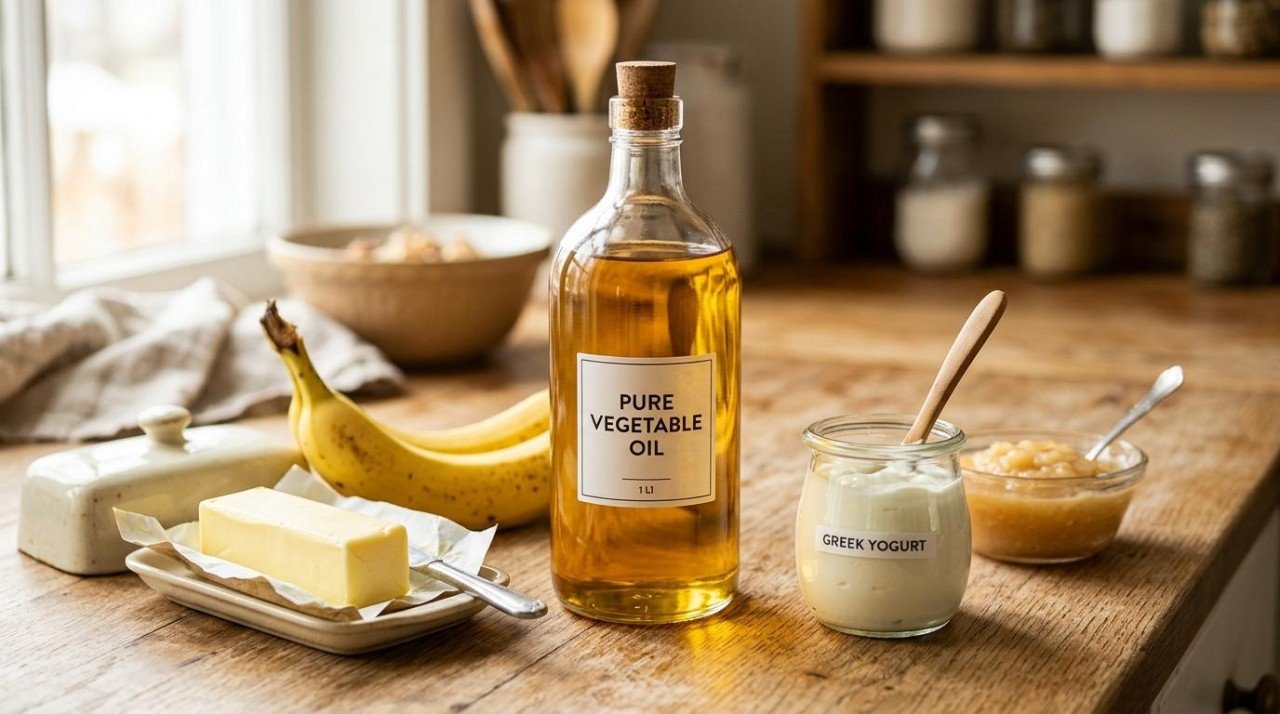
The batter is half-mixed, or the pan is already warming, and the vegetable oil bottle turns out to be empty. It is one of the most common mid-recipe gaps there is — and one of the easiest to fill, because vegetable oil is a neutral, do-nothing fat whose whole job is to add moisture and carry heat without adding flavor.
That neutrality is exactly why the right substitute depends entirely on what you are making. In a cake or a batch of muffins, oil is there for fat and moisture, so anything that provides those — even unsweetened applesauce — can step in. In a hot skillet or a pot of frying oil, what matters is the smoke point, the temperature at which a fat starts to break down and turn bitter, and applesauce is obviously useless there.
So the list below is split by the two jobs vegetable oil does: baking and cooking over heat. Find your situation, grab the swap that fits, and get back to it. Exact ratios and honest trade-offs are included for each.
The Quick List
- Another neutral oil (canola, sunflower, grapeseed) — the simplest 1:1 swap for anything, baking or cooking
- Avocado oil — the best pick for high-heat frying and searing; highest smoke point of any common oil
- Light or refined olive oil — a more monounsaturated swap for sauteing and baking (not extra virgin for high heat)
- Peanut oil — a frying favorite with a high smoke point and faintly nutty character
- Melted butter or ghee — when you want flavor in the pan or a richer bake (ghee for high heat)
- Melted coconut oil — works for baking and moderate sauteing (adds a hint of coconut)
- Unsweetened applesauce — a lower-fat swap for baking only; never for cooking
- Mashed banana — moisture and natural sweetness for muffins and quick breads
- Greek yogurt — adds protein and moisture to bakes with less fat
For Baking (Cakes, Muffins, Quick Breads, Brownies)
In a batter, vegetable oil provides fat and moisture and almost nothing else — it has no flavor to lose. That makes it the easiest job to substitute, and the one place where you can quietly swap in something more nutritious without hurting the result.
Another Neutral Oil
- Swap: 1:1 (1 cup vegetable oil to 1 cup canola, sunflower, grapeseed, or other neutral oil)
- Best for: Any baked good, no adjustments needed
- Skip it for: Nothing — this is a true like-for-like swap
The most reliable substitute for vegetable oil is simply a different neutral oil. Canola, sunflower, grapeseed, and generic vegetable-oil blends are all liquid, flavorless fats that behave identically in a batter. Drop any of them in at a straight 1:1 and your cake will not know the difference. If you have one of these on the shelf, stop reading and use it.
Melted Butter
- Swap: 1:1 by volume, melted and cooled
- Best for: Cakes, muffins, and quick breads where richer flavor is welcome
- Skip it for: Recipes leaning on oil's tender, long-lasting moisture
Melted, cooled butter swaps into most batters at 1:1 and adds a richer, more classic baked flavor. The honest trade-off is that butter is only about 80% fat — the rest is water and milk solids — while oil is pure fat, so butter-based bakes tend to be slightly less moist and stale a little faster. For most cakes and muffins the difference is small and the flavor gain is worth it.
Light or Refined Olive Oil, or Avocado Oil
- Swap: 1:1
- Best for: Any baked good, when you want a better fat profile
- Skip it for: Delicate bakes if you only have strong extra virgin olive oil — its flavor can intrude
Both olive and avocado oil are liquid fats that drop into batter at 1:1, and both are built mostly on monounsaturated fat rather than the omega-6-heavy profile of most refined seed oils. Reach for light or refined olive oil (not peppery extra virgin) or mild avocado oil so no strong flavor sneaks into a vanilla cake. If you want to lean into it, an olive oil cake is a genuinely lovely thing. For a deeper look at swapping olive oil around, see our guide to olive oil substitutes.
Melted Coconut Oil
- Swap: 1:1, melted to liquid first
- Best for: Muffins, brownies, and anything where a faint coconut note works
- Skip it for: Recipes where coconut would clash, or batters mixed with cold ingredients
Coconut oil is solid at room temperature, so melt it before measuring for a clean 1:1 swap. One quirk: because it re-solidifies when cold, it can seize into little flecks if your eggs or milk are straight from the fridge — bring those to room temperature first. Refined coconut oil is nearly neutral; unrefined virgin coconut oil carries a mild coconut flavor that suits brownies and tropical bakes. Note that it is high in saturated fat, so treat it as a texture-and-flavor swap, not a nutritional upgrade.
Unsweetened Applesauce (the Lighter Option)
- Swap: Replace up to half the oil 1:1 with unsweetened applesauce; go 1:1 for all of it only if you accept a denser crumb
- Best for: Muffins, quick breads, snack cakes, and brownies when you want to cut fat
- Skip it for: Anything that needs a light, tender, oil-rich crumb
- Health notes: A tablespoon of oil has about 120 calories and 14 grams of fat; the same amount of unsweetened applesauce has roughly 6 calories and no fat
Applesauce is the classic fat-cutter, and it works because its pectin and moisture mimic what oil does for a crumb. The safest approach is to replace half the oil and keep the rest — swap out all of it and the texture turns gummy and dense, because you have removed the fat that keeps a bake tender. Use unsweetened applesauce so you are not adding sugar, and if you do replace all the oil, cut the recipe's sugar by a couple of tablespoons to account for the fruit's natural sweetness. It also adds a little fiber the oil never did.
Mashed Banana
- Swap: Replace the oil with about half as much mashed ripe banana (1 cup oil to about ½ cup banana), or do a half-and-half swap to play it safe
- Best for: Banana bread, muffins, pancakes, and chocolate bakes
- Skip it for: Anything where banana flavor would be unwelcome
A very ripe mashed banana brings moisture, natural sweetness, and a little fiber and potassium, but it is more concentrated than applesauce, so you need less of it. It will make its presence known with flavor, which is why it shines in bakes that already welcome it. As with applesauce, expect a denser, more tender result than the full-oil version, and consider dialing back the sugar slightly.
Greek Yogurt
- Swap: Replace 1 cup oil with ⅔ cup Greek yogurt plus ⅓ cup oil; or go up to 1:1 in sturdy bakes if you accept a denser texture
- Best for: Muffins, quick breads, and coffee cakes where you want moisture with less fat
- Skip it for: Light, airy cakes that depend on a high fat content
- Health notes: Adds protein and calcium while cutting fat
Plain Greek yogurt keeps bakes moist while adding a subtle tang and a real protein boost. The dairy folks at US Dairy suggest replacing 1 cup of oil with ⅓ cup oil plus ⅔ cup Greek yogurt — keeping some oil preserves tenderness while the yogurt does the heavy lifting on moisture. It is a natural fit for dense, sturdy bakes like banana bread and coffee cake, and less so for delicate layer cakes. If you like the tang, our guide to choosing a Greek yogurt is worth a look.
Take the Guesswork Out of Eating Well
Eat Well Planner helps you organize your favorite recipes, plan balanced meals, and automatically generate shopping lists — all in one place. Whether you're tracking macros, managing dietary restrictions, or just trying to stop asking "what's for dinner?", we've got you covered.
Our AI-powered tools can adapt any recipe to your dietary needs, help you discover new meals you'll love, and even log your nutrition effortlessly. It's meal planning made simple.
Start Organizing Your Meals — FreeFor Frying, Sauteing, and Roasting (Where Heat Is the Point)
When vegetable oil is doing the cooking, the moisture-and-fat swaps above are off the table — applesauce in a hot skillet just scorches. What matters here is the smoke point. Vegetable oil (usually a soybean or canola blend) smokes somewhere around 400 to 450°F, so your substitute needs to at least match that for sauteing, roasting, and frying.
Canola or Other Neutral Oil
- Swap: 1:1
- Best for: Everyday sauteing, roasting, and pan-frying
- Skip it for: Dishes where you wanted the oil to add flavor — these add none
Canola, sunflower, grapeseed, and generic vegetable oil are the true like-for-like swaps, because vegetable oil often is one of these. Canola smokes around 400°F and grapeseed around 420°F, both comfortable for most stovetop and oven work. Use any of them exactly where the recipe wanted vegetable oil, at a straight 1:1.
Avocado Oil
- Swap: 1:1
- Best for: High-heat searing, stir-frying, and deep-frying
- Skip it for: Nothing, really — cost is the only downside
- Health notes: Mostly monounsaturated fat, similar to olive oil
Refined avocado oil is the best high-heat replacement on this list. It is mild and clean-tasting, and its smoke point of around 520°F is the highest of any common kitchen oil, so it handles screaming-hot cast iron without smoking. Nutritionally it leans on monounsaturated fat, much like olive oil, making it a solid everyday cooking upgrade if you do not mind the higher price.
Peanut Oil
- Swap: 1:1
- Best for: Deep-frying and stir-frying (a fryer's favorite)
- Skip it for: Cooking for anyone with a peanut allergy
Peanut oil is a frying classic for good reason: it has a high smoke point of around 450°F, holds up to repeated use, and carries a faint nutty warmth that suits fried chicken, french fries, and stir-fries. Swap it in at 1:1. The obvious caution is allergies — never use it when a guest could react to peanuts.
Light or Refined Olive Oil
- Swap: 1:1
- Best for: Sauteing, roasting, and pan-frying at medium to medium-high heat
- Skip it for: Very high-heat deep-frying, especially with extra virgin
- Health notes: Monounsaturated fat and, in extra virgin, plant polyphenols
Light or refined olive oil is neutral enough to stand in for vegetable oil at 1:1 and smokes up to around 470°F, plenty for most cooking. Extra virgin olive oil works too for sauteing and roasting — its lower smoke point is less of a problem than the old kitchen myth suggests — but its flavor is more assertive, so save it for dishes that welcome it. Either way, olive oil is one of the better-studied fats for everyday cooking.
Melted Butter or Ghee
- Swap: Start at 1:1 by volume
- Best for: Pan-frying and sauteing where you want the fat to add flavor
- Skip it for: High-heat cooking with plain butter — it burns; use ghee instead
When you want the pan itself to add richness, butter is the move — it browns and turns a plain saute into something that tastes deliberate. The catch is heat: butter's milk solids and water scorch around 302°F, so it burns fast. Ghee — butter with the milk solids strained out — solves that, carrying the same nutty flavor with a smoke point near 482°F. Both bring more saturated fat than vegetable oil, so treat this as a flavor swap.
What Not to Use
A few common instincts backfire:
- Do not use applesauce, banana, or yogurt for any cooking over heat. They are moisture swaps for baking only. In a hot pan they scorch, spit, and never do the job of a frying fat.
- Do not replace all the oil in a bake with a fruit puree and expect the same crumb. Removing all the fat leaves a gummy, dense result. Keep at least half the oil when you want tenderness.
- Do not reach for margarine or spreads in a hot pan. Many contain water and additives that spit, burn, and behave unpredictably. Real butter, ghee, or a neutral oil is more reliable.
- Do not deep-fry in an unrefined nut or seed oil. Cold-pressed oils like flaxseed have very low smoke points, so they break down and turn bitter long before frying temperature.
The through-line for vegetable oil is simple: figure out whether the oil is baking or cooking, then match the job. For a batter, almost any fat or fruit puree that adds moisture will work — and it is a free chance to add a little fiber or protein. For the pan, match the smoke point and keep the flavor neutral (or deliberately not).
Not sure which swap fits the exact dish in front of you? That is what Eat Well Planner's AI recipe chat is built for. Pull up your recipe, tell it you are out of vegetable oil, and it will suggest the substitute that fits that recipe — with the ingredients and cooking method already in view. And if you are curious whether swapping applesauce or Greek yogurt into a bake actually moves the numbers, the Recipe Playground shows the change to a recipe's nutrition score live, before you commit. Match the job, make the swap, and get back to cooking.