If you have ever stood in front of the mirror as an adult, wondering why your skin is breaking out like it is high school all over again, you are in good company. Adult acne, stubborn eczema, flushing rosacea — these flare-ups feel personal and frustrating, especially when expensive creams only do so much. And somewhere along the way, you may have heard that the answer is not on your face at all, but in your gut.
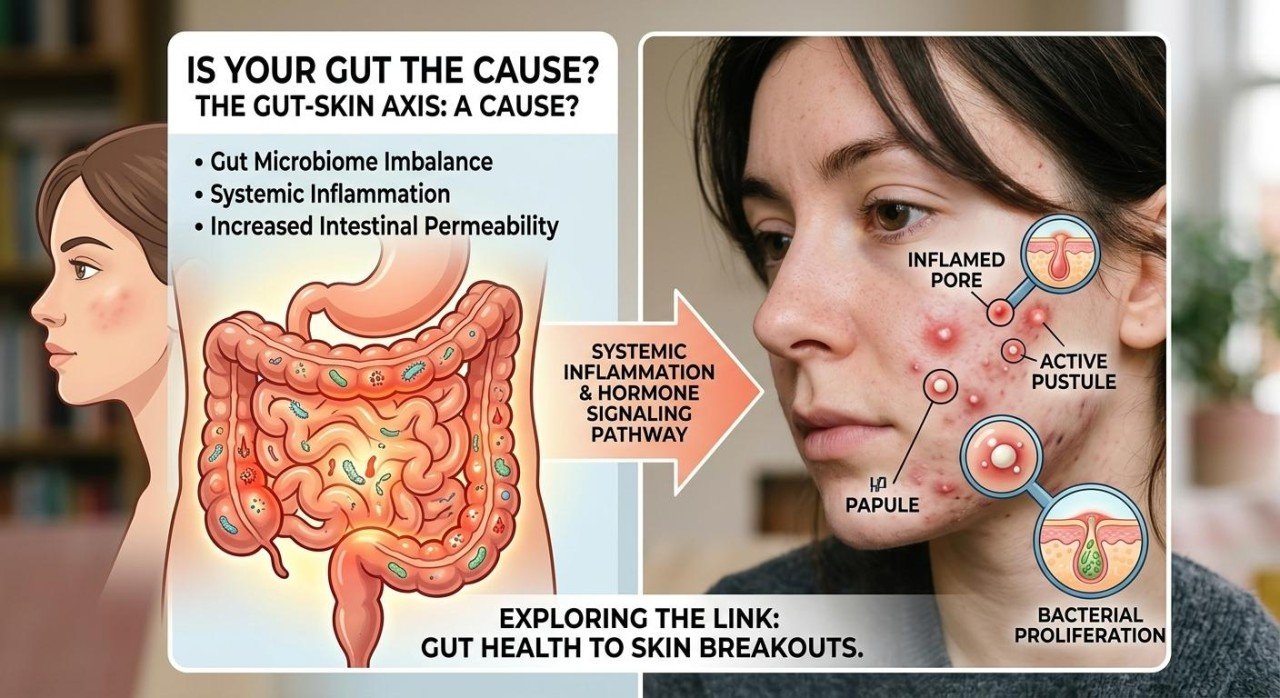
It sounds almost too tidy. But there is a real and growing body of science behind the idea, and it goes by a name: the gut-skin axis. The short version is that your digestive tract and your skin are in constant conversation, mediated by your immune system, your hormones, and the trillions of microbes living in your intestines. When that conversation goes sideways, your skin can be one of the first places it shows.
The important caveat up front: skin is multifactorial. Genetics, hormones, stress, sleep, skincare, and the weather all matter. Diet is one lever among several — not a cure, and not a moral test. But it happens to be a lever you can actually pull, and the evidence for a few specific dietary moves is surprisingly solid. Let us walk through what is real, what is promising, and what to put on your plate.
What the Gut-Skin Axis Actually Is
The gut and skin have a lot in common. Both are barrier organs — they stand between you and the outside world, and both are home to their own communities of microbes. They also talk to each other constantly through the immune system and the bloodstream.
According to a 2025 narrative review of the gut-skin axis, the connection runs through a few main channels. The most important may be short-chain fatty acids (SCFAs) like butyrate, which your gut bacteria produce when they ferment fiber. These compounds strengthen the gut barrier and help calm the immune system body-wide by supporting regulatory T cells. When the balance of gut microbes is healthy, that anti-inflammatory signal reaches your skin too.
The trouble starts with dysbiosis — an imbalanced gut microbiome — which can increase intestinal permeability, sometimes called leaky gut. The review describes how, when the gut barrier weakens, bacterial byproducts can slip into the bloodstream and accumulate in skin tissue, disrupting the way skin cells mature and produce keratin. At the same time, dysbiosis ramps up pro-inflammatory cytokines like IL-17, TNF-alpha, and IL-6 that act on both gut and skin at once. That same review links altered gut bacteria to acne, atopic dermatitis (eczema), psoriasis, and rosacea — for instance, reduced levels of the beneficial microbe Faecalibacterium prausnitzii in eczema, and lower Akkermansia muciniphila in psoriasis.
None of this means your breakouts are simply caused by your gut. But it does mean the foods that shape your microbiome and your inflammation levels are plausibly part of the picture — which is exactly where diet comes in.
The Blood Sugar Lever: The Most Evidence-Backed Diet Connection
If there is one dietary factor with the strongest evidence for acne, it is glycemic load — how much and how quickly a food spikes your blood sugar. White bread, sugary drinks, pastries, and other refined carbohydrates send blood sugar and insulin up fast. That surge raises insulin-like growth factor-1 (IGF-1) and androgen activity, both of which crank up oil production and skin cell turnover — a recipe for clogged pores.
This is not just theory. In a 12-week randomized controlled trial published in the American Journal of Clinical Nutrition, 43 young men with acne were split into two groups. One followed a low-glycemic-load diet (more protein and low-glycemic carbohydrates); the other ate a typical carbohydrate-dense diet. By the end, total acne lesions dropped by 23.5 in the low-glycemic group versus 12.0 in the control group — roughly twice the improvement. The low-glycemic eaters also saw better insulin sensitivity. The authors were careful to note that weight loss and other factors made it hard to isolate one single cause, but the direction was clear.
The broader eating pattern matters too. A 2025 systematic review and meta-analysis of five studies and 765 participants found that higher adherence to a Mediterranean diet — rich in vegetables, legumes, olive oil, and fish — was significantly correlated with less severe acne. Higher vegetable consumption alone was associated with notably lower odds of acne (an odds ratio of 0.46). The researchers were honest that the studies were observational and the overall evidence quality was weak, so this is a supporting clue rather than proof. Still, it points the same way: more whole plants, fewer refined carbohydrates.
The practical takeaway is not to fear all carbs. It is to lean toward the slow-burning kind — whole grains, beans, lentils, vegetables, and intact fruit — and to treat sugary drinks and refined snacks as occasional rather than default.
Take the Guesswork Out of Eating Well
Eat Well Planner helps you organize your favorite recipes, plan balanced meals, and automatically generate shopping lists — all in one place. Whether you're tracking macros, managing dietary restrictions, or just trying to stop asking "what's for dinner?", we've got you covered.
Our AI-powered tools can adapt any recipe to your dietary needs, help you discover new meals you'll love, and even log your nutrition effortlessly. It's meal planning made simple.
Start Organizing Your Meals — FreeWhat About Dairy?
Dairy is the other food group that comes up constantly in acne conversations, and the evidence here is real but more nuanced. A large 2018 systematic review and meta-analysis of 78,529 children, adolescents, and young adults found that dairy consumption was associated with higher odds of acne: an odds ratio of about 1.25 for any dairy, 1.28 for milk, and — interestingly — 1.32 for skim and low-fat milk, slightly higher than for whole milk.
Before you pour out your milk, read the fine print. The authors stressed that these were observational studies that cannot prove dairy causes acne, that the data were heterogeneous, and that most studies did not even adjust for glycemic load. In other words, the people drinking more milk may also have been eating more sugar. Dairy is a reasonable thing to experiment with if your skin is stubborn — particularly skim milk and whey-heavy products — but it is not a guaranteed culprit for everyone, and dairy is also a valuable source of protein and calcium. This is a personal experiment, not a universal rule.
Feeding Your Microbes: Fiber, Polyphenols, and Fermented Foods
If short-chain fatty acids and a calm immune system are part of how the gut supports skin, then the foods that feed your good bacteria deserve attention. That means fiber and polyphenols — the colorful plant compounds in berries, dark leafy greens, green tea, olive oil, herbs, and cocoa — which your gut microbes ferment into those anti-inflammatory metabolites.
Fermented foods may be an especially efficient tool. In a striking 10-week Stanford study published in Cell, 36 healthy adults were randomly assigned to either a high-fiber diet or a diet rich in fermented foods like yogurt, kefir, kimchi, fermented vegetables, brine drinks, and kombucha. The fermented-food group saw a measurable increase in gut microbiome diversity and a broad drop in 19 inflammatory proteins in their blood — including IL-6, one of the very cytokines implicated in inflammatory skin conditions. Notably, the high-fiber group did not see the same anti-inflammatory effect over that short window, which the researchers suspect is because many people in industrialized countries have depleted the fiber-digesting microbes needed to benefit quickly.
The lesson is not fermented foods instead of fiber — it is both, ideally building up gradually. A daily spoonful of plain yogurt or kefir, a forkful of sauerkraut or kimchi, alongside a steady increase in beans, vegetables, and whole grains, gives your microbiome both the raw material and the reinforcements it needs.
Omega-3s and the Inflammation Dial
Omega-3 fatty acids — the kind concentrated in salmon, sardines, mackerel, walnuts, and flax — are among the body's most reliable anti-inflammatory nutrients, and they have drawn growing interest for skin. A 2024 intervention study followed 60 people with mild to moderate acne who combined a Mediterranean diet with omega-3 supplementation over 16 weeks. A remarkable 98.3% of participants were deficient in omega-3s at the start, and those who reached healthy omega-3 levels saw significant improvements in both inflammatory and non-inflammatory acne lesions, along with better quality of life.
The honest framing, which the study authors share, is that this was not a placebo-controlled trial, so omega-3s are a promising adjunct rather than a proven standalone treatment. But the underlying logic — that most of us eat far more inflammatory omega-6 (from refined seed oils and processed food) than anti-inflammatory omega-3 — is well established, and shifting that ratio toward oily fish and whole-food fats is good for far more than your skin.
Skin Aging, Sugar, and Glycation
The gut-skin story is mostly about flare-ups, but diet also shapes how skin ages — and here, blood sugar shows up again through a process called glycation. When excess sugar circulates in the blood, it binds to proteins like collagen and elastin to form advanced glycation end products (AGEs).
According to a review on AGEs and skin aging, glycated collagen forms abnormal cross-links that make it stiff, brittle, and resistant to the body's normal repair processes, while glycated elastin loses its springiness — together translating into the loss of firmness and elasticity we associate with aging skin. AGEs come from inside the body, but also from the diet: the review notes that fried and high-heat-cooked foods contain far more AGEs than boiled or steamed foods, and that roughly 10 to 30% of the AGEs you eat are absorbed into circulation. Smoking and sun exposure accelerate the same damage.
You cannot stop glycation entirely — it is a normal part of being alive. But the same pattern that helps with breakouts helps here too: less sugar and refined carbohydrate, and gentler cooking methods (steaming, poaching, slow simmering) in place of constant high-heat frying and charring.
An Honest Word: Diet Is a Lever, Not a Cure
It would be lovely if clearing your plate cleared your skin. Sometimes diet makes a real, visible difference — and the science above shows why it can. But acne, eczema, rosacea, and aging are genuinely multifactorial. If you have persistent or severe skin issues, a dermatologist is your ally, not your enemy, and food works best alongside proper treatment, not instead of it. Be patient, too: skin cells turn over on the scale of weeks, so dietary changes typically take one to three months to show.
The encouraging part is that everything that supports your skin from the inside — steadier blood sugar, more plants and fiber, fermented foods, omega-3s, less ultra-processed food — is exactly what supports the rest of your body. You are not chasing a beauty hack; you are eating in a way that happens to be good for you, with clearer skin as a likely bonus.
A Realistic Skin-Support Plate
Pulling it all together, here is what a food-first, skin-supporting pattern looks like in practice — no perfection required:
- Build meals around slow carbs. Beans, lentils, whole grains, and vegetables instead of refined bread, sugary drinks, and packaged snacks.
- Eat the rainbow for polyphenols. Berries, leafy greens, herbs, olive oil, green tea, and a little dark chocolate all feed your microbes.
- Add a daily fermented food. Plain yogurt, kefir, kimchi, sauerkraut, or miso — start small and build up.
- Get omega-3s a few times a week. Salmon, sardines, mackerel, walnuts, or ground flax.
- Cook gently more often. Steam, poach, and simmer in place of constant deep-frying and charring to keep dietary AGEs down.
- Experiment, do not obsess. If your skin is stubborn, try dialing back skim milk or sugar for a few weeks and watch what happens — for you.
Making the Pattern Stick
The hard part is rarely knowing what to eat — it is doing it consistently across busy real-life weeks. That is where a little structure helps. Eat Well Planner is a free app built to make this kind of eating the path of least resistance: you can save and organize lower-glycemic, plant-rich recipes, generate weekly meal plans built around fiber, fermented foods, and omega-3s, and get an automatic shopping list so the fresh ingredients are actually in your kitchen when hunger strikes.
Its food diary — including quick voice logging — is especially handy for the gut-skin connection, because it lets you track what you eat and notice patterns over the weeks it takes for skin to respond. And if you want to cut back on dairy or refined sugar, the AI recipe chat can suggest substitutions and adapt recipes to your preferences, so eating for your skin never feels like deprivation. Your gut and your skin are having a conversation either way — this just helps you feed it well.
Try organizing your meals with Eat Well Planner and give your skin the steady, plant-rich, low-inflammation diet the science keeps pointing toward.