Here's a quiet truth that almost nobody tells beginner cooks: the people who seem effortlessly competent in the kitchen are not working from a mental library of three hundred dishes. They're cooking a small handful of meals they know cold, over and over, with little tweaks. The confidence you're admiring isn't breadth. It's repetition.
If that sounds too simple, the numbers back it up. In a 2023 survey of 2,000 Americans conducted by OnePoll for HelloFresh, respondents said they knew an average of just 15 recipes "like the back of their hand" and ate around 10 home-cooked meals a week. Most of us, even the enthusiastic cooks, already run on a rotation. We just don't think of it that way, so it feels chaotic instead of reliable.
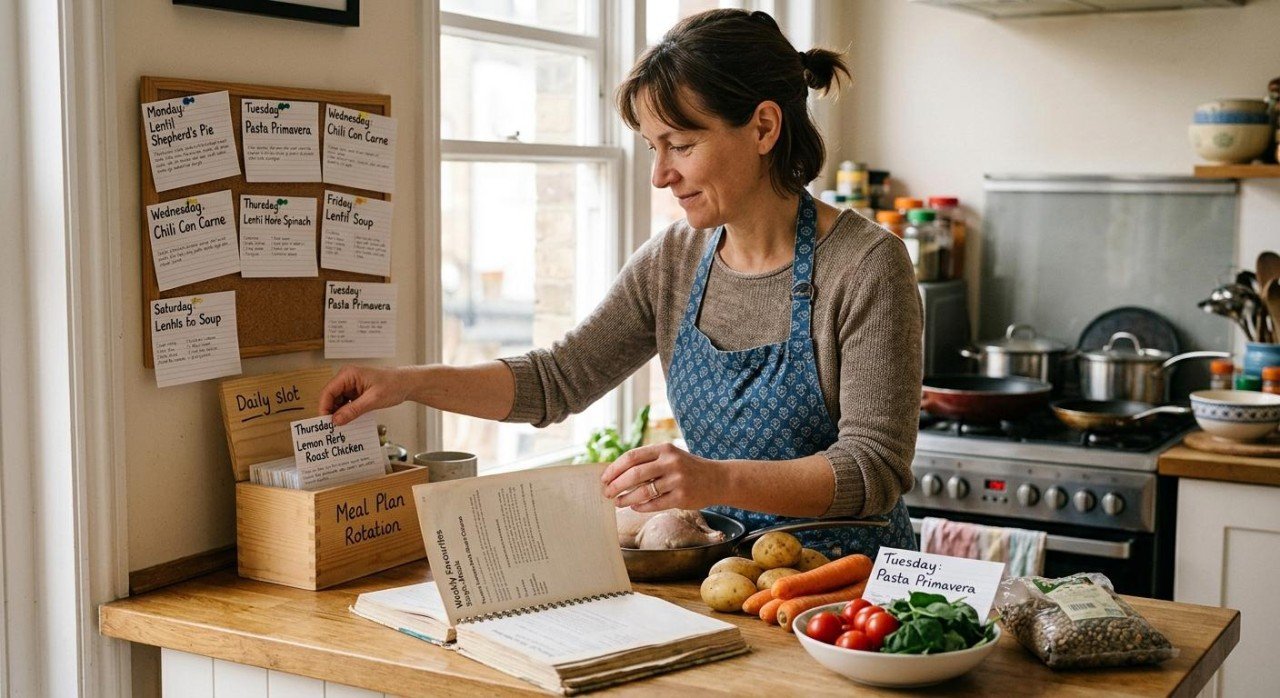
This post is about doing it on purpose. Build a deliberate set of about ten meals you can cook on autopilot, and you replace the nightly scramble with something closer to muscle memory. Here's how to choose your core ten, why a small rotation builds more skill than a big collection, and how small variations keep it from ever getting boring.
Why Fewer Recipes Makes You a Better Cook
The instinct when you want to "get better at cooking" is to collect: bookmark more recipes, save more reels, buy another cookbook. But a giant pile of untested recipes doesn't make you a cook. It makes you a person with a giant pile of untested recipes. Every one of them is a first attempt, which means every one is slow, uncertain, and a little stressful.
Repetition flips that. There's a well-documented psychological principle called the mere exposure effect, first studied by psychologist Robert Zajonc, which shows that people develop a stronger preference for things they encounter repeatedly. Zajonc found the relationship follows a "positive, decelerating curve" — the earliest exposures move the needle most. The same logic applies to a recipe. The first time you make a dish, you're reading every line and measuring everything. By the fifth time, you've internalized the rhythm: you know what the onions should look like before you add the garlic, you know the pasta water needs salt, you know roughly how long until dinner. The recipe has become a skill.
A small rotation also kills the most exhausting part of feeding yourself: the deciding. Anyone who has stood in front of an open fridge at 6 p.m. with no idea what to make knows that decision fatigue is real, and "what's for dinner?" is one of the most relentlessly recurring questions in adult life. When you have ten meals you can make without thinking, the question mostly answers itself. You're choosing from a short, familiar menu instead of inventing dinner from scratch every single night.
Why Cooking at Home Is Worth Protecting
It's worth remembering what's at stake when home cooking falls apart, because that's exactly when convenience food fills the gap. A CDC report covering August 2021 to August 2023 found that about 53% of the calories adults in the U.S. consume come from ultra-processed foods — and nearly 62% for children. We don't usually default to those foods because we prefer them. We default to them because, in the moment, they require no decision and no skill. A reliable rotation is the thing that makes a fresh meal the easy option instead.
And cooking at home genuinely moves the needle on diet quality. In a study of more than 9,000 adults published in Public Health Nutrition, Johns Hopkins researchers Julia Wolfson and Sara Bleich found that people who cooked dinner six or seven nights a week ate fewer calories, less sugar, and less fat than those who cooked once a week or less — and they also ate less when they did eat out. A separate analysis of NHANES data confirmed the pattern with a different yardstick: cooking dinner most nights was associated with a meaningfully higher Healthy Eating Index-2015 score (about 3.6 points overall). You don't have to cook elaborately to get there. You just have to cook, consistently — which is precisely what a rotation makes possible.
How to Choose Your Core Ten
A good rotation isn't ten random favorites. It's ten meals that cover the different situations a real week throws at you, spread across a few proteins, a couple of cuisines, and a range of speeds. Think of it less like a wish list and more like a toolkit. Here's a framework for the slots to fill.
1. A fast weeknight meal (15–20 minutes)
Your bad-day default. Something you can make tired, hungry, and slightly annoyed. A stir-fry, a quick pasta, eggs and greens on toast, a grain bowl with whatever's in the fridge. This is the meal that competes directly with takeout, so it has to be genuinely fast.
2. A one-pot or sheet-pan meal
Minimal cleanup is its own kind of confidence. A tray of roasted vegetables and chicken thighs, a one-pot rice dish, a soup or chili that simmers itself. These reward you twice: easy to cook, easy to clean.
3. A batch-cook that makes leftovers
One that intentionally produces a second (or third) meal. A big pot of bolognese, a curry, a tray of roasted veg you can repurpose. Cooking once and eating twice is the single biggest time-saver in any rotation, and it gives you a fallback on nights you don't cook at all.
4. A crowd-pleaser
The meal you bring out when people come over or the family is being picky. Tacos, a big pasta bake, a roast. It should feel a little generous and be hard to mess up, so you can relax while you make it.
5. A use-up-the-fridge meal
Less a recipe than a format: fried rice, a frittata, a soup, a "throw it all in" pasta. This is the meal that flexes around whatever's about to go off, which is how you stop wasting food and money. Master one flexible template and you'll rarely look at a half-empty fridge in despair again.
6–10. Round it out for variety
The remaining slots are where you add range so you don't eat the same five things forever. Aim to cover:
- A second and third protein, so you're not leaning on chicken every night — fish, beans or lentils, eggs, tofu, or a cut of beef or pork.
- A different cuisine or flavor world from your fast weeknight meal, so dinner doesn't taste the same all week.
- A reliable breakfast or lunch anchor, since the rotation isn't only about dinner.
- A no-cook assembly meal — a big salad, a snack-style plate, a wrap — for the nights cooking just isn't happening.
- One comfort meal you genuinely love, because a rotation you don't enjoy is one you'll abandon.
Ten is a target, not a rule. Some people thrive on eight, others want a dozen. The point is to keep the number small enough that every meal gets cooked often enough to become second nature.
This is also exactly the kind of thing worth writing down in one place instead of keeping it scattered across screenshots and memory. Eat Well Planner lets you build a personal recipe book and pull your core rotation together — import recipes straight from a website, an Instagram reel, or a YouTube video, and the app extracts the ingredients, instructions, and nutrition for you. Once your ten are saved, the AI can build a balanced weekly meal plan from them and turn it into an organized shopping list automatically, so the rotation runs itself.
Take the Guesswork Out of Eating Well
Eat Well Planner helps you organize your favorite recipes, plan balanced meals, and automatically generate shopping lists — all in one place. Whether you're tracking macros, managing dietary restrictions, or just trying to stop asking "what's for dinner?", we've got you covered.
Our AI-powered tools can adapt any recipe to your dietary needs, help you discover new meals you'll love, and even log your nutrition effortlessly. It's meal planning made simple.
Start Organizing Your Meals — FreeHow Small Variations Keep It From Getting Boring
The obvious objection to a ten-meal rotation is monotony, and it's a fair one. The same mere exposure effect that builds familiarity has a ceiling: liking tends to peak after a number of repetitions and can fade into boredom if nothing ever changes. The trick isn't more recipes. It's variations on the ones you already know.
Because here's what makes a rotation powerful: once you've internalized the technique, the specifics become swappable. You're no longer cooking "chicken stir-fry," you're cooking a stir-fry — and that means:
- Swap the protein. Tonight's chicken stir-fry is next week's shrimp or tofu or beef. Same method, completely different meal.
- Swap the sauce or spice profile. Take that one-pot braise from Italian (tomato, garlic, basil) to North African (cumin, cinnamon, harissa) to nothing more than lemon and herbs. The base stays; the personality changes.
- Swap the vegetables by season. A frittata or roasted-veg tray follows whatever's fresh and cheap — asparagus in spring, zucchini in summer, squash in fall.
- Swap the carbohydrate. Rice becomes quinoa becomes noodles becomes a baked potato. Small change, new dinner.
A rotation of ten meals with three or four easy variations each isn't ten dinners. It's effectively dozens — but without the cognitive cost of learning dozens of recipes from scratch. You get variety on top of competence, instead of trading one for the other.
This is where a little help goes a long way. If you've got a staple saved in Eat Well Planner, you can ask the AI recipe chat for substitutions on the fly — make it dairy-free, bump the servings for guests, or suggest what to do with the vegetables you actually have — or have it generate a full variation of the recipe to match a dietary need. Your ten stay fixed; the way you cook them keeps evolving.
Confidence Is Built, Not Born
If you take one idea from this, let it be that cooking confidence is a product of repetition, not talent — and the payoff is long-term. A longitudinal study from Project EAT tracked more than 1,100 people from young adulthood into their thirties and found that those who rated their cooking skills as "very adequate" at ages 18–23 were about 3.5 times more likely to be preparing meals with vegetables most days a decade later, and significantly less likely to rely on fast food. The skills you build now compound quietly for years.
And those skills come from doing, not from collecting. Research on home cooks consistently finds that confidence in the kitchen grows with hands-on practice over time — one study of 487 adults found that people who started cooking in childhood or as teenagers reported higher cooking-skills confidence as adults, simply because they'd had more years of repetition behind them. You can't read your way to that. You cook your way there, one repeated meal at a time.
So don't start by trying to learn everything. Start by picking your ten. Cook them until they're boring, then start varying them until they're interesting again. Within a couple of months you'll have what every confident home cook actually has — not an encyclopedia, but a reliable, flexible, well-worn set of meals you can make without thinking, on the worst night of the week, without opening a single recipe.
When you're ready to put yours together, try building your core rotation with Eat Well Planner — save your staples, let the AI plan the week and keep them fresh, and turn it all into a shopping list in a couple of taps.