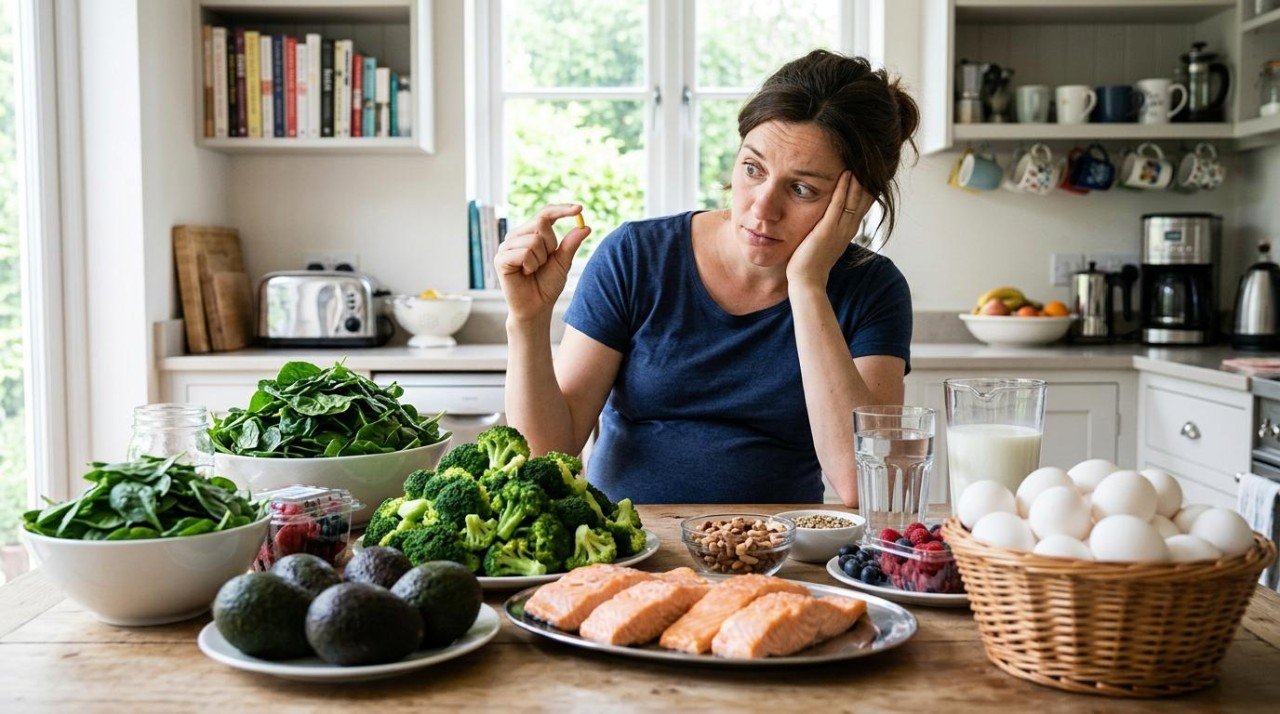
Few life stages come with as much unsolicited nutrition advice as pregnancy. Everyone has a list of foods you must eat, foods you must never touch, and supplements you apparently can't live without. It's a lot — and it tends to arrive right when you're most tired, most nauseous, or least in the mood to overthink dinner.
So let's take a breath. Eating well in pregnancy is not about perfection or a color-coded rulebook. It's about steadily supplying a handful of nutrients that genuinely shape how your baby develops, while keeping meals appealing enough to actually eat. This guide walks through those standout nutrients, how your needs shift trimester by trimester, and how to handle food safety without living in fear of your own refrigerator.
One important note up front: this is general information, not medical advice. Your obstetric provider knows your history, your labs, and your specific needs. Use this to ask better questions at your next appointment — not to override what your provider tells you.
You're not really "eating for two"
The old "eating for two" line is one of the most persistent myths in pregnancy. In terms of calories, the increase is surprisingly modest — roughly a few hundred extra calories a day in the second and third trimesters, and essentially none in the first. What changes far more dramatically is your need for specific nutrients. Your body is building a brain, a skeleton, a blood supply, and an entire new organ (the placenta) largely from the raw materials you eat.
That's why the goal is nutrient density, not volume. A plate built around vegetables, fruit, whole grains, beans, eggs, dairy, fish, and lean meats delivers far more of what matters than the same number of calories from ultra-processed snacks. Let's look at the nutrients doing the heavy lifting.
The headline nutrients — and why they matter
Folate and folic acid: start before you're pregnant
If there's one nutrient to get right, it's folate — and the catch is that it matters before you even know you're pregnant. The neural tube, which becomes the brain and spinal cord, closes within the first four weeks of pregnancy, often before a positive test. That's why the U.S. Preventive Services Task Force recommends that everyone who could become pregnant take 400 to 800 mcg of folic acid daily, starting at least a month before conception and continuing through the first two to three months of pregnancy. Adequate folic acid reduces the risk of neural tube defects like spina bifida — birth defects that affect roughly 3,000 U.S. pregnancies each year.
Folic acid is the synthetic form found in supplements and fortified grains; folate is the natural form in food. Leafy greens, legumes, asparagus, citrus, and fortified cereals and breads are all solid sources. Because the critical window is so early, a supplement is the reliable insurance policy here — but a folate-rich diet builds on that foundation.
Iron: fueling a much bigger blood supply
Pregnancy dramatically expands your blood volume — plasma volume rises by 40 to 50 percent while red blood cell mass climbs 15 to 25 percent, according to a clinical review of iron deficiency anemia in pregnancy. All those new red blood cells need iron, and so do the placenta and the growing baby. In total, a single pregnancy requires about 1,000 mg of iron, which is why the recommended intake jumps to 27 mg per day.
Iron deficiency is genuinely common: the same review notes that around 25 percent of pregnant people in the U.S. are iron deficient, with rates climbing across the pregnancy — from about 7 percent in the first trimester to 24 percent in the second and 39 percent in the third. Left unaddressed, it's linked to preterm birth and low birth weight. Iron from meat, poultry, and fish (heme iron) is absorbed more easily than iron from beans, lentils, tofu, and greens, but you can boost absorption from plant sources by pairing them with vitamin C — think lentils with bell peppers, or spinach with a squeeze of lemon.
Choline and omega-3 DHA: brain builders
Choline and the omega-3 fat DHA are the quiet MVPs of fetal brain development, and most people don't get enough of either. Choline supports the formation of the hippocampus (the brain's memory center), while DHA is a core structural fat in the brain and retina — it makes up roughly half the fatty acids in the eye's photoreceptor cells, per a review of choline and DHA in maternal and infant nutrition.
The recommended choline intake in pregnancy is 450 mg per day, yet that same review notes over 90 percent of the U.S. population falls short of adequate choline intake. And the two nutrients appear to work as a team: in one trial, choline or DHA alone had limited effect, but taken together they raised levels of a key DHA-carrying compound by 63 percent. Eggs are a choline powerhouse (much of it in the yolk), along with lean meat, poultry, beans, and cruciferous vegetables. For DHA, fatty fish like salmon and sardines lead the pack — which brings up seafood safety, covered below.
Calcium and vitamin D: building the skeleton
Your baby's skeleton is mineralizing throughout pregnancy, and it draws on your calcium stores to do it. The recommended intake during pregnancy is about 1,000 mg of calcium and 600 IU of vitamin D per day. The two nutrients are partners — vitamin D helps you absorb and use calcium. A study of pregnant adolescents found that adequate calcium and sufficient vitamin D each supported fetal bone growth, and that one could partly compensate when the other ran low, with the best outcomes when both were adequate. Dairy, fortified plant milks, tofu set with calcium, canned fish with soft bones, and leafy greens all contribute calcium; vitamin D comes from sunlight, fatty fish, eggs, and fortified foods, and is a common gap that prenatal vitamins help fill.
Iodine: small mineral, big role
Iodine rarely makes the headlines, but it's essential: your thyroid needs it to make the hormones that steer your baby's brain development, especially early on when the fetus relies entirely on your thyroid hormones. The recommended intake rises to 220 mcg per day in pregnancy (the World Health Organization suggests 250 mcg), according to a review of iodine nutrition in pregnancy. That review notes that even mild deficiency matters — children of mildly hypothyroid mothers scored about 7 IQ points lower in one comparison. Dairy, seafood, eggs, and iodized salt are the main dietary sources. Worth knowing: many "gourmet" and sea salts aren't iodized, and neither is the salt in most processed foods, so iodine can quietly slip through the cracks. Many prenatal vitamins now include it.
Protein: the raw material for growth
Protein supplies the building blocks for your baby's tissues, your placenta, and your own expanding body. Requirements rise as pregnancy progresses: the standard recommendation moves to about 1.1 g per kilogram of body weight per day — often cited as roughly 70+ grams daily — during the second and third trimesters. Newer research using more precise methods suggests the true requirement in late pregnancy may be considerably higher still, because tissue growth accelerates toward the end. You don't need to count grams obsessively — but making sure each meal has a real protein anchor (eggs, dairy, beans, lentils, fish, poultry, or meat) covers most people comfortably.
Take the Guesswork Out of Eating Well
Eat Well Planner helps you organize your favorite recipes, plan balanced meals, and automatically generate shopping lists — all in one place. Whether you're tracking macros, managing dietary restrictions, or just trying to stop asking "what's for dinner?", we've got you covered.
Our AI-powered tools can adapt any recipe to your dietary needs, help you discover new meals you'll love, and even log your nutrition effortlessly. It's meal planning made simple.
Start Organizing Your Meals — FreeHow your needs shift, trimester by trimester
The nutrients above matter across all of pregnancy, but the emphasis — and the obstacles — change as you go.
First trimester: the folate-and-survival phase
Early on, the headline nutrient is folate, precisely when nausea can make eating anything feel impossible. Nausea and vomiting affect somewhere between 50 and 85 percent of pregnancies, typically starting around week 7, peaking near week 9, and easing by about week 20, according to a systematic review of dietary strategies for nausea and vomiting in pregnancy. If that's you, the classic advice holds up: small, frequent meals rather than large ones, bland and dry starches, and cold or room-temperature foods, which give off fewer nausea-triggering smells. Spreading protein across several small snacks through the day may also help settle the stomach.
Ginger has real evidence behind it too. A review of ginger for pregnancy nausea found that about 1 gram per day modestly reduced symptoms — roughly one in three women stopped vomiting within six days — with a large cohort study finding no increase in malformations or other adverse outcomes. Vitamin B6 is another commonly recommended option. Check with your provider before adding any supplement, and don't stress if your diet is narrow for a few weeks; this phase usually passes.
Second trimester: the rebuilding window
For many people, the second trimester is the sweet spot — nausea fades, appetite returns, and eating becomes enjoyable again. This is the time to lean into variety and rebuild any nutrient reserves that took a hit early on. Iron and calcium demands are ramping up as your blood volume expands and the baby's skeleton mineralizes, so this is a good stretch to make iron-rich meals and calcium sources a regular habit while food actually sounds appealing.
Third trimester: brain growth and a squeezed stomach
In the final stretch, the baby's brain is growing fast, so DHA, choline, and protein are especially valuable now. The practical challenge flips: as the uterus crowds your stomach, large meals become uncomfortable and heartburn is common. The same fixes that helped with first-trimester nausea help here too — smaller, more frequent meals rather than big ones, not lying down right after eating, and easing off personal reflux triggers (for many, that's very greasy, spicy, or heavily acidic foods). Nutrient-dense mini-meals let you keep intake up without an overstuffed, uncomfortable belly.
Food safety, without the fear
Food-safety rules in pregnancy can read like a list of everything you love being taken away. The reality is more manageable once you understand the two real concerns: listeria and mercury.
Listeria is a bacterium that most healthy adults shrug off, but pregnancy makes you far more susceptible, and an infection can lead to miscarriage, stillbirth, or preterm delivery. According to a MotherToBaby fact sheet on listeria in pregnancy, the foods to be careful with are the ones where the bacteria can grow in cold storage: unpasteurized (raw) milk and soft cheeses made from it (like some feta, Brie, Camembert, blue cheeses, and queso fresco), deli meats and hot dogs unless reheated until steaming, refrigerated pâtés and smoked seafood, and unwashed produce. The reassuring part: heat kills listeria, so cooked versions of these foods — and hard or clearly pasteurized cheeses — are fine. You don't have to give up your favorites so much as tweak how they're served.
Mercury is the reason for the fish rules, but here the message is more "eat the right fish" than "avoid fish." Seafood is one of the best sources of DHA, and the evidence on fish in pregnancy frames it as an opportunity rather than a risk: the FDA and EPA advise 8 to 12 ounces (about two to three servings) of low-mercury fish per week, and studies associate that intake with measurable gains in children's cognitive development — on the order of a few IQ points. Salmon, sardines, trout, shrimp, and canned light tuna are all low-mercury "best choices." The short avoid list is the big predatory fish that accumulate mercury: shark, swordfish, king mackerel, and tilefish (with albacore/white tuna best limited). So the takeaway isn't "skip fish" — it's "choose the low-mercury ones and enjoy them regularly."
Beyond those two, the standard sense-checks apply: cook meat, poultry, and eggs thoroughly, wash fruits and vegetables, and skip raw or undercooked seafood and unpasteurized juices. None of it requires anxiety — just a little awareness.
Prenatal vitamins fill gaps — food comes first
A good prenatal vitamin is genuinely useful. It's the reliable safety net for folic acid, iron, iodine, vitamin D, and often DHA and choline — nutrients that are hard to hit consistently, especially when nausea narrows your diet. But a prenatal is a supplement, not a substitute. Whole foods deliver these nutrients alongside fiber, other vitamins, and the compounds that help your body absorb and use them — the choline-and-DHA synergy is a perfect example of nutrients working better in combination than in isolation. Think of the vitamin as insurance and food as the main investment. And because prenatals vary a lot in what they contain (some skip choline or iodine entirely), it's worth reviewing yours with your provider.
Making it actually doable
Here's the honest tension: pregnancy is exactly when balanced, nutrient-dense eating matters most, and also when planning, shopping, and cooking feel hardest — between fatigue, nausea, appetite swings, and a growing to-do list. This is where having a system, rather than willpower, makes the difference.
That's the gap Eat Well Planner is built to close. You can set up a pregnancy-focused profile that prioritizes the nutrients that matter most right now — folate, iron, choline, protein — and let the app build weekly meal plans around recipes you actually want to eat. When first-trimester nausea hits, you can lean on quick, bland, low-effort meals; when appetite returns, you can plan the iron- and calcium-rich dishes you skipped. The auto-generated shopping lists mean fresh ingredients are in the house, so you're not defaulting to processed convenience food on the rough days.
The nutrition tracking and food diary let you see your actual intake of key nutrients over a week — a far more useful picture than judging any single meal — so you can spot, say, that your iron or protein has been running low and adjust. And the AI recipe chat is handy for the constant small adaptations pregnancy demands: swapping a soft cheese for a pasteurized one, making a recipe reflux-friendly, or turning a favorite dish into something a queasy first-trimester stomach can handle. It takes the mental load off, so eating well becomes the easy default instead of one more thing to figure out.
Above all, be kind to yourself. Pregnancy nutrition isn't a test you pass or fail meal by meal. It's a stretch of months where consistently good-enough eating, a reliable prenatal vitamin, and your provider's guidance add up to exactly what you and your baby need.