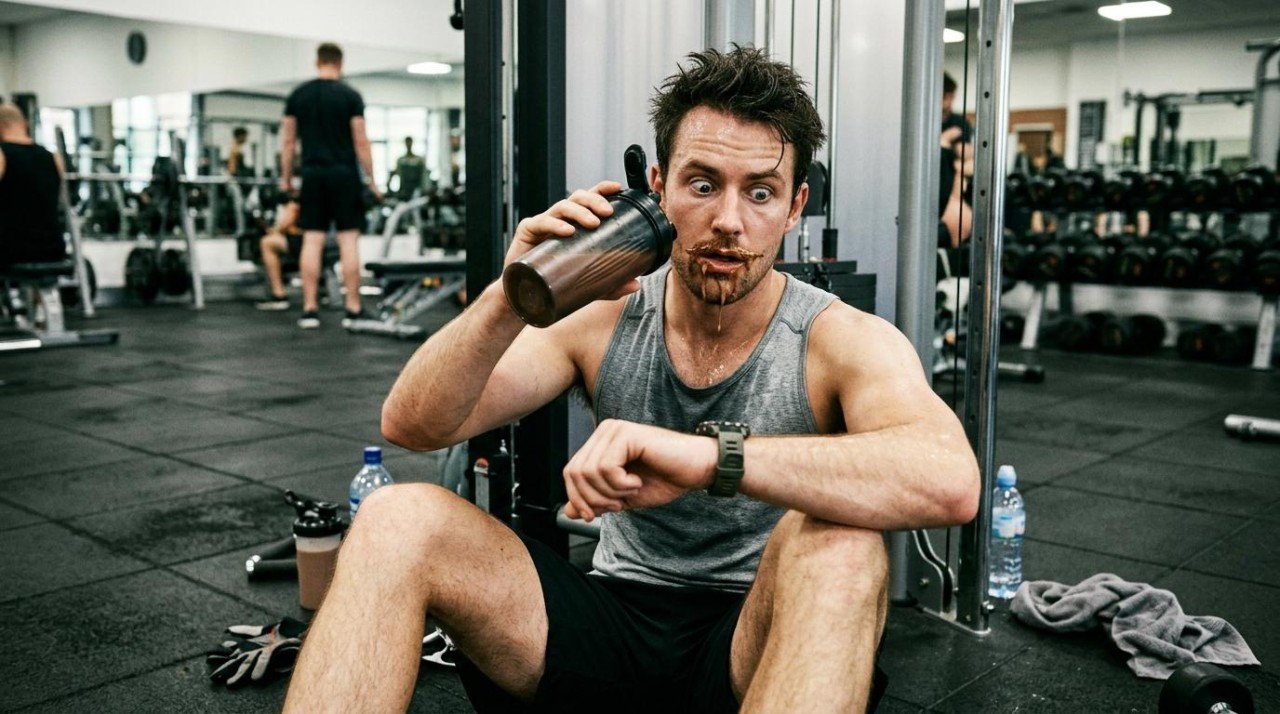
Walk into any gym and you'll hear the same two rules repeated like gospel. Do your cardio before breakfast, on an empty stomach, if you want to burn fat. And whatever you do, get protein in within 30 minutes of your last rep, or you've wasted the whole session. Both ideas are sticky because they feel scientific and they give you something concrete to do. The trouble is that the research has moved on, and the honest version of each is a lot more relaxing than the gym-floor version.
Here's the short summary before we dig in: fasted cardio burns slightly more fat during the workout but makes no meaningful difference to fat loss over weeks and months. And the post-workout "anabolic window" isn't a 30-minute sprint to the shaker — it's a window several hours wide, and what actually moves the needle is how much protein you eat over the whole day. Let's look at why.
Fasted Cardio: Real Effect, Wrong Conclusion
The logic behind fasted cardio isn't made up. When you exercise after an overnight fast, your body does lean more heavily on stored fat for fuel, because your glycogen and blood sugar are lower. Measure fat oxidation during that single session and it's genuinely higher than if you'd eaten first. That part is true.
The mistake is assuming that "more fat burned during the session" translates to "more fat lost over time." It doesn't, and we have direct evidence. In a 2014 randomized controlled trial published in the Journal of the International Society of Sports Nutrition, Brad Schoenfeld and colleagues put 20 young women on a calorie-controlled diet (a 500-calorie deficit, with protein set at 1.8 g/kg) and had them do an hour of steady-state cardio three days a week for four weeks. One group trained fasted; the other had a shake before their session. Both groups lost fat — around 1 kg on average — and, in the researchers' words, "no significant between-group differences were noted in any outcome measure." Being fasted didn't win.
Zoom out and the picture holds. A 2018 systematic review and meta-analysis in the Scandinavian Journal of Medicine & Science in Sports examined fasted versus fed exercise and found that eating before training actually enhanced performance in prolonged aerobic sessions, while fasted training raised circulating free fatty acids and some metabolic signaling. Interesting for physiology nerds, but nothing that adds up to a body-composition advantage. The thing that determines whether you lose fat is your overall energy balance — how much you eat versus how much you burn across the whole week — not whether your treadmill session happened before or after toast.
So Should You Do Fasted Cardio or Not?
The freeing part of this is that it becomes a personal preference rather than a rule. Fasted cardio is a perfectly fine choice if you actually like it. Some people find that a morning walk or easy jog feels lighter and less sloshy on an empty stomach, and doing it first thing means it's done before the day gets a chance to derail it. If that's you, keep going — you're not missing out on anything by eating first, and you're not gaining a special advantage either. It's simply what fits your schedule and your stomach.
There are a few situations where eating something first is the smarter call:
- Hard or long sessions. If you're doing intense intervals, a long run, or anything where performance matters, the evidence leans toward eating beforehand. You'll likely train harder and get more out of the session with some fuel on board — and how hard you train matters far more than the fasted-fat-burning trick.
- You feel lightheaded, shaky, or weak. If training on empty leaves you dizzy or flat, that's your body telling you it wants fuel. There's no prize for pushing through it.
- You have a blood-sugar condition. This one is genuinely individual. Some people with type 1 diabetes actually use short fasted morning workouts to avoid lows — a 2019 study in the Journal of Clinical Endocrinology & Metabolism found that brief fasted high-intensity or moderate exercise didn't produce detrimental 24-hour glucose profiles in adults with type 1 diabetes. But the researchers were careful to note this applied to short, controlled sessions and couldn't be extended to longer efforts. If you manage diabetes or reactive hypoglycemia, this is a decision to individualize with your care team, not a blanket rule from a blog.
The bottom line: fasted cardio is a tool, not a requirement. Use it if you like it, skip it if you don't, and don't expect it to out-perform simply eating well and training consistently.
The "Anabolic Window" Has Basically Closed
Now for the other half of the gym mythology. The anabolic window is the belief that there's a narrow post-workout period — often quoted as 30 to 45 minutes — in which you must consume protein to capture muscle growth, and that miss it and the session's gains slip away. It's why so many people sprint to a protein shake before they've even racked their weights.
This idea has quietly collapsed under scrutiny. In their review "Nutrient timing revisited: is there a post-exercise anabolic window?", Alan Aragon and Brad Schoenfeld found little evidence for a narrow window. Because a pre-workout meal keeps amino acids circulating in your blood well into your recovery period, the practical window is far wider than 30 minutes. They concluded that pre- and post-exercise meals generally shouldn't be separated by more than about three to four hours for a typical training session — and if you ate a larger mixed meal beforehand, that gap can stretch to five or six hours. That's a window measured in hours, not minutes.
A meta-analysis of 23 studies by Schoenfeld, Aragon, and Krieger drove the point home. When they pooled the data, protein timing appeared to help muscle growth — but once they controlled for confounding variables, that effect vanished. The real driver they identified was total daily protein: "total protein intake was the strongest predictor" of results. In other words, the apparent benefit of the magic post-workout shake was really just people who timed their protein also eating more protein overall. Eat enough across the day and the exact minute doesn't matter.
What Actually Matters: Total Daily Protein
If timing is mostly a distraction, the real question is how much protein you're getting in a day. Here the research is refreshingly clear. A large 2018 meta-analysis in the British Journal of Sports Medicine — 49 studies and 1,863 participants — found that protein intake supported gains in strength and lean mass up to a plateau of about 1.62 grams of protein per kilogram of body weight per day (with the confidence interval reaching up to 2.2 g/kg for some people). Beyond roughly that point, more protein didn't produce further gains in fat-free mass.
Translated into everyday terms, that's around 0.7 grams of protein per pound of body weight for people who train regularly. A 150-pound person lands near 105 grams a day; a 180-pound person, around 125 grams. You don't need to hit it to the gram — think of it as a target zone rather than a precise dose. And note this is a figure for active people building or maintaining muscle; it's higher than the baseline RDA, which is set to prevent deficiency, not to optimize training.
Spread It Out Across the Day
There's one nuance to total protein that's worth getting right: how you distribute it across your meals seems to matter more than how you time it around a workout. Your body can only use so much protein to build muscle at once, so a day where you eat a little protein at breakfast, a bit at lunch, and then a giant slab at dinner is less effective than spreading it evenly.
A study in The Journal of Nutrition tested exactly this. Participants ate the same total protein either evenly (about 30 grams at each of breakfast, lunch, and dinner) or skewed toward the evening (roughly 10 grams at breakfast, 16 at lunch, and 63 at dinner). The evenly distributed pattern stimulated 24-hour muscle protein synthesis about 25% more than the skewed one — and the effect held up after a week of eating that way. Same total protein, better result, just from spreading it out.
So the practical target is something like 25 to 40 grams of protein at each of three or four meals. That's the version worth remembering: enough protein, spread across the day — two numbers that quietly determine your results while everyone else argues about the 30-minute window.
The catch is that "am I actually getting 0.7 grams per pound, spread evenly?" is genuinely hard to eyeball. Most people dramatically overestimate their breakfast and lunch protein and get most of it at dinner without realizing. This is exactly the kind of thing where seeing the numbers changes behavior.
Eat Well Planner gives you those two numbers directly. The food diary lets you log meals by voice, photo, or text and works out the nutrition for you, so you can see your daily protein total and how it's distributed across your meals — the two things this research says actually matter. Its nutrient highlights flag when a recipe is a good source of protein, and when you're planning your week, the meal planner helps you build days that hit your protein target without you having to do the math in your head.
Take the Guesswork Out of Eating Well
Eat Well Planner helps you organize your favorite recipes, plan balanced meals, and automatically generate shopping lists — all in one place. Whether you're tracking macros, managing dietary restrictions, or just trying to stop asking "what's for dinner?", we've got you covered.
Our AI-powered tools can adapt any recipe to your dietary needs, help you discover new meals you'll love, and even log your nutrition effortlessly. It's meal planning made simple.
Start Organizing Your Meals — FreeWhat About Protein Powder?
If total daily protein is the goal, protein powder starts to look like what it actually is: a convenience, not a requirement. Nothing in the research says the protein has to come from a tub. Whey and other supplements are simply a fast, cheap, portable way to add a chunk of high-quality protein — useful if you struggle to hit your target from food alone, or if a shake is genuinely easier than cooking after a workout. But it's optional.
Whole foods do the same job and bring fiber, micronutrients, and satiety along for the ride. If you're wondering what 25 to 35 grams of protein looks like on a plate, here are some easy anchors:
- 4 ounces of cooked chicken breast — about 35 grams
- A cup of Greek yogurt — roughly 20 to 23 grams
- A cup of cottage cheese — around 25 grams
- Three large eggs — about 18 grams
- A 4-ounce can of tuna or a 3-ounce fillet of salmon — roughly 22 to 25 grams
- A cup of cooked lentils — about 18 grams, plus a big dose of fiber
- A cup of edamame — around 18 grams
Build a couple of those into each meal and you'll clear your daily target without a scoop in sight. Use powder if it makes your life easier; don't feel behind if you skip it.
The Simple Version
Strip away the mythology and workout nutrition gets a lot calmer:
- Fasted cardio is fine if you like it and fine to skip if you don't. It doesn't melt away extra fat over time — your overall intake does. Eat first if you're doing something hard or long, or if training empty makes you feel bad.
- The anabolic window is hours wide, not minutes. You don't need to rush a shake. As long as you're eating protein-containing meals across the day, you're covered.
- Total daily protein — roughly 0.7 grams per pound if you're active — is the number that matters, ideally spread across three or four meals rather than dumped into dinner.
- Protein powder is a handy shortcut, not a rule. Whole foods work just as well.
None of this requires a stopwatch or a specific pre-dawn ritual. It requires eating enough good food, fairly evenly, most days. That's the unglamorous truth behind almost every nutrition question worth asking — and it's a lot easier to stick with than a rule you have to sprint to obey.
If you'd like the "enough protein, spread out" part to run on autopilot, that's what Eat Well Planner is built for: plan balanced meals, track your daily and per-meal protein without the mental math, and spend your energy on training and eating well instead of second-guessing the timing.