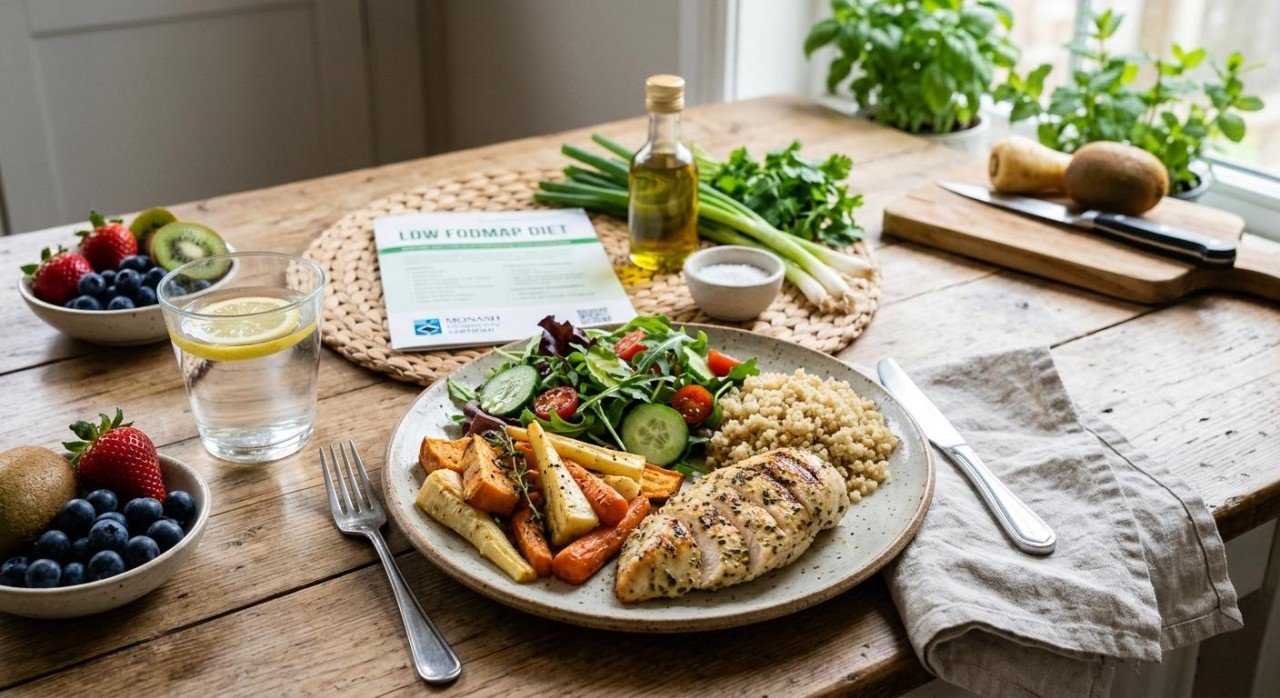
If you've spent any time in IBS forums or bloating-cure corners of the internet, you've probably met someone who is, in their own words, "doing FODMAP." They've cut out onion and garlic. They eye an apple like it's a personal threat. They've been eating the same five "safe" meals for eight months and they're miserable about it — but at least the bloating is better, so they keep going.
Here's the thing almost nobody tells them: the low-FODMAP diet was never designed to be a permanent way of eating. It's a short diagnostic protocol with a beginning, a middle, and an end. Getting stuck in the first stage — the part where you cut everything out — isn't "doing it right." It can actually work against your gut over time. If that describes you or someone you love, this is the post that untangles it.
What FODMAPs Actually Are
FODMAP is an awkward acronym for a fairly simple idea. It stands for Fermentable Oligosaccharides, Disaccharides, Monosaccharides, And Polyols — a group of short-chain carbohydrates that some people's small intestines don't absorb well, as the Cleveland Clinic explains. They show up in a huge range of healthy, everyday foods, which is exactly why this diet feels so overwhelming at first.
According to Monash University — the Australian research group that developed the low-FODMAP diet — common high-FODMAP foods include onions, garlic, wheat-based bread, legumes, apples and pears, cow's milk and yogurt, honey, and vegetables like asparagus, cauliflower, and mushrooms. Notice something about that list: these are not junk foods. Most of them are the kind of fresh, fiber-rich ingredients a dietitian would normally beg you to eat more of. That tension is at the heart of why this diet has to be temporary.
Why FODMAPs Trigger Symptoms in Sensitive Guts
FODMAPs aren't inherently bad, and they don't bother most people at all. The problem is mechanical, and it happens in two ways, per Monash. First, these carbohydrates are osmotically active — they pull water into the small intestine as they move through. Second, when they reach the large intestine, gut bacteria ferment them rapidly, producing gas.
In a person with a typical gut, that extra water and gas pass through unnoticed. But in someone with irritable bowel syndrome — a condition that affects roughly one in seven adults — the intestinal wall is hypersensitive to being stretched. The same normal stretching and gas that wouldn't register for your neighbor registers as pain, bloating, cramping, and urgent trips to the bathroom. The FODMAPs are doing what they always do; the gut is just dialed up too loud.
This is also why the low-FODMAP diet works so well as a tool: temporarily turning down the fermentable load gives the gut a quieter baseline. Monash's research found that IBS symptoms improve in about three out of four people who follow it properly. That's an impressive number for any IBS intervention. But "follow it properly" is doing a lot of work in that sentence — and it does not mean staying in restriction forever.
The Part Most People Miss: It's Three Phases, Not One
The single most common mistake people make is treating low-FODMAP as a list of forbidden foods to avoid indefinitely. It isn't. It's a structured, three-phase protocol designed to identify your specific triggers and then give you back as much food as possible.
Phase 1: Elimination
This is the part everyone knows. For a short window — 2 to 6 weeks, according to Monash — you swap high-FODMAP foods for low-FODMAP alternatives to calm symptoms down to a manageable baseline. Crucially, Monash describes this as a substitution diet, not a starvation one: you swap a daily apple for an orange, or an onion for chives, rather than simply removing whole categories of food. The goal is just to get quiet enough to start the real work.
Phase 2: Reintroduction
This is where the diagnosis happens, and it's the phase most over-restrictors skip entirely. Over roughly six to eight weeks, you systematically reintroduce each FODMAP group one at a time — testing fructans, then lactose, then polyols, and so on — while keeping the rest of your diet low-FODMAP. You're looking for which specific groups, and in what amounts, actually cause your symptoms. Most people discover they're sensitive to only one or two groups, not all of them.
Phase 3: Personalization
Armed with that information, you build a long-term way of eating that only limits the FODMAP groups you're genuinely sensitive to, while welcoming back everything else. This is the actual destination. As the Cleveland Clinic puts it, the elimination phase "is not meant to be permanent," because "in nutrition, variety is always the best policy for getting all of your micronutrients."
Keeping a clear record of what you eat and how you feel is what makes phases 2 and 3 work — and it's exactly the kind of tedious tracking that's easy to abandon. This is where having the right tools matters.
Take the Guesswork Out of Eating Well
Eat Well Planner helps you organize your favorite recipes, plan balanced meals, and automatically generate shopping lists — all in one place. Whether you're tracking macros, managing dietary restrictions, or just trying to stop asking "what's for dinner?", we've got you covered.
Our AI-powered tools can adapt any recipe to your dietary needs, help you discover new meals you'll love, and even log your nutrition effortlessly. It's meal planning made simple.
Start Organizing Your Meals — FreeWhy Staying in Elimination Can Backfire
So why not just stay in the comfortable elimination phase if it makes you feel better? Because the very foods you're cutting out are some of the most important fuel for your gut bacteria.
Remember those fermentable carbohydrates that cause gas? Many of them — particularly fructans and galacto-oligosaccharides (GOS) — are prebiotics. They feed the beneficial bacteria in your large intestine. Monash is blunt about the trade-off: "by adhering to a strict low FODMAP diet, levels of some of our good bacteria fall," which is exactly why they advise that "a very strict low FODMAP diet should not be followed over the long-term."
This isn't a hunch. A 2017 review in the Journal of Gastroenterology and Hepatology noted that the low-FODMAP diet "markedly reduces luminal Bifidobacteria concentration" — Bifidobacteria being a group of bacteria widely associated with gut health. Add in the nutritional gaps that come from long-term avoidance of fruits, whole grains, legumes, and dairy, and you can see why an indefinite elimination phase is a bad bargain: you trade short-term comfort for a less diverse, less well-fed microbiome.
Here's the genuinely encouraging part. A 2022 study published in Neurogastroenterology & Motility followed IBS patients through the full protocol and found that completing reintroduction and personalization gave them the best of both worlds. Adequate symptom relief rose from 28% at baseline to 67% on the long-term personalized diet — and, critically, Bifidobacteria abundance on that personalized diet was no different from baseline. The researchers concluded that "FODMAP reintroduction and personalization may normalize some of the effects of short-term FODMAP restriction." In plain English: finishing the protocol both keeps your symptoms in check and protects your gut bacteria. Getting stuck in phase one does neither over the long run.
Practical Swaps to Get You Started
If you're working through the elimination phase (ideally with professional support — more on that below), the substitution mindset makes it far less daunting. You're not deleting flavor and nutrition; you're trading one ingredient for a gentler stand-in. A few common swaps:
- Onion and garlic → the green tops of scallions, chives, or garlic-infused oil. The FODMAPs in garlic and onion are water-soluble, not oil-soluble, so infused oil gives you the flavor without the fructans.
- Wheat bread and pasta → sourdough (the long fermentation breaks down some fructans) or certified gluten-free options.
- Apples and pears → oranges, strawberries, grapes, or firm bananas.
- Cow's milk and yogurt → lactose-free dairy, or hard aged cheeses, which are naturally very low in lactose.
- Beans and lentils → canned, well-rinsed lentils in small portions, or firm tofu.
- Cauliflower and mushrooms → carrots, bell peppers, zucchini, or spinach.
The point isn't to memorize an enormous list. It's to realize that almost every trigger food has a satisfying low-FODMAP cousin, so your meals can still be varied, colorful, and genuinely enjoyable while you do your detective work.
Please Don't Do This Alone
Both Monash and the Cleveland Clinic are emphatic on one point: this protocol is best done with guidance. Monash recommends that both the elimination and reintroduction phases be completed under the supervision of a dietitian, and the Cleveland Clinic recommends working with "a registered dietitian or GI specialist" who can guide you through the nuances.
There are good reasons for this. First, IBS is a diagnosis of exclusion — the symptoms of celiac disease, inflammatory bowel disease, and other conditions can overlap, so you want a clinician to rule those out before you start manipulating your diet. Second, the reintroduction phase is genuinely fiddly, and it's easy to misread results without a structured plan. A professional keeps you from either giving up too early or restricting more than you need to.
Making the Protocol Easier to Actually Follow
The honest reason so many people get stranded in the elimination phase isn't stubbornness — it's friction. Figuring out low-FODMAP swaps for your favorite recipes is tedious. Tracking exactly what you reintroduced, in what quantity, on which day, and how your gut responded 24 hours later is the kind of admin that falls apart by week two. That's precisely the part technology can take off your plate.
This is where Eat Well Planner fits naturally into the process. If a recipe you love is loaded with onion and garlic, the AI recipe chat can suggest low-FODMAP substitutions on the spot — turning a "can't eat this" into a "here's how to make this work." You can build a personal recipe book of gut-friendly meals so the elimination phase doesn't collapse into the same five sad dinners, and let the AI meal planner assemble a varied week from recipes you've already vetted.
The food diary is arguably even more useful during reintroduction. Logging what you eat — by text or even by voice — gives you a running record you can look back on to connect a specific reintroduced food to the bloating that showed up the next morning. That pattern-spotting is the entire point of phase two, and it's far more reliable on paper (or screen) than in your memory. And once you reach personalization, the auto-generated shopping lists make it easy to stock your kitchen around the foods you now know you tolerate, so eating well stays the path of least resistance.
The Takeaway
The low-FODMAP diet is one of the best-researched tools we have for taming IBS — but its power comes from using it as designed: a short, structured investigation, not a life sentence. The goal was never to live without onions and apples forever. It was to find out which specific foods bother your gut, so you can eat as broadly, as nutritiously, and as joyfully as possible while keeping symptoms quiet.
If you've been stuck in elimination mode, consider this your permission slip to move forward — ideally with a dietitian, a little tracking, and a kitchen set up to make the whole thing easier. Try organizing your gut-friendly recipes and reintroduction plan with Eat Well Planner, and give yourself the full diet back, one food group at a time.