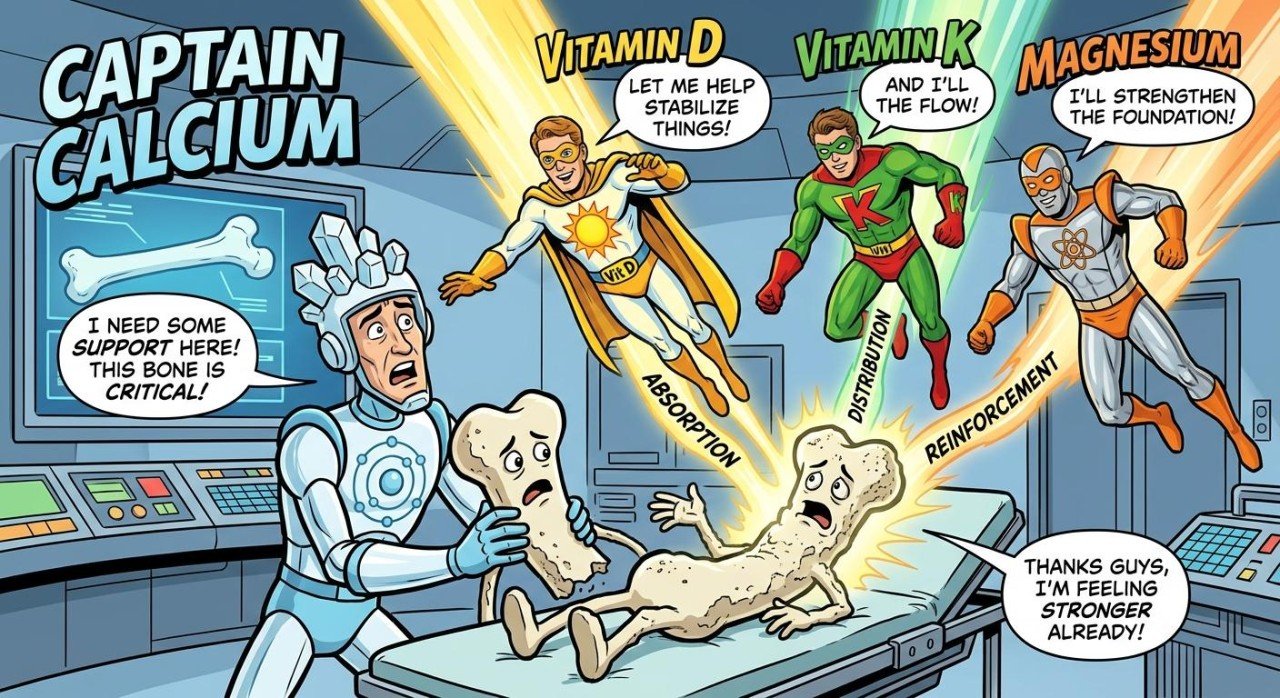
You probably grew up hearing the same thing: drink your milk, strengthen your bones. Calcium became the poster nutrient for the skeleton, and for decades that message went largely unchallenged. But the science has moved on, and the picture it paints is more complex than a glass of milk and a tick in the calcium box.
A pair of analyses published in The BMJ, reviewing over 70 studies, found that consuming 1,000mg of calcium daily did not reduce fractures in people over 50. Bone density increased by just 0.6-1.8% — too small to meaningfully affect fracture risk. The researchers concluded that the evidence for calcium supplementation alone as a fracture prevention strategy is weak at best.
That doesn't mean calcium is irrelevant. It means it's one ingredient in a recipe that requires several more. As UCLA Health puts it, "taking calcium alone without zinc, magnesium and vitamin K2 is like trying to make a cake when the only ingredient you put in the bowl is flour."
Here are the nutrients that actually build and protect your bones — and how to get them from real food.
First, the Scale of the Problem
Osteoporosis isn't a rare condition that happens to other people. According to the International Osteoporosis Foundation, one in three women and one in five men over 50 will experience an osteoporotic fracture. Approximately 200 million women worldwide have the condition, and the risk climbs steeply with age: one in ten women at 60, one in five at 70, and two in five by 80.
Among women over 45, osteoporosis accounts for more days spent in hospital than diabetes, heart attacks, or breast cancer. White women face a one-in-six lifetime risk of hip fracture — greater than their one-in-nine risk of breast cancer.
Yet most people's bone health strategy begins and ends with calcium. The research suggests that's nowhere near enough.
1. Vitamin D — The Gatekeeper
Without vitamin D, your body can only absorb about 10-15% of the calcium you eat. With adequate vitamin D, that figure rises to 30-40%. So you could eat all the calcium-rich food in the world, but if you're low on vitamin D, most of it passes straight through you.
Vitamin D acts as a hormonal gatekeeper, switching on the mechanisms in your gut that absorb dietary calcium and phosphorus into the bloodstream. It also helps regulate the process of bone remodelling — the ongoing cycle where old bone tissue is broken down and replaced with new.
How much do you need?
The National Institute of Arthritis and Musculoskeletal and Skin Diseases recommends 600 IU (15 mcg) daily for adults up to age 70, and 800 IU (20 mcg) for those over 70. Many researchers argue these numbers are too conservative, and that 1,000 IU or more may be needed for optimal bone health.
Where to get it
Your skin makes vitamin D from sunlight, but in higher latitudes (above about 37 degrees north), this is unreliable for much of the year. Food sources include fatty fish like salmon, mackerel, and sardines, egg yolks, and fortified dairy or plant milks. Despite these options, most people in the United States do not consume enough vitamin D to meet recommended intakes. If you rarely get sun exposure, a supplement is worth discussing with your GP.
2. Vitamin K2 — The Traffic Controller
Here's a problem that doesn't get enough attention: calcium doesn't automatically know where to go. Once it's in your bloodstream, it can end up in your bones (good), or it can accumulate in your arteries, kidneys, and soft tissues (very bad). Vitamin K2 is the nutrient that directs traffic.
K2 activates two critical proteins. The first is osteocalcin, which binds calcium into your bone matrix, strengthening the skeleton. The second is matrix GLA protein (MGP), which acts as a calcification inhibitor — it prevents calcium from depositing in your arterial walls. A review in Clinical Pharmacology & Biopharmaceutics found that without adequate K2, newly made osteocalcin can't become fully activated, and calcium ends up in the wrong places.
The evidence is striking
The Rotterdam Study, a population-based investigation of 4,807 healthy individuals over 55, found that those with the highest dietary K2 intake (at least 32 mcg daily) had a 50% lower risk of death from cardiovascular disease related to arterial calcification, and a 25% reduction in all-cause mortality.
A separate double-blind trial of 244 postmenopausal Dutch women found that 180 mcg of MK-7 (a form of K2) daily for three years significantly improved both bone mineral density and arterial elasticity. In the EPIC cohort study following 16,000 women for eight years, every additional 10 mcg of dietary K2 was associated with a 9% decrease in coronary heart disease risk.
Where to find it
K2 is different from K1 (which is abundant in leafy greens and primarily involved in blood clotting). The best food sources of K2 include natto (fermented soybeans — the richest source by far), aged cheeses like Gouda and Brie, egg yolks, butter from grass-fed animals, and liver. If natto isn't your thing, aged cheese and eggs are the most accessible everyday sources.
3. Magnesium — The Structural Partner
About 60% of the magnesium in your body is stored in your bones, where it forms part of the mineral crystal structure. This isn't a minor supporting role — magnesium is literally woven into the fabric of your skeleton.
Magnesium also plays several indirect roles in bone health. It's an essential cofactor for converting vitamin D into its active form, meaning that if you're low on magnesium, your vitamin D may not work properly either. It helps regulate parathyroid hormone, which controls calcium balance, and it promotes the activity of osteoblasts (the cells that build new bone) while suppressing osteoclasts (the cells that break it down).
Deficiency is alarmingly common
A review in Nutrients found that roughly 48% of all age groups in the United States consume less magnesium than recommended. Among postmenopausal women — the very group most vulnerable to osteoporosis — 30-40% show low magnesium levels. All nine serum concentration studies since 2009 confirmed that lower magnesium levels correlate with the presence of osteoporosis.
Where to find it
The best food sources are dark leafy greens (especially spinach and Swiss chard), pumpkin seeds, almonds, cashews, black beans, avocados, and dark chocolate. A handful of pumpkin seeds alone delivers roughly 150mg of magnesium — about a third of the daily requirement.
Take the Guesswork Out of Eating Well
Eat Well Planner helps you organize your favorite recipes, plan balanced meals, and automatically generate shopping lists — all in one place. Whether you're tracking macros, managing dietary restrictions, or just trying to stop asking "what's for dinner?", we've got you covered.
Our AI-powered tools can adapt any recipe to your dietary needs, help you discover new meals you'll love, and even log your nutrition effortlessly. It's meal planning made simple.
Start Organizing Your Meals — Free4. Phosphorus — The Other Half of Bone Mineral
About 85% of the phosphorus in your body exists in your bones and teeth as hydroxyapatite — the calcium-phosphate crystal that gives bone its rigid structure. Without phosphorus, calcium has nothing to bind to. They are inseparable partners in bone mineralization.
Unlike most nutrients on this list, phosphorus deficiency from whole foods is rare. The recommended intake is 700mg per day, and most Western diets provide well above that. The problem with phosphorus is actually the opposite: too much of the wrong kind.
The processed food problem
Phosphoric acid and phosphate additives are used extensively in processed foods — frozen meals, packaged meats, fizzy drinks, baked goods, and even some yogurts. These additives can add roughly 736mg of extra phosphorus daily compared to additive-free diets. When phosphorus intake is far higher than calcium intake, it can trigger secondary hyperparathyroidism, pulling calcium out of bones to compensate.
The solution isn't to avoid phosphorus — it's to get it from whole food sources like fish, poultry, eggs, dairy, legumes, and nuts, where it comes packaged with the calcium, magnesium, and protein your bones also need. The problems arise when phosphorus floods in from processed additives without those balancing nutrients.
5. Protein — The Scaffold
Bone isn't just a mineral — roughly half of bone volume is protein, primarily collagen, which provides the flexible scaffold that minerals attach to. Think of it like reinforced concrete: calcium and phosphorus are the concrete, but collagen is the steel rebar holding the structure together.
Research published in Aging Health found that higher protein intake is associated with greater bone mineral density and a lower risk of hip fracture in older adults. Protein stimulates the production of IGF-1 (insulin-like growth factor-1), a key mediator of bone growth, and improves intestinal calcium absorption.
How much matters — especially as you age
The current recommended daily allowance is 0.8g per kilogram of body weight, but research suggests older adults may need 1.0-1.2g per kilogram to protect both muscle and bone. One five-year cohort study found that whole-body bone mineral content was 5-6% greater in the highest versus lowest tertile of protein intake.
Spread your intake across the day rather than loading it all at dinner. Two eggs at breakfast, a tin of fish or chicken at lunch, and a portion of meat or legumes at dinner creates a consistent stimulus for both bone and muscle maintenance.
The Supporting Cast: Boron
One trace mineral deserves honorable mention. Boron doesn't make the headline nutrients, but the research behind it is hard to ignore.
A review published in Integrative Medicine reported that when postmenopausal women supplemented with just 3mg of boron daily, their urinary calcium excretion dropped by 44% — meaning their bodies were retaining far more calcium instead of flushing it away. Boron also appeared to increase serum vitamin D levels by 39% over 49 days and nearly doubled oestradiol levels, a hormone critical for maintaining bone density in women.
You don't need a supplement — boron is found in prunes, raisins, dried apricots, avocados, and nuts. A handful of prunes and almonds gets you close to the 3mg daily amount used in the research.
What's Quietly Damaging Your Bones
Getting the right nutrients in is only half the equation. Several everyday habits actively accelerate bone loss.
Excess sodium
Sodium increases how much calcium you excrete through urine. A high-salt diet forces your body to pull more calcium from your bones to maintain blood levels. The more processed food in your diet, the more likely your sodium intake is working against your bones.
Cola drinks
A study from the Framingham Osteoporosis Study of over 2,500 participants found that women who drank cola daily had 3.7% lower bone mineral density at the femoral neck and 5.4% lower at Ward's area compared to those who rarely drank it. The association was specific to cola — not other carbonated drinks — pointing to phosphoric acid and caffeine as the likely culprits. Diet cola showed similar patterns, ruling out sugar as the sole driver.
Caffeine in excess
Moderate coffee consumption (two to three cups daily) is unlikely to harm your bones, especially if your calcium intake is adequate. But heavy caffeine intake increases urinary calcium loss and, when combined with low calcium intake, can compound the problem.
Crash dieting
Severe calorie restriction — the kind of aggressive dieting that promises rapid weight loss — can directly damage bone density. Research shows that rapid weight loss and significant energy deficits increase bone resorption, and it becomes nearly impossible to get adequate calcium, vitamin D, protein, and magnesium on very low calorie intakes. When weight loss is needed, a moderate approach combined with resistance exercise is far safer for your skeleton.
A sedentary lifestyle
Bones adapt to the demands placed on them. When you spend most of your day sitting, your skeleton gets the message that it doesn't need to be strong. Weight-bearing exercise — walking, running, dancing, strength training — stimulates extra deposits of calcium and nudges bone-forming cells into action. Numerous studies have shown it can slow bone loss, and several show it can actually build new bone.
Building a Bone Health Plate
The nutrients above work as a team, not in isolation. Here's what a bone-friendly meal framework looks like in practice:
Breakfast: Greek yogurt (calcium, protein) with pumpkin seeds (magnesium, phosphorus), a few walnuts (boron), and berries. Two eggs on the side if you want the extra protein plus vitamin D and K2 from the yolks.
Lunch: Sardines on wholegrain toast (calcium, vitamin D, phosphorus, protein) with a large side salad of dark leafy greens (calcium, magnesium, vitamin K1), avocado (magnesium, boron), and a squeeze of lemon.
Dinner: Salmon or chicken thighs (protein, vitamin D, phosphorus) with roasted broccoli and kale (calcium, vitamin K1), sweet potato (magnesium), and a side of white beans or lentils (calcium, magnesium, protein, phosphorus).
Snack: A small handful of almonds and a few dried prunes (boron, magnesium, calcium). Or a piece of aged cheese like Gouda (calcium, K2, protein).
Notice the pattern: whole foods, especially fish, leafy greens, nuts, seeds, eggs, and legumes keep appearing across the categories. You don't need to micromanage each nutrient. If you're eating a varied diet built around these foods, the bone-building nutrients tend to come along for the ride.
Dairy Isn't the Only Answer
Dairy products are a convenient source of calcium and protein, but they're far from the only option. If you're lactose intolerant, vegan, or simply don't love dairy, there are plenty of plant sources that deliver calcium effectively.
- Calcium-set tofu — up to 350mg per serving, plus complete protein
- Kale and bok choy — lower in oxalates than spinach, so their calcium is better absorbed
- Fortified plant milks — most provide 300mg or more per glass, similar to cow's milk
- White beans and chickpeas — a cup of cooked white beans provides roughly 160mg of calcium
- Almonds — 80mg per 30g serving, plus magnesium
- Broccoli — the body absorbs roughly 62% of broccoli's calcium, compared to about 33% from dairy
The key is variety. No single food delivers every bone nutrient, and combining several plant sources across the day easily covers the gaps.
Who Should Be Especially Proactive?
Everyone benefits from looking after their bones, but certain groups face higher risk and should pay closer attention:
- Women over 40 — Bone loss accelerates significantly during perimenopause and menopause as oestrogen levels drop. According to the Bone Health and Osteoporosis Foundation, a woman can lose up to 20% of her bone density in the five to seven years following menopause.
- Anyone with a family history of osteoporosis — A parent or sibling with osteoporosis, particularly a parental hip fracture, significantly increases your own risk.
- Smaller-framed individuals — People with less bone mass to start with have a smaller buffer before bone loss becomes dangerous.
- Anyone who has dieted aggressively — Repeated cycles of severe calorie restriction can compound bone mineral losses over time.
- People on certain medications — Long-term use of corticosteroids, some anti-seizure medications, and proton pump inhibitors can reduce bone density.
- Smokers and heavy drinkers — Both tobacco and excessive alcohol directly impair bone-forming cells.
If several of these apply to you, a bone density scan (DEXA scan) is worth discussing with your doctor sooner rather than later.
The Bottom Line
Calcium matters, but it's not the lone hero of bone health. Your skeleton is a living, dynamic tissue that needs vitamin D to absorb the calcium, vitamin K2 to direct it to the right place, magnesium as a structural partner and vitamin D activator, phosphorus from whole foods (not processed additives) as the other half of bone mineral, and enough protein to maintain the collagen scaffold that holds everything together.
Add in weight-bearing exercise, reduce the bone-damaging habits, and eat a varied diet rich in fish, leafy greens, nuts, seeds, eggs, and legumes — and you'll be giving your bones a far better chance than any single supplement could.
If keeping track of all these nutrients sounds overwhelming, that's exactly the kind of thing Eat Well Planner is built for. The app tracks calcium, vitamin D, magnesium, and other bone-health nutrients across your meals, so you can see at a glance whether you're hitting your targets. You can save bone-friendly recipes, build weekly meal plans around nutrient-dense foods, and let the AI generate shopping lists that cover your bases — no spreadsheets required.