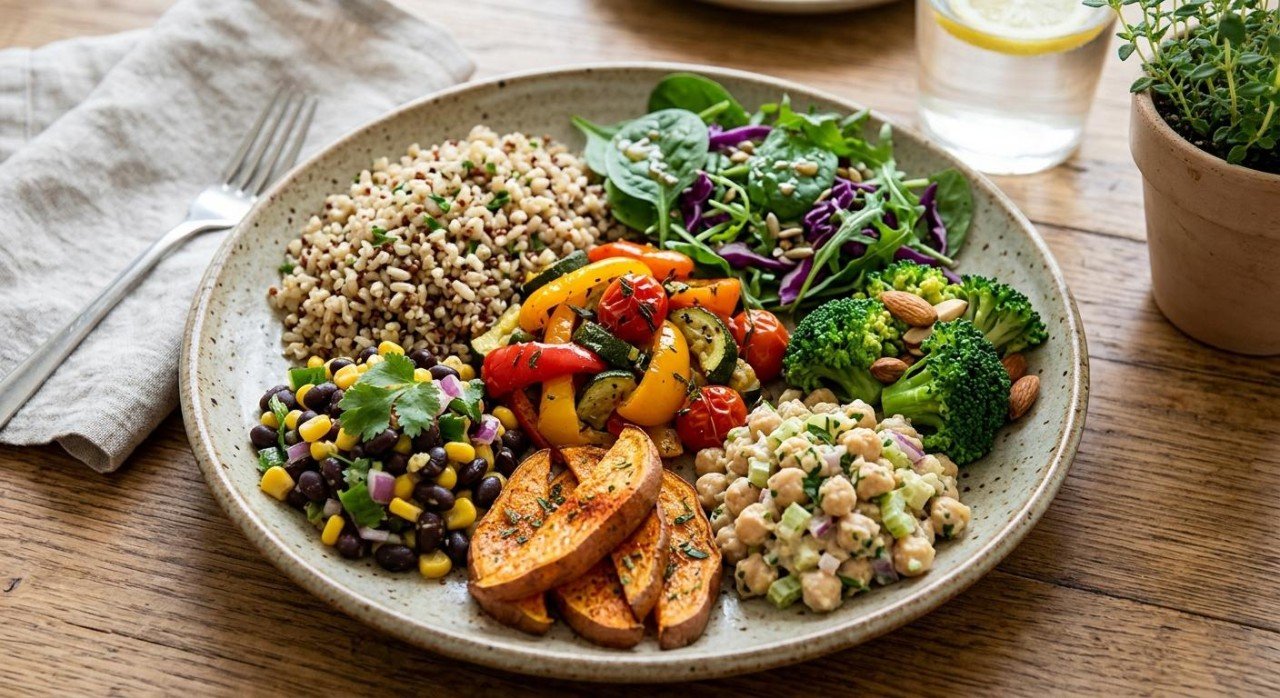
You have probably heard the advice by now: aim for 30 different plants a week. It is one of those numbers that sounds arbitrary until you understand where it came from and, more importantly, what it sets in motion inside you. Because the 30-plant goal is not really about plants at all. It is about the trillions of microbes living in your gut, and the cascade of effects they trigger in your immune system, your brain, and your heart.
In a companion piece, we covered why eating the same dozen plants on repeat quietly works against you and what counts as a plant. This article goes one layer deeper: what actually happens, biologically, when you go from a low-diversity week to a high-diversity one. Once you can picture it, the goal stops feeling like a chore and starts feeling like something you genuinely want to do.
Where the Number 30 Comes From
The figure traces back to the American Gut Project, one of the largest citizen-science microbiome studies ever run, with samples from more than 10,000 people across the US, UK, and Australia. When researchers analyzed the data, a clear pattern emerged. Participants who ate more than 30 different types of plants per week had gut microbiomes that were more diverse than those who ate 10 or fewer types.
Two details make this finding especially striking. First, the people eating 30-plus plants also carried fewer antibiotic resistance genes in their gut bacteria. Second, self-applied labels like "vegan" or "omnivore" did not predict microbiome diversity. What mattered was not the dietary identity you claimed, but the sheer variety of plants actually landing on your plate. A meat-eater with a wildly varied vegetable intake could easily out-diversify a vegan who lives on pasta and a few stand-by vegetables.
So 30 is not a magic threshold so much as a useful target that reliably separates "varied enough to feed a thriving microbiome" from "stuck in a rut." Let us look at what that rut actually costs you.
A Low-Diversity Week vs a High-Diversity Week
Picture a fairly typical week. Breakfast is the same cereal or toast every morning. Lunch rotates between two or three sandwiches. Dinner leans on chicken with potatoes, pasta with a jar of sauce, and maybe a stir-fry with the same three vegetables. It feels reasonably healthy. But count the distinct plants and you might land somewhere around 8 to 12, with the same handful repeating day after day.
Inside your gut, this monotony has consequences. Different microbial species specialize in fermenting different types of fiber. When you feed your gut the same narrow set of plants, you support a narrow set of microbes. The species that prefer the fibers you rarely eat slowly dwindle. Your internal ecosystem contracts, like a garden where only a few hardy weeds survive.
Now picture a high-diversity week: a breakfast with oats, berries, nuts, and seeds; lunches built around different beans, leaves, and vegetables; dinners that rotate grains, legumes, and a rainbow of produce; snacks of fruit and nuts. You are now feeding dozens of different microbial species the specific fibers each one needs. The ecosystem expands. And a richer, more diverse gut community is exactly what the research links to better health across the body.
What Happens in Your Gut
Here is the central mechanism, and it is worth understanding because everything downstream depends on it. Your own digestive enzymes cannot break down most dietary fiber. It travels largely intact to your large intestine, where your gut bacteria ferment it. The main byproducts of that fermentation are short-chain fatty acids (SCFAs) such as acetate, propionate, and butyrate.
Butyrate in particular is a star performer. It is the preferred fuel source for the cells lining your colon, helping maintain a strong, intact gut barrier. That barrier matters enormously: when it is healthy, it keeps the contents of your gut where they belong; when it weakens, bacterial fragments can leak into the bloodstream and drive low-grade inflammation throughout the body. Butyrate has also been linked to better satiety after meals and may be protective against conditions ranging from inflammatory bowel disease to type 2 diabetes.
The catch is that different fibers feed different SCFA-producing bacteria. The more varied your plant intake, the broader your fiber intake, and the more robust your community of SCFA producers becomes. This is the biological reason diversity beats quantity. Eating a huge bowl of the same fiber feeds the same few bugs; eating many different fibers feeds many different bugs and keeps the whole system humming.
What Happens in Your Immune System
Roughly 70% of your immune system resides in and around your gut, so it is no surprise that the two are in constant conversation. Short-chain fatty acids are a big part of how that conversation happens.
SCFAs, especially butyrate, help promote the expansion of regulatory T cells, the immune cells that keep inflammation in check and help prevent the immune system from overreacting to harmless triggers. Butyrate also influences gene expression in immune cells and reinforces the tight junctions between the cells of your gut lining. In practical terms, a well-fed, diverse microbiome helps train your immune system to be appropriately responsive rather than chronically inflamed.
When plant diversity drops and SCFA production falls, that calming, regulating influence weakens. The result is a gut environment more prone to inflammation, which is increasingly recognized as a common thread running through many chronic diseases.
What Happens in Your Brain
The gut and the brain are linked by a constant two-way exchange often called the gut-brain axis, and your microbes are active participants. Again, short-chain fatty acids are central to the story.
According to research on SCFAs and gut-brain communication, these molecules can influence the brain through several routes. They help regulate the enzyme involved in synthesizing serotonin, the neurotransmitter tied to mood. They appear to support the integrity of the blood-brain barrier. They influence the vagus nerve, the main communication highway between gut and brain, which helps mediate satiety, stress, and mood. SCFAs have even been shown to support the maturation of microglia, the brain's resident immune cells.
This does not mean a varied salad is an antidepressant. But it does mean that the diversity of what you eat plausibly reaches all the way up to how you feel and think, through chemistry produced by bacteria you are feeding three times a day.
What Happens in Your Cardiovascular System
The heart benefits too, and here the evidence is some of the strongest in all of nutrition. A landmark 2019 series of analyses published in The Lancet pooled data from 185 studies and 58 clinical trials. It found a 15 to 30% reduction in all-cause and cardiovascular-related mortality when comparing the people who ate the most dietary fiber to those who ate the least. The protective effect was clear at around 25 to 29 grams of fiber per day, with hints that even more may be better.
Then there is the PREDIMED trial, one of the largest dietary intervention studies ever conducted, which tested a Mediterranean diet rich in vegetables, fruits, legumes, nuts, and olive oil. After the study was reanalyzed and republished to correct a randomization issue, the headline finding held: people on the plant-rich Mediterranean diet had roughly a 30% lower incidence of major cardiovascular events compared with those on a lower-fat control diet. A diverse, plant-forward way of eating is not a fringe idea for heart health; it is one of the best-supported dietary patterns we have.
A 7-Day Plan That Hits 30+ Plants Without Exotic Ingredients
The biggest objection to the 30-plant goal is that it sounds like it requires a specialty grocery run and a lot of money. It does not. Here is a realistic week built from ordinary supermarket ingredients. Remember that herbs, spices, nuts, seeds, whole grains, and legumes all count, and small portions add up.
Breakfasts
- Overnight oats with banana, blueberries, walnuts, and chia seeds (oats, banana, blueberries, walnuts, chia)
- Whole grain toast with peanut butter and sliced apple, dusted with cinnamon (wheat, peanut, apple, cinnamon)
- Yogurt bowl with strawberries, pear, and pumpkin seeds (strawberries, pear, pumpkin seeds)
Lunches
- Big chickpea salad with spinach, tomato, cucumber, red onion, olive oil, and lemon (chickpeas, spinach, tomato, cucumber, red onion, olives, lemon)
- Lentil and vegetable soup with carrots, celery, garlic, and parsley (lentils, carrots, celery, garlic, parsley)
- Brown rice bowl with black beans, corn, bell pepper, and avocado (brown rice, black beans, corn, bell pepper, avocado)
Dinners
- Stir-fry with broccoli, mushrooms, zucchini, ginger, and cashews over quinoa (broccoli, mushrooms, zucchini, ginger, cashews, quinoa)
- Roasted sweet potato with kale and a sprinkle of flaxseed (sweet potato, kale, flaxseed)
- Pasta tossed with green peas, garlic, and a tomato-based sauce
Snacks
- Orange segments and a small handful of almonds (orange, almonds)
Tally the distinct plants and you sail past 30 without a single ingredient you cannot find in a standard store. Notice the trick: you are not eating more food, you are simply spreading variety across the week. A four-bean mix instead of one bean. A bag of mixed leaves instead of plain lettuce. A scatter of seeds on top of meals you already make. Each small swap adds plants without adding effort.
Take the Guesswork Out of Eating Well
Eat Well Planner helps you organize your favorite recipes, plan balanced meals, and automatically generate shopping lists — all in one place. Whether you're tracking macros, managing dietary restrictions, or just trying to stop asking "what's for dinner?", we've got you covered.
Our AI-powered tools can adapt any recipe to your dietary needs, help you discover new meals you'll love, and even log your nutrition effortlessly. It's meal planning made simple.
Start Organizing Your Meals — FreeMaking 30 Plants the Path of Least Resistance
The honest difficulty with eating 30 plants a week is not knowledge or willpower. It is logistics: remembering the variety, shopping for it, and actually building it into meals when you are tired and busy. This is precisely the gap a good plan closes.
Eat Well Planner is built to make this kind of variety the default rather than something you have to fight for. You can save recipes from anywhere, and the app generates personalized weekly meal plans that pull from your collection, so a varied week gets assembled for you instead of you staring into the fridge hoping for inspiration. From that plan, it auto-builds an organized shopping list, which means the diverse ingredients are in your kitchen before the tired-and-busy version of you starts cooking.
Because the app tracks the nutrition of your recipes and logged meals, you can also see your fiber and plant variety building up over the week rather than guessing. And if a recipe leans on the same few vegetables you always reach for, the AI recipe chat can suggest swaps and variations to widen the range. The 30-plant goal becomes less of a number to chase and more of a natural byproduct of how you are already planning to eat.
The Bottom Line
Thirty plants a week is shorthand for something profound: a gut ecosystem diverse enough to produce the short-chain fatty acids that strengthen your gut lining, calm your immune system, communicate with your brain, and protect your heart. The American Gut Project showed that variety, not dietary labels, predicts microbial diversity. Decades of research on fiber and the Mediterranean diet show where that diversity leads.
You do not need exotic ingredients or hours in the kitchen to get there. You need a little variety, spread across the week, made easy enough to stick with. Pick one extra plant to add to a meal you already eat, and build from there. Your microbes, and everything they touch, will thank you.