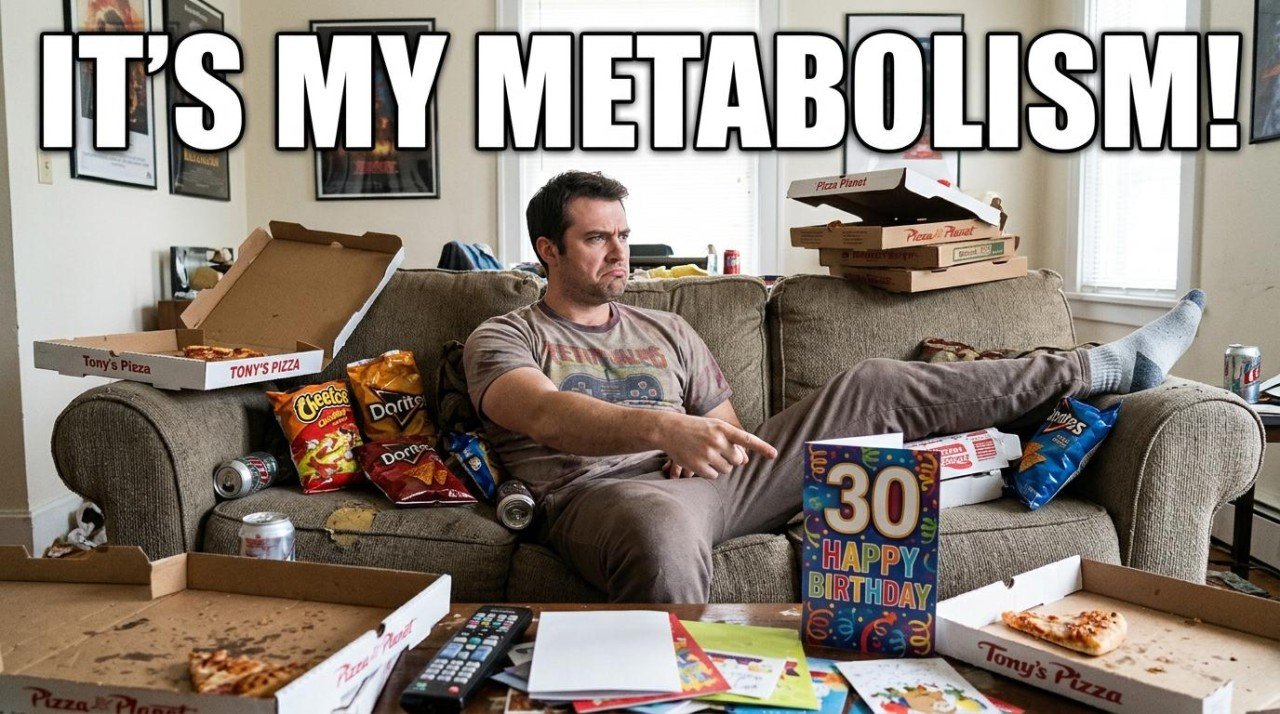
Somewhere around your 30th birthday, someone probably told you to enjoy your metabolism while it lasted. Maybe it was a parent, a coworker, or a stranger online. The idea is everywhere: your body burns fewer calories every year after your twenties, and the jeans that used to fit are the proof.
It's a tidy story. It's also not what the best data we have shows. In 2021, a large international team measured how many calories people actually burn in daily life, from newborns to people in their 90s. The result was striking. For most of adulthood, metabolism barely moved.
Here's what that study found, what does change as you get older, and what you can do about the parts that are in your control.
The Study That Changed the Story
The research was published in the journal Science in August 2021, led by Duke University evolutionary anthropologist Herman Pontzer along with dozens of colleagues. The paper pooled measurements from 6,421 people in 29 countries, ranging in age from 8 days to 95 years.
What made it different was the method. Most earlier large studies measured basal metabolic rate, the energy your body uses at complete rest just to keep you alive. But as Duke explained when the study came out, that's only 50% to 70% of the calories you burn in a day. It leaves out everything else: walking to the car, carrying groceries, fidgeting, cooking dinner.
This team used a technique called doubly labeled water. Participants drink water tagged with harmless, traceable forms of hydrogen and oxygen, and researchers track how quickly those tags leave the body in urine over a week or two. Because oxygen leaves as both water and carbon dioxide, while hydrogen leaves only as water, the difference reveals how much carbon dioxide the body produced, and that translates into calories burned. It captures real life, not just a lab bed.
The researchers then adjusted for body size and composition. That matters, because a bigger body, and especially a body with more muscle, burns more calories simply because there's more tissue to run. In fact, fat-free mass (muscle, organs, bone) explained about 83% of the differences in daily energy use between people. The question the study could then answer was: once you account for how much body you have, does the rate itself change with age?
The Four Phases of Metabolism
The data showed four distinct life stages, and none of them started at 30.
- Infancy (birth to about 1 year): Babies start out burning calories at roughly adult rates for their size, then climb fast. Around their first birthday, they're burning close to 50% more than adults once body size is accounted for.
- Childhood and adolescence (1 to about 20): The rate slowly declines, by about 2.8% per year, settling at adult levels in the early twenties. Surprisingly, there was no spike during puberty. "We really thought puberty would be different and it's not," Pontzer told Duke.
- Adulthood (20 to 60): Stable. Energy expenditure through the 20s, 30s, 40s and 50s was the most consistent stretch of the whole lifespan.
- Older adulthood (60 and up): The decline finally begins, with the turning point around age 63. Even then, it's gradual: about 0.7% per year. By their 90s, people burn roughly 26% fewer calories per day than middle-aged adults, after adjusting for body size.
The researchers also found that in adults, men and women had the same energy expenditure once body composition was taken into account. And pregnancy didn't speed up the rate either; the extra calories matched the extra body mass being carried.
One important caveat: these are averages across thousands of people. Individuals vary, and the paper doesn't mean every 45-year-old burns exactly what they did at 25. But the idea that there's a built-in metabolic cliff at 30, or 40, simply didn't show up.
So Why Do So Many People Gain Weight in Midlife?
The weight gain itself is real. A large analysis published in the New England Journal of Medicine followed more than 120,000 American health professionals and nurses for up to 20 years. On average, they gained 3.35 pounds every four years, or about 16.8 pounds over two decades.
That's less than a pound a year, which is part of why it feels so mysterious. Nothing dramatic happens. It just quietly adds up.
The 2021 study didn't set out to explain midlife weight gain. But as Duke put it when summarizing the findings, several factors could explain the thickening waistlines of our prime working years, and a slowing metabolism isn't one of them. The same NEJM study points to what those other factors might look like. Over each four-year period:
- Each extra daily serving of potato chips was linked to 1.69 pounds of gain, potatoes to 1.28 pounds, and sugar-sweetened drinks to 1.00 pound.
- Each extra daily serving of yogurt was linked to 0.82 pounds less gain, nuts to 0.57 pounds less, fruit to 0.49 pounds less, and whole grains and vegetables to smaller reductions.
- People who increased their physical activity the most gained 1.76 pounds less than those whose activity dropped the most.
- Each extra hour of daily TV was linked to 0.31 pounds of gain, and each extra daily alcoholic drink to 0.41 pounds.
- Sleep mattered too: people sleeping fewer than six hours gained more than those getting six to eight.
These are associations from observational data, not proof that any one food causes weight gain. But the pattern is consistent: midlife weight tracks with what fills the plate, how much we move, and how we rest. Those are exactly the things that tend to shift as careers, kids, commutes and responsibilities pile up in our 30s and 40s.
Movement Quietly Disappears
The activity piece deserves a closer look, because the drop-off is steep. According to CDC data from 2020, only 24.2% of American adults met the federal guidelines for both aerobic and muscle-strengthening activity. And the share fell with every age group.
Among men, 41.3% of those aged 18 to 34 met both guidelines, compared with 29.4% at 35 to 49 and 21.6% at 50 to 64. Among women, it went from 28.7% at 18 to 34, to 22.7% at 35 to 49, and 17.6% at 50 to 64.
Remember that the 2021 study measured total daily calories, and it adjusted for body size. So a stable rate doesn't mean a stable total for everyone. If you move less, you burn less, no matter how steady your cells are. That's a behavior change, not a broken metabolism, and it's one you can do something about. (It's also worth noting that exercise alone usually isn't enough to drive weight loss; we cover why in You Can't Outrun Your Fork.)
The Real Thing to Watch: Muscle
If there's one age-related change that genuinely affects how many calories you burn, it's muscle. Because fat-free mass drives most of your daily energy use, losing it lowers your total burn even if your metabolic rate per pound stays the same.
And muscle does slip away if you don't use it. A review in Current Sports Medicine Reports notes that inactive adults lose 3% to 8% of their muscle mass per decade, along with a drop in resting metabolic rate and an increase in body fat.
The same review has encouraging news: about 10 weeks of resistance training can add roughly 1.4 kg (about 3 pounds) of lean weight, raise resting metabolic rate by about 7%, and cut about 1.8 kg (roughly 4 pounds) of fat. It's one of the few things that measurably nudges your metabolism upward, and it brings a long list of other benefits, from blood sugar control to bone density.
Protein is the other half of the equation. The international PROT-AGE Study Group found that older adults need more protein than younger adults to maintain muscle and function, and recommends that people over 65 aim for at least 1.0 to 1.2 grams of protein per kilogram of body weight per day, and 1.2 grams or more for those who are exercising. For a 150-pound person, that's roughly 68 to 82 grams a day. We go deeper on getting there in You're Losing Muscle Right Now, Here's the Protein Fix.
What About Menopause?
Many women notice their bodies change in their late 40s and early 50s, and the 2021 study doesn't settle that question. It didn't analyze menopause separately, so it can't tell us much about it directly.
Other research fills in part of the picture. The long-running Study of Women's Health Across the Nation (SWAN) tracked body composition with DEXA scans through the menopause transition. Its 2019 analysis in JCI Insight found that at the start of the transition, the rate of fat gain doubled and lean mass began to decline, a pattern that continued until about two years after the final period before leveling off.
Here's the interesting twist: total weight didn't accelerate. Women were gaining weight at a steady pace before menopause, and that pace didn't speed up during the transition. What changed was the mix, with more fat and less lean tissue. So if the number on the scale looks the same but your body feels different, you're not imagining it.
The practical takeaway lines up with everything above: the menopause years are an especially good time to prioritize strength training and enough protein to protect lean mass.
What This Means for You
The good news buried in this research is that the thing most people blame for midlife weight gain is mostly out of the picture until your 60s. That means the levers that matter are ones you can actually pull.
1. Build and keep muscle
Two or more sessions of strength training a week, whether that's weights, resistance bands, or bodyweight moves, helps protect the tissue that does most of your calorie burning. It's never too late to start, and the benefits go well beyond metabolism.
2. Get enough protein, spread through the day
Rather than loading it all into dinner, aim for a solid source of protein at each meal: eggs or Greek yogurt at breakfast, beans, lentils, fish, chicken or tofu at lunch and dinner. This matters more with every decade.
3. Lean on the foods linked to less weight gain
The NEJM data points toward a familiar list: more vegetables, fruit, whole grains, nuts and yogurt, and fewer chips, sugary drinks and processed meats. Think of it as crowding in the good stuff rather than banning anything.
4. Keep moving outside the gym
Walking, taking the stairs, gardening, playing with your kids: all of it counts in your total daily burn. If your days have become mostly desk and couch, small increases add up over years in the same quiet way the weight did.
5. Protect your sleep
Short sleep was linked to more weight gain over time. It's not a nutrition fix, but it affects your appetite, your energy to cook, and your motivation to move.
6. Stop chasing metabolism hacks
If your metabolic rate isn't the problem, products and routines that claim to "boost" it aren't the solution. That includes the old advice to graze all day; eating small meals constantly doesn't rev your metabolism either.
Making the Changes Stick
None of this is complicated in theory. The hard part is that midlife is busy. When you're juggling work, family and everything in between, protein-rich meals and vegetable-heavy dinners are the first things to slip, and the quick, processed options fill the gap.
That's where having a plan helps. Eat Well Planner builds weekly meal plans from your own saved recipes based on your goals, so if you want more protein at every meal, you can set that up in your profile and let the AI do the math. Nutrition tracking shows your actual daily protein and fiber intake, which makes it easy to spot whether you're really hitting those targets or just assuming you are. And the shopping list is generated automatically, so the yogurt, beans and vegetables make it into your cart instead of being forgotten.
Take the Guesswork Out of Eating Well
Eat Well Planner helps you organize your favorite recipes, plan balanced meals, and automatically generate shopping lists — all in one place. Whether you're tracking macros, managing dietary restrictions, or just trying to stop asking "what's for dinner?", we've got you covered.
Our AI-powered tools can adapt any recipe to your dietary needs, help you discover new meals you'll love, and even log your nutrition effortlessly. It's meal planning made simple.
Start Organizing Your Meals — FreeIf you're not sure whether your go-to dinners are pulling their weight, every recipe gets a Nutrition Score, and the Make It Healthier feature suggests specific swaps, like adding a protein source or a side of vegetables, with each change verified by a nutrition calculator before you see it. The food diary lets you log meals by voice, so tracking doesn't become another chore on the list.
The Bottom Line
Your metabolism almost certainly didn't fall off a cliff at 30. According to a study of more than 6,400 people across the lifespan, it holds remarkably steady from your 20s through your 50s, and only begins a slow decline after about 60.
What does change in midlife is the stuff around it: we move less, lose muscle if we don't work to keep it, sleep less, and eat more of whatever is fastest. For women, the menopause transition shifts the balance of fat and lean tissue. Those are real changes, but they're also the ones you have the most say over.
So instead of mourning the metabolism you supposedly lost, put your energy into the things that move the needle: lifting something heavy a couple of times a week, getting protein at every meal, filling your plate with plants, and planning ahead so eating well is the easy option.
Ready to make that easier? Try planning your meals with Eat Well Planner and see how much simpler a protein-rich, plant-forward week can be.