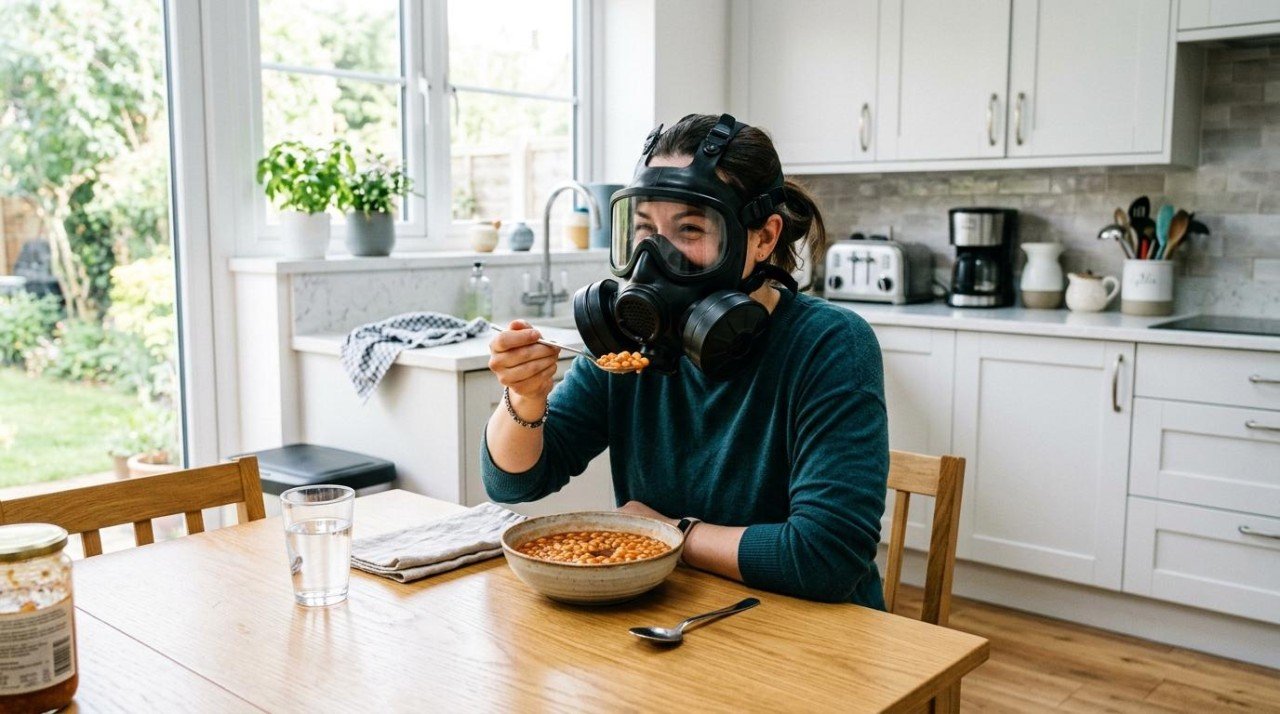
Beans are one of the cheapest, most nutrient-dense foods on the planet, and Americans barely eat them. On any given day, only about 20.5% of US adults eat any legumes at all, and average intake works out to roughly 9.3 grams a day — around 7.3 pounds of dry beans a year, when the Dietary Guidelines point toward closer to five times that.
Ask people why, and you get one answer more than any other. It is not cost, taste, or cooking time. It is gas.
So let us treat that seriously instead of waving it off. Here is exactly what is happening in your gut when you eat beans, what the research says about how long it lasts, and which of the popular fixes actually hold up when you look for evidence behind them. Some of them work better than their reputation. One famous one has essentially no human evidence at all.
First, a Reality Check on What "Normal" Looks Like
Most people have no idea what a normal amount of intestinal gas is, which makes it hard to judge whether beans are causing a problem or just making a normal process noticeable.
In a small but careful study published in Gut, researchers collected 24 hours of flatus from 10 healthy volunteers eating their normal diet plus 200 grams of baked beans. Total daily volume ranged from 476 to 1,491 ml, with a median of 705 ml. Men and women produced equivalent amounts. The largest single component was hydrogen (median 361 ml/24h), followed by unidentified gas presumed to be nitrogen, then carbon dioxide. Only three of the ten produced any methane at all.
Then the researchers did something clever: they put the volunteers on a fiber-free diet for 48 hours. Total volume dropped to a median of 214 ml a day, while the residual non-fermentation gas held steady at around 200 ml. In other words, roughly two thirds of everyday flatus is fermentation gas, and it exists because you are feeding bacteria.
Worth noting too: volume and odor are largely separate problems. When researchers quantitatively collected flatus from 16 healthy subjects who ate pinto beans and lactulose, malodor correlated significantly with hydrogen sulfide concentration, and treating samples with activated charcoal removed virtually all odor. The bulk gases beans generate — hydrogen and carbon dioxide — are not the ones anybody notices from across the room.
The Actual Mechanism: A Sugar You Were Never Built to Digest
Beans, lentils, peas, and soybeans all contain a family of carbohydrates called raffinose family oligosaccharides, or RFOs. The three that matter are raffinose, stachyose, and verbascose. They are built from galactose units joined by an alpha-galactoside bond.
Here is the whole problem in one sentence: humans do not make alpha-galactosidase. As a 2019 review in the Czech Journal of Food Sciences puts it, because of the absence of alpha-galactosidase in the digestive tract of humans and other single-stomached animals, RFOs pass through the stomach and upper intestine undigested.
So they arrive intact in your large intestine, where trillions of bacteria are extremely pleased to see them. Those bacteria do have alpha-galactosidase. They ferment the RFOs, and the byproducts are carbon dioxide, hydrogen, sometimes methane — and short-chain fatty acids, including butyrate, which your colon cells burn for fuel and which is one of the main reasons fiber shows up as protective in study after study. (We went deep on that in our piece on butyrate, the gut compound that may be why fiber works.)
This is the honest framing that most bean advice skips. The gas is not a malfunction, an intolerance, or a sign the beans are "too much" for you. It is the audible receipt for a fermentation event that also produced the compounds you eat fiber to get. The goal is not to eliminate it. The goal is to get it down to a level you do not think about.
How Long Does It Actually Last?
This is where the research gets genuinely encouraging, and where the common belief ("beans always do this to me") turns out to be mostly wrong.
Researchers Donna Winham and Andrea Hutchins pooled self-reported gastrointestinal symptoms from three separate feeding studies in which adults ate half a cup of beans daily for 8 or 12 weeks. The pattern in the first week was about what you would expect: 50% reported increased flatulence on pinto beans, 47% on vegetarian baked beans, and just 19% on black-eyed peas, against 3% on the control of canned carrots.
Then it collapsed. By week two, reports on pinto beans had fallen to 6%, and across weeks three through eight only one or two participants were still reporting symptoms. The authors summarized it plainly: "seventy percent or more of the participants who experienced flatulence felt that it dissipated by the second or third week."
The 12-week parallel-arm study was less dramatic and deserves to be reported honestly — 45% in the first week, declining to 15% to 23% by weeks six through twelve. So symptoms fade substantially, but not always to zero for everyone. These were also self-reports rather than gas measurements, which is a real limitation.
Still, the direction is consistent, and there is a well-documented mechanism behind it. When your colon receives the same fermentable carbohydrate on a regular schedule, the bacterial community reorganizes around it. The best-studied example is lactose. A review of colonic adaptation in lactose intolerance describes a measurable increase in fecal beta-galactosidase after regular lactose consumption, an expansion of lactobacilli and bifidobacteria, and a breath hydrogen response that shifts from a maldigester pattern to a digester pattern — with one landmark study showing hydrogen normalization within 16 days.
Two things follow from that. First, adaptation is fast, on the order of two to three weeks. Second, the same review notes the effects dissipated within 72 hours when consumption stopped. Which explains the most common bean failure mode: eating a huge bowl of chili once a month, having a rough evening, concluding beans are not for you, and never getting past week one.
The Fixes, Ranked by How Much Evidence Is Behind Them
1. Ramp up gradually and then stay consistent
This is the one with the strongest support, and it is what the researchers themselves do. In the BE GONE trial at MD Anderson Cancer Center, participants did not jump straight to the study dose. They added half a cup of canned navy beans a day over a two-week ramp-up period, then went to one cup a day for another six weeks. At that full dose — 16 grams of fiber a day from beans alone — mild to moderate bloating or flatulence was reported by 33% of the people who completed the study, and changed bowel habits by 10%. For context, 12% reported bowel changes during the bean-free control periods too.
A cup a day is a lot of beans. A practical version for most people: start with a quarter cup, three or four times a week, and hold there for a week or two before increasing. Small and frequent beats large and occasional, because frequency is what drives the adaptation.
Consistency is the part people underestimate, and it is exactly the part that is hard to sustain without a plan. Building a week of meals that quietly includes legumes three or four times, then shopping for it in one trip, is much easier than deciding in the moment — which is where Eat Well Planner is genuinely useful. You can build a plan that ramps beans up week over week, let it generate the shopping list, and let Plant Points count each new legume variety toward the 30-plants-a-week gut health target so the variety happens on purpose instead of by accident.
Take the Guesswork Out of Eating Well
Eat Well Planner helps you organize your favorite recipes, plan balanced meals, and automatically generate shopping lists — all in one place. Whether you're tracking macros, managing dietary restrictions, or just trying to stop asking "what's for dinner?", we've got you covered.
Our AI-powered tools can adapt any recipe to your dietary needs, help you discover new meals you'll love, and even log your nutrition effortlessly. It's meal planning made simple.
Start Organizing Your Meals — Free2. Cook them thoroughly — this matters more than soaking
Here is a genuine surprise from the research. Soaking on its own does much less than its reputation suggests. In work cited in the Czech Journal review, soaking pinto beans produced a 9.8% reduction in RFOs. Soaking followed by boiling for 90 minutes produced a 57.6% reduction.
Heat plus water does the heavy lifting, and RFOs are thermally degraded as well as leached. Under-cooked beans are firmer, more fermentable, and more likely to give you trouble. Cook them until they are properly soft — genuinely creamy, not just yielding.
3. Throw the water away, both times
RFOs are water-soluble, so they leave the bean and enter the surrounding liquid. Monash University, which does the primary laboratory work behind the low FODMAP diet, confirms the mechanism directly: oligosaccharides are water soluble, so when legumes are boiled, the liquid they are cooking in becomes higher in oligosaccharides, and straining after cooking can reduce their content.
That means the cooking water matters at least as much as the soaking water. One study of lima beans found roughly a third of the raffinose and a fifth of the stachyose ended up in the soaking water, with the rest going into the cooking water. Changing the soak water helps too: decanting it at four-hour intervals over a 16-hour soak removed 80.3% of raffinose and 44.8% of stachyose from soybeans, far more than a single unchanged soak.
Two honest caveats. Results vary by variety — one study found soaking and discarding the water reduced oligosaccharides in Michigan black beans but had no effect on red or navy beans. And RFOs are not the only thing that leaves: a systematic review of eleven soaking studies notes that discarding the water also carries off phytates, tannins, and phenolic compounds, some of which may themselves be protective at low concentrations. The reviewers weighed that up and still concluded there was a greater advantage to discarding it — their reasoning being that if oligosaccharide discomfort makes someone stop eating beans entirely, they lose all of it anyway.
4. Rinse canned beans (and skip the soak question entirely)
Canned beans have already been soaked, cooked, and left sitting in liquid, which means a good share of their oligosaccharides is dissolved in the can. Monash notes that canned legumes or those boiled and drained tend to be lower in FODMAPs as some oligos leach out into the canning or cooking water and are removed when they are drained and rinsed.
Drain them, then rinse under running water until the foam stops. It also cuts a meaningful amount of the added sodium. Canned beans are not the compromise option here — for someone starting out, they are arguably the better one.
5. Pressure cook
Higher temperature degrades RFOs more aggressively than boiling does. In one comparison collected in the Czech Journal review, three hours of ordinary cooking at 100C reduced raffinose in legume seeds by 29% to 32% and stachyose by 41% to 47%, while autoclaving the same material at 121C for 90 minutes reduced raffinose by 45% to 51% and stachyose by 68% to 69%. In cowpeas specifically, pressure cooking at 120C raised stachyose loss from 59.8% to 66.1% compared with ordinary cooking.
An Instant Pot is not a laboratory autoclave, but it operates in the right direction and gets beans genuinely soft with less attention. If you own one, use it for beans.
6. A pinch of baking soda in the soak
Alkaline soaking is more effective than plain water. Soaking cowpea seeds in a 0.03% sodium bicarbonate solution for 16 hours produced complete removal of raffinose and more than 80% removal of stachyose. That is a striking result — though it is worth knowing baking soda also softens skins, can make beans mushy and slightly soapy if you overdo it, and degrades some thiamin. A quarter teaspoon per pound of dry beans in the soak water, thoroughly rinsed off afterward, is plenty.
7. Start with the lower-RFO legumes — but do not over-trust the ranking
Total RFO content genuinely varies. Using the concentration tables in the Czech Journal review, lentils come in relatively low (roughly 4.5 g/kg raffinose, 16.5 stachyose, 6.2 verbascose on a dry matter basis), while kidney beans sit at the high end (5 to 14 g/kg raffinose and 32 to 47 g/kg stachyose). Lentils and split peas are a reasonable place to begin, and they cook fast without soaking, which removes another barrier.
But the ranking is not destiny. Black-eyed peas are actually high in RFOs on paper, and they were the best tolerated legume in the Winham feeding studies at 19% versus 50% for pintos. The likely explanation is dose rather than chemistry: the black-eyed pea serving carried 4 grams of fiber against 7 for pinto beans. How much fermentable material arrives at once matters as much as which molecule it is.
8. Beano and other alpha-galactosidase supplements
These supply the enzyme you lack, sourced from Aspergillus niger, so it can break the alpha-galactoside bonds before your bacteria get the chance. The evidence is real but modest, and dose-dependent.
The original double-blind crossover trial fed 19 subjects meatless chili made with navy, pinto, and kidney beans, with eight drops of alpha-galactosidase or placebo, then had them log every gas passage for six hours. Flatulence events per hour were significantly lower on the enzyme across the follow-up period (P=.016). But there was no difference in bloating or pain, the effect reached significance in only one individual hour, and — the detail that rarely gets quoted — among the ten subjects who described themselves as having a particular problem with gas after eating beans, there were no statistically significant differences at all.
A later randomized, double-blind, placebo-controlled study gave eight healthy volunteers 300 or 1,200 GalU of alpha-galactosidase with a test meal containing 420 grams of cooked beans. The 1,200 GalU dose significantly reduced both breath hydrogen excretion and flatulence severity, and both doses significantly reduced the total symptom score. So it works, better at higher doses.
The philosophical catch is worth stating plainly: alpha-galactosidase works by destroying the prebiotic. Those oligosaccharides are precisely what your bifidobacteria were going to eat. As a tool for a dinner party or a long flight, it is genuinely useful. As a permanent daily strategy, you are paying to remove part of what you eat beans for.
9. Kombu: tradition, not evidence
The advice to drop a strip of kombu seaweed into the pot appears in Japanese temple cooking and Western macrobiotic cooking, and it circulates widely online with the explanation that kombu contains alpha-galactosidase.
We went looking for a human trial, or even a food-science measurement of RFO reduction in kombu-cooked beans, and could not find one. The mechanistic story also has a problem: enzymes are proteins, and a protein does not survive an hour at boiling point. Whatever kombu does for a pot of beans, an intact enzyme reaching your colon is unlikely to be it.
None of which is a reason to stop. Kombu adds glutamates that make beans taste noticeably richer, plus minerals and iodine. Just do not count on it for digestion, and do not conclude beans have failed you when the kombu does not deliver.
When It Is Not Just Adaptation
Two caveats matter. If you have IBS, RFOs are galacto-oligosaccharides — the GOS in FODMAP — and your response may be about visceral sensitivity rather than gas volume. Portion size is the lever there; Monash's tested low-FODMAP servings for legumes are small and specific, such as a quarter cup of canned drained chickpeas, and their app has the current numbers. Small tested portions of well-rinsed canned legumes are usually workable even on a restricted diet, and a low-FODMAP approach was never designed to be permanent.
And if bloating is severe, comes with pain, weight loss, or a change in bowel habits that persists, that deserves a doctor rather than a soaking technique. Persistent symptoms on a high-fiber diet can point to something else entirely, including bacterial overgrowth in the small intestine.
What You Get for Two Weeks of Mild Inconvenience
The BE GONE trial is the clearest picture of the payoff. Forty-eight adults with obesity and a history of colorectal cancer or high-risk polyps completed a crossover trial adding a cup of canned navy beans a day. Within eight weeks, microbial diversity increased significantly, and Faecalibacterium, Eubacterium, and Bifidobacterium all rose — three of the most consistently beneficial groups in the human gut. Markers of intestinal and systemic inflammation shifted. As the MD Anderson team put it, observing a shift in microbiome diversity with diet intervention alone is rare.
Then they stopped the beans, and the gains regressed. Faecalibacterium dropped significantly. Which is the whole argument for consistency, restated from the other end.
Zoom out and the epidemiology points the same way. A 2023 dose-response meta-analysis in Advances in Nutrition pooling 32 cohorts and more than 1.1 million participants found each additional 50 grams of legumes per day was associated with roughly 6% lower all-cause mortality. Meanwhile only 5% of American men and 9% of American women get the recommended amount of fiber, and beans are among the densest, cheapest ways to close that gap — one cup of the BE GONE navy beans carried 16 grams of fiber and 14 grams of protein for 220 calories.
The Two-Week Plan
Put together, the evidence supports something quite simple:
- Week 1: A quarter cup of well-rinsed canned lentils or chickpeas, three or four times. Stirred into a soup, folded into a salad, blended into a dip. Small enough that nothing much happens.
- Week 2: Half a cup, four or five times. This is where most of the adaptation happens, and where most people quit if they are not expecting it.
- Week 3 onward: Increase toward a cup a day if you want, and start rotating varieties — black beans, pintos, split peas, black-eyed peas, kidney beans last.
- Cooking dried beans: Soak, change the water once or twice, drain, cook in fresh water until genuinely soft, and drain again. Pressure cook if you have the option.
- Reach for the enzyme when the timing is bad, not as your default.
The one thing that reliably fails is the pattern most people are actually running: a large plate of beans once every few weeks, permanently stuck at day one of adaptation, with the gas taken as proof rather than as a starting point.
This is also the kind of change that is trivially easy to intend and surprisingly easy to drop by Thursday. If you want the ramp to actually happen, put it in a plan rather than in your memory. Eat Well Planner can build a week of meals that works legumes in at the frequency you choose, generate the shopping list so the beans are in the house when you need them, and show you the fiber and nutrient picture of what you have planned — including which of your recipes already qualify as a good source of fiber, folate, or potassium. Plant Points then turns "eat more variety" into a number you can actually watch move.
Beans are not a food you have to be brave about. They are a food you have to be consistent about for roughly two weeks. That is the entire price of admission.