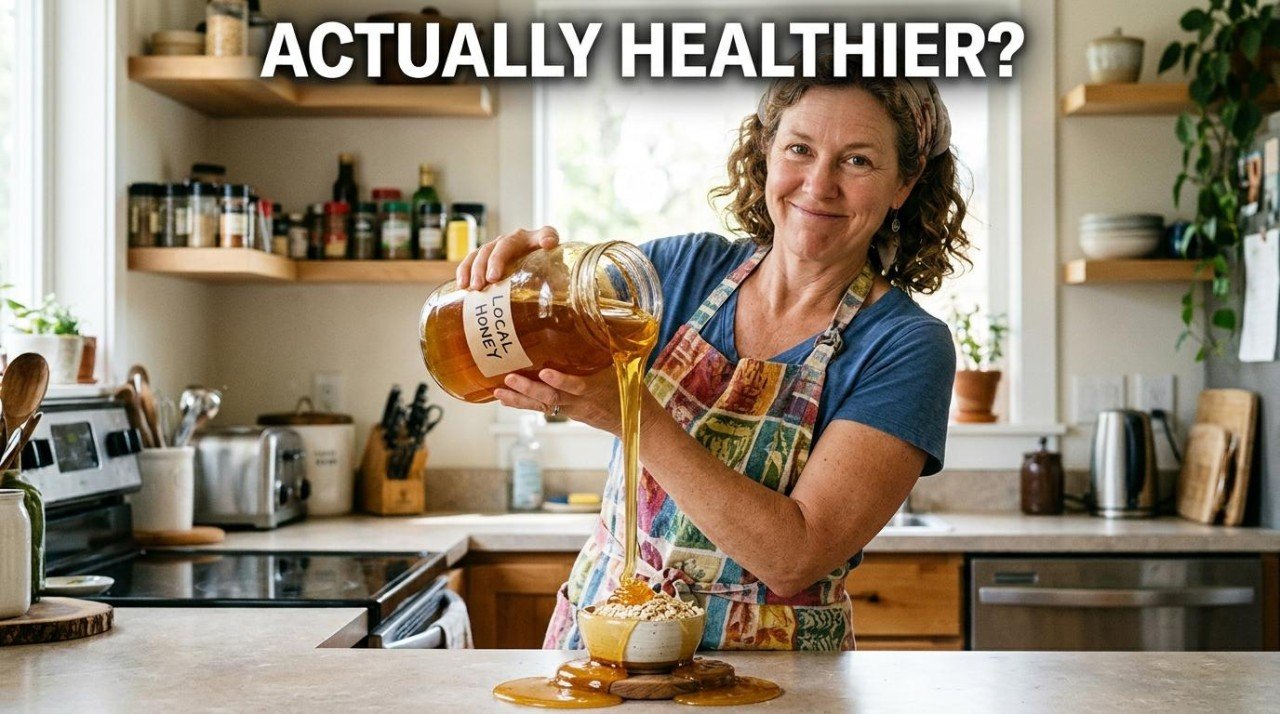
Walk down the baking aisle and the sweeteners have sorted themselves into two camps. On one side, plain white sugar in a paper bag. On the other, amber jars of raw honey, glass bottles of dark maple syrup, and pouches of coconut sugar with words like "unrefined," "low glycemic," and "nutrient-rich" printed across the front. The second camp costs more and feels like the better choice.
But is it? If you swap the sugar in your banana bread for maple syrup, or stir honey into your tea instead of a spoonful of the white stuff, are you actually doing your body a favor? The honest answer is more interesting than either "yes, it's natural" or "no, sugar is sugar." Some of these sweeteners really do carry extra nutrients and plant compounds. The catch is the dose: how much you would need to eat to get a meaningful amount, and what else comes along with it.
Let's walk through what the research actually says about trace nutrients, blood sugar, and the handful of clinical trials that exist, and then talk about when switching is genuinely worth it.
First, Your Body Counts Them All as Added Sugar
Start with how health authorities see these sweeteners, because they are remarkably consistent. The World Health Organization's definition of "free sugars" explicitly includes "sugars naturally present in honey, syrups, fruit juices and fruit juice concentrates," right alongside the sucrose added by manufacturers and cooks. WHO recommends keeping free sugars under 10% of daily calories, and notes that going below 5%, or roughly 25 grams (6 teaspoons) a day, would provide additional health benefits.
The FDA takes the same view in the U.S. The Daily Value for added sugars is 50 grams per day on a 2,000-calorie diet, and pure honey and maple syrup still list a percent Daily Value for added sugars on their Nutrition Facts labels. The FDA allows single-ingredient products like these to handle the gram amount a little differently "so that it does not look like more sugars have been added to the product," but it doesn't exempt them from counting toward your daily limit.
So "natural" is not a separate category. Coconut sugar comes from the sap of coconut palm flowers, maple syrup from boiled-down tree sap, and honey from bees concentrating flower nectar. White sugar comes from boiled and crystallized cane or beet juice. They are all concentrated sugars extracted from plants. (If you want a broader look at how that word gets used on packaging, we've written about why "natural," "clean," and "detox" mean nothing on a label.)
That framing matters, but it isn't the whole story. The more useful question is whether a tablespoon of one is meaningfully different from a tablespoon of another. Let's look.
The Trace Nutrient Argument: Real, But Mind the Dose
The main case for "natural" sweeteners is that they keep some of the minerals, vitamins, and antioxidants that refining strips out of white sugar. That part is true. Whether it matters depends on which sweetener you're talking about.
Maple syrup: the one with a genuine nutrient story
Maple syrup is the surprise here. According to USDA data (as shown on NutritionValue.org), one tablespoon of maple syrup provides about 0.58 mg of manganese, which is 25% of the Daily Value, and 0.25 mg of riboflavin, about 20% of the Daily Value. That's not nothing. Very few sweeteners can say a single tablespoon covers a fifth or a quarter of your daily need for anything.
The rest of the label is less exciting: about 3% of the Daily Value for zinc, 2% for calcium, and 1% for potassium. And that same tablespoon carries about 52 calories and 12 grams of sugar, roughly a quarter of the FDA's 50-gram daily limit for added sugars. Manganese and riboflavin are also easy to get from whole foods like whole grains, nuts, legumes, eggs, and dairy, without the sugar attached.
Honey: lots of reputation, very little on the label
Honey's nutrient story is weaker than its reputation. Using USDA figures from NutritionValue.org, a tablespoon of honey contains about 64 calories and 17 grams of sugar, with potassium, iron, vitamin C, riboflavin, and manganese each coming in below 1% of the Daily Value. That 17 grams is about a third of the daily added sugar limit in one spoonful.
Honey does contain bioactive compounds, like polyphenols and enzymes, that don't show up on a nutrition label, and that's where its more interesting research lives. We'll get to that below.
Coconut sugar: mostly sucrose with a little inulin
Coconut sugar is often marketed as mineral-rich and gut-friendly. One study published in Acta Manilana by Philippine researchers found that coconut sap sugar contains inulin, a prebiotic fiber, at about 4.7 grams per 100 grams. That sounds promising until you scale it to a real serving: a teaspoon of coconut sugar weighs about 4 grams, so it would deliver roughly a fifth of a gram of inulin. The same study found no dietary fiber in the sap sugar itself.
Meanwhile, the main carbohydrate in coconut sugar is sucrose, the same molecule as table sugar, which makes up around 70% to 79% of its weight.
The antioxidant math
The best-known study on this question comes from researchers at Virginia Tech. In a 2009 paper in the Journal of the American Dietetic Association, Phillips, Carlsen, and Blomhoff measured the total antioxidant capacity of refined sugar and a dozen alternatives. Refined sugar, corn syrup, and agave nectar had almost no measurable antioxidant activity (under 0.01 mmol per 100 grams). Raw cane sugar came in at 0.1. Maple syrup, brown sugar, and honey landed in the middle at 0.2 to 0.7. Dark and blackstrap molasses were the standouts, at 4.6 to 4.9.
The authors estimated that swapping refined sugar for these alternatives could add about 2.6 mmol of antioxidants a day, similar to a serving of berries or nuts. That's a real finding, but look at the assumption behind it: the estimate was based on an average intake of 130 grams of refined sugar per day. That's more than two and a half times the FDA's 50-gram daily limit, or roughly 30 teaspoons. If you're eating a more reasonable amount of sugar, the antioxidant bump from switching shrinks proportionally, and an actual serving of berries or nuts starts to look like the far better deal.
That's the theme of this whole post in one number: the nutrients are there, but you'd need to eat a lot of sugar to get much of them.
The Glycemic Index Claim
The second big selling point, especially for coconut sugar, is a "low glycemic index." The glycemic index (GI) ranks how quickly a carbohydrate food raises blood sugar compared with pure glucose.
Coconut sugar's low-GI reputation traces back largely to a Philippine test that reported a GI of 35. But when the University of Sydney's Glycemic Index Research Service measured coconut sugar, it got a GI of 54. Published values vary with how the sugar is harvested and processed, so the number on a bag may not match what's in it.
Honey and agave tend to score lower than table sugar for a simpler reason: fructose. Fructose barely raises blood glucose on its own, so a sweetener with more fructose scores lower on the GI scale. Honey contains slightly more fructose than glucose, and Harvard Health notes that some types of agave nectar contain up to 90% fructose. A low GI driven by fructose isn't a health halo, though. Harvard's conclusion is blunt: "Whether an added sugar contains more or less fructose versus glucose has little impact on health," and "for most people, one type of sugar isn't better than another."
There's also the question of portion size. GI describes the type of carbohydrate, not the amount, and a tablespoon of any sweetener is a small dose of sugar either way. What moves your blood sugar more is how much you use and what you eat it with, which is why glycemic load is often the more useful number.
What the Clinical Trials Actually Show
Lab measurements only go so far. Fortunately, a few studies have tested these sweeteners in people, and they're worth looking at honestly, including their limitations.
Honey: modest signals, low certainty
A 2023 systematic review and meta-analysis in Nutrition Reviews pooled 18 controlled trials with 1,105 participants. Honey was associated with small reductions in fasting blood sugar, total and LDL cholesterol, and triglycerides, along with a rise in HDL cholesterol. The effects appeared stronger for raw honey and for certain floral sources such as robinia (acacia) and clover.
The details are important here. The median dose was 40 grams a day, about two tablespoons, for a median of eight weeks. In most comparisons, honey was added on top of people's usual diets rather than replacing other sugars. The certainty of evidence was rated low for most outcomes. The fasting glucose reduction, about 0.20 mmol/L (around 3.6 mg/dL), was no longer statistically significant after the authors adjusted for possible publication bias, and they described the lipid benefits as appearing "clinically trivial."
So honey may not behave exactly like an equal amount of table sugar, and raw honey in particular deserves more research. But this isn't evidence that honey is a health food or that eating more of it will improve your numbers.
Maple syrup: one encouraging trial, with an asterisk
In 2024, The Journal of Nutrition published a randomized, double-blind crossover trial in which 42 overweight adults replaced 5% of their daily calories from added sugars with either maple syrup or an artificially flavored sucrose syrup for eight weeks. On a 2,000-calorie diet, that's about 100 calories, or roughly two tablespoons of maple syrup a day.
Compared with the sucrose syrup, maple syrup led to a lower blood sugar response during a glucose tolerance test, a small drop in systolic blood pressure (about 2.7 mm Hg versus a slight increase in the sucrose group), and a small decrease in abdominal fat. Blood lipids didn't change. The researchers also observed some shifts in gut bacteria.
The asterisk: as nutrition researcher Marion Nestle pointed out, the study was funded by Quebec's maple syrup producers' association and the provincial agriculture ministry. Industry funding doesn't automatically make results wrong, but a single, industry-funded trial of 42 people isn't enough to call maple syrup a health food. Nestle's summary is worth remembering: "Maple syrup is sugar, especially deliciously flavored."
Coconut sugar: no meaningful human outcome trials
We couldn't find human trials showing health benefits from eating coconut sugar instead of regular sugar. Its case rests on the inulin content and the disputed GI, both covered above.
One Important Safety Note About Honey
Natural doesn't always mean gentler. Honey should never be given to babies under 12 months old. According to the University of Florida's extension service, the CDC, the American Academy of Pediatrics, and the National Honey Board all recommend against it because honey can carry botulism spores that an infant's immature gut can't handle. A survey of U.S. honey found spores in 10% of samples. That includes honey added to water, food, or formula. For older children and adults, this isn't a concern.
So, Is "Natural" Sugar Any Better for You?
Here's how the evidence shakes out:
- Maple syrup has the strongest case. A tablespoon delivers meaningful manganese and riboflavin, it carries more antioxidants than white sugar, and one (industry-funded) trial found modest metabolic benefits when it replaced refined sugar. It's still about 12 grams of sugar per tablespoon.
- Honey has interesting research behind it, especially raw honey, but the evidence is low certainty and the effects are small. Nutritionally, it's mostly sugar, and it's a bit more concentrated than maple syrup per spoonful.
- Coconut sugar is mostly sucrose. Its inulin content is tiny at real serving sizes, and its low-GI claim isn't consistent across testing.
- Agave, often grouped with these, has almost no antioxidant activity and can be very high in fructose.
If you're choosing between white sugar and pure maple syrup or raw honey for the same recipe, the "natural" option is a slightly better pick, not a dramatically better one. The far bigger lever is the amount. Going from two tablespoons of sweetener to one does more for your health than switching from sugar to any of these.
It also helps to know where sugar actually comes from in most diets. A lot of it isn't the spoonful you add at home but the sugar already built into packaged foods, sauces, and drinks. Our guide to the many names for added sugar can help you spot it.
When the Swap Is Worth It: Flavor
Here's the best reason to reach for honey or maple syrup: they taste like something. White sugar is pure sweetness. Dark maple syrup brings caramel and vanilla notes. Buckwheat or wildflower honey can be floral, earthy, or almost malty. Coconut sugar has a toasty, brown-sugar quality.
That flavor can help you use less. When a sweetener contributes character instead of just sweetness, a smaller amount often feels like enough. A few ways to put that to work:
- Drizzle rather than mix in. A teaspoon of maple syrup on top of plain yogurt or oatmeal hits your taste buds first, so you notice it more than the same amount stirred in.
- Choose stronger varieties. Darker maple syrups and bolder honeys pack more flavor per spoonful than their mild, light-colored counterparts.
- Cut the amount in baking. Many quick bread, muffin, and oatmeal recipes still taste great with a quarter less sweetener, especially when you're using a flavorful one alongside spices like cinnamon or vanilla.
- Let fruit do some of the work. Mashed banana, grated apple, or chopped dates bring sweetness along with fiber, which a syrup or sugar can't.
- Pair sweet with savory. A little honey in a vinaigrette or a maple glaze on roasted carrots or salmon goes further than the same amount in a dessert.
Keep in mind that liquid sweeteners behave differently in recipes than granulated sugar. If you're swapping one for another, our substitution guides for maple syrup and honey cover the practical ratios.
Take the Guesswork Out of Eating Well
Eat Well Planner helps you organize your favorite recipes, plan balanced meals, and automatically generate shopping lists — all in one place. Whether you're tracking macros, managing dietary restrictions, or just trying to stop asking "what's for dinner?", we've got you covered.
Our AI-powered tools can adapt any recipe to your dietary needs, help you discover new meals you'll love, and even log your nutrition effortlessly. It's meal planning made simple.
Start Organizing Your Meals — FreeSeeing the Difference in Your Own Recipes
It's one thing to read that the amount matters more than the type. It's another to see it play out in the recipes you actually cook.
In Eat Well Planner, every recipe gets a Nutrition Score, so you can see at a glance how a dish stacks up. If you want to test a sweetener swap, the Recipe Playground lets you change ingredients and watch the score update live, with a per-edit delta showing exactly how much each change moves the needle. Try swapping white sugar for maple syrup, and then try cutting the amount by a third. You'll likely see for yourself which change makes the bigger difference.
If you'd rather not experiment manually, Make It Healthier proposes specific ingredient changes for a recipe and verifies the actual nutritional gain with a calculator before suggesting them, so you're not relying on a "natural" label to decide what's better. And nutrition tracking gives you a clearer picture of how much sugar is actually showing up across your week, which is where the real progress happens.
The Bottom Line
Honey, maple syrup, and coconut sugar aren't magic, and they aren't a scam either. Maple syrup brings real minerals, honey has some intriguing early research, and both have a little more going on than white sugar. But your body still treats all of them as added sugar, and the extra nutrients only add up if you eat more sugar than anyone would recommend.
So pick the sweetener you love the taste of, use it on purpose, and use a little less. If you notice you're reaching for sweet things more than you'd like, it may help to understand why sugar cravings aren't a sign of weakness and how to gently reset them.
Want to see how small sweetener changes add up across your week? Try planning your meals with Eat Well Planner and put the numbers to work for you.