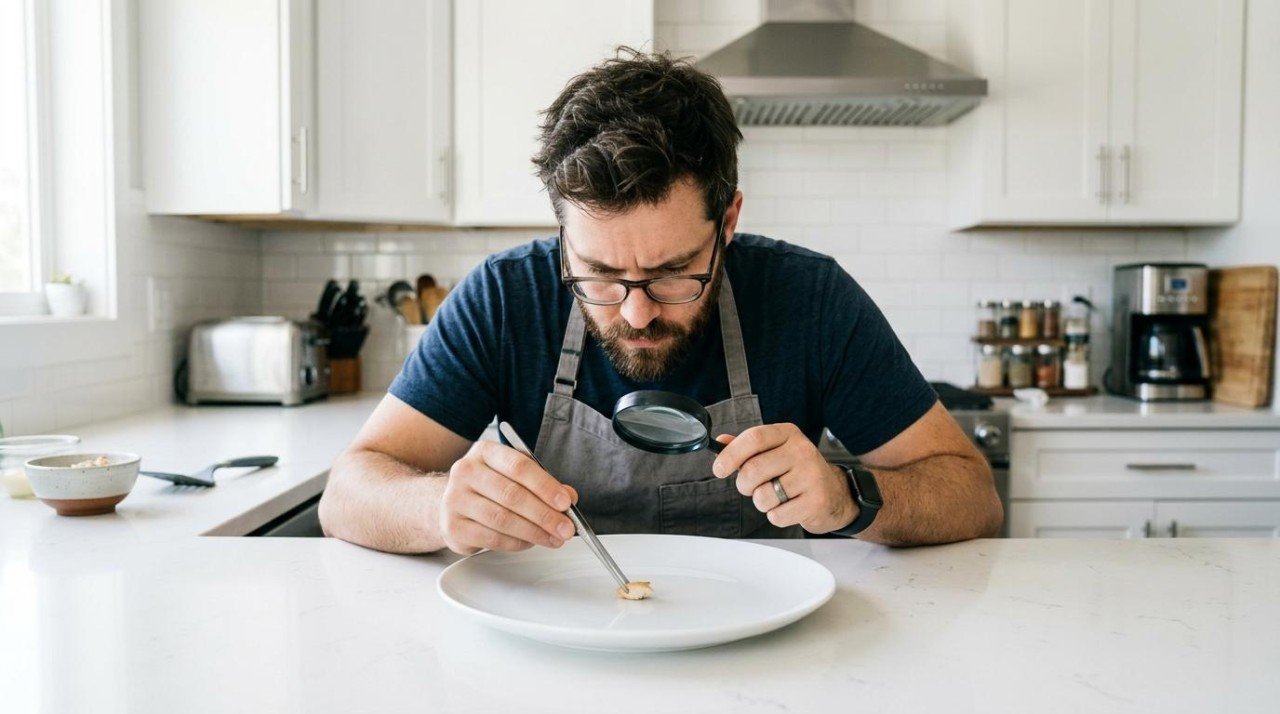
Most nutrition advice assumes you want to eat more than you should. Portion tricks, smaller plates, filling up on salad first, strategies for the 4pm vending machine. Nearly all of it is built around the idea that appetite is the thing you are fighting.
On a GLP-1 medication, that assumption stops being true almost overnight. Appetite goes quiet. Food stops calling. And a lot of people discover, somewhere around week three, that they have no framework at all for the actual problem in front of them: they are eating very little, and they have no idea whether what they are eating is enough of the right things.
This is not a small group of people. In a KFF Health Tracking Poll conducted in late 2025, about one in eight US adults (12%) said they were currently taking a GLP-1 drug, and nearly one in five (18%) had taken one at some point. Among adults with diabetes, current use was 45%.
So this post is about the inverted problem. Not how to eat less — the medication handles that — but how to make a much smaller amount of food carry everything your body still needs. No opinions here about whether anyone should be on these drugs. That is between a person and their clinician. This is about eating well once you are.
When you eat less, every bite has to work harder
Here is the math that changes everything. Your calorie intake might drop by a third or more. Your requirement for protein, iron, calcium, magnesium, zinc, B12, and fiber does not drop at all. Some of it goes up.
That means the nutrient density of your food, meaning how much nutrition arrives per bite, has to rise sharply just to keep you where you were. A diet that was merely mediocre when you were eating 2,400 calories becomes genuinely deficient at 1,400.
In 2025, four major organizations (the American College of Lifestyle Medicine, the American Society for Nutrition, the Obesity Medicine Association, and The Obesity Society) published a joint advisory on nutritional priorities for people on GLP-1 therapy. It lays out eight priorities, and the through-line across most of them is exactly this: nutrient adequacy inside a substantially smaller amount of food.
Practically, it means the discretionary stuff gets squeezed out first, not because it is sinful, but because there is simply no longer room for it. When you have four or five small eating occasions a day and each one is a few bites, a snack that delivers nothing but calories is not a treat. It is one of your only remaining slots, spent.
Protein first, and what the muscle research actually says
You have probably seen alarming headlines about GLP-1s and muscle loss. The truth is more interesting than either the panic or the dismissal.
It is accurate that a meaningful share of the weight lost is lean mass. A 2026 review in the European Journal of Clinical Investigation puts it at roughly 20% to 40% of total weight lost, depending on the trial. In the STEP 1 semaglutide trial, fat mass fell 19.3% while lean body mass fell 9.7%.
But two pieces of context matter enormously. First, that same review notes that when you compare diet-induced weight loss, GLP-1 weight loss, and bariatric surgery, the absolute lean mass losses are "broadly comparable across modalities." Losing lean tissue alongside fat is what significant weight loss does, full stop. It is not a special property of these drugs. Second, "lean mass" on a DXA scan is not the same thing as muscle. It bundles in water, organ tissue, and connective tissue. And on the measure people actually care about, the review found that "muscle strength appears preserved and objective functional capacity seems to be stable or improved."
So the honest framing is not "these drugs melt your muscle." It is: rapid weight loss of any kind puts lean tissue at risk, you have well-established tools to protect it, and the appetite suppression makes one of those tools, eating enough protein, considerably harder to pull off.
And people are, in fact, falling short. A cross-sectional study of 60 adults who had been using a GLP-1 for at least a month collected three-day food records and found men averaging 88.1 g of protein a day and women 74.4 g. Only 43% hit the minimum target of 1.2 g per kg of body weight, and just 10% reached 1.6 g/kg. The authors concluded that protein intake in this group was suboptimal for the size of the calorie deficit involved.
How much, and how to actually get it in
The joint advisory recommends 1.2 to 1.6 g of protein per kg of body weight per day during active weight reduction, roughly 80 to 120 g a day for many adults, or about 16% to 24% of calories on a 2,000-calorie diet. The European Journal of Clinical Investigation review lands in a similar place at 1 to 1.5 g/kg, with higher intakes for older adults. The advisory also flags both ends: sustained intake below 0.4 to 0.5 g/kg risks muscle atrophy, and going above 2 g/kg long term is not advised.
Getting there on a suppressed appetite takes deliberate sequencing:
- Eat the protein first. The advisory specifically suggests putting protein-rich foods at the start of a meal, because fullness may arrive well before the plate is finished. Whatever you eat first is what you actually get.
- Spread it across the day. Small, regular eating occasions every three to four hours beat one attempted large meal, which on a GLP-1 often ends with most of it uneaten.
- Favor protein that goes down easily. Greek yogurt, cottage cheese, eggs, fish, tofu, lentils in soup, milk or a protein shake. Dense, dry, chewy proteins like a big steak or a chicken breast are frequently the hardest to finish on rough days.
- Count it, at least at first. Almost nobody estimates protein accurately, and the gap between what people think they eat and what a food record shows is exactly what that 60-person study measured.
Lifting matters at least as much as the protein
Protein alone does not protect lean mass. It protects lean mass in the presence of a reason to keep it. That reason is resistance training.
A network meta-analysis of 62 randomized controlled trials covering 4,429 participants compared exercise approaches during calorie restriction. Of every combination tested, calorie restriction on its own was the only one that produced a statistically significant loss of lean mass compared with control. Adding exercise, particularly low to moderate intensity resistance training, preserved it. The authors concluded that combining moderate and low-intensity resistance or aerobic exercise with calorie restriction "optimizes fat loss while preserving lean body mass."
The joint advisory translates that into a prescription: resistance training at least three times a week, plus at least 150 minutes of moderate aerobic activity. This does not require a gym. Bands, body weight, or a couple of dumbbells at home, three times a week, done consistently, is the intervention.
Fiber and fluids: the constipation problem
Constipation is one of the most common complaints on these medications. The advisory puts it at 17% to 24% of users in trials, and it tends to be the side effect that lingers after nausea has settled down.
The mechanism is straightforward. GLP-1s slow gastric emptying by design. Food volume drops. Fluid intake often drops with it, because thirst cues get bundled in with the appetite that just went quiet. Fiber intake collapses, since fiber comes from bulk (vegetables, fruit, legumes, whole grains) and bulk is exactly what you are no longer eating.
Americans were already behind here. Analysis of NHANES data from more than 14,600 adults found that only 5% of men and 9% of women meet the recommended fiber intake of 14 g per 1,000 calories. Cut total food volume by a third from that starting point and the shortfall gets steep.
There is a real tension to navigate, and the advisory is candid about it: high-fiber foods can worsen nausea early in treatment, while fiber is the main dietary answer to constipation. The resolution is timing and gradualism: ease off during dose escalation when nausea peaks, then build fiber back up steadily once your stomach settles, alongside genuinely adequate fluids. The advisory's constipation toolkit is fluids first, then gradual increases in soluble and insoluble fiber, with a clinician's help if that is not enough.
Hydration deserves its own line. The advisory warns that severe nausea, vomiting, or diarrhea can cause dehydration serious enough to lead to acute kidney injury. If thirst is no longer a reliable signal, drinking has to become scheduled rather than responsive.
One more reason to prioritize plants specifically: variety appears to matter, not just grams. In the American Gut Project, people eating more than 30 different plant types a week had more diverse gut microbiomes and more short-chain fatty acid producers than those eating fewer than 10. When your total intake is small, hitting variety takes intent, but small portions of many plants is a perfectly good way to get there, and arguably easier than it was when you were eating big plates of a few things.
The micronutrient squeeze
This is the quietest risk, because nothing announces it. You will notice nausea. You will notice constipation. You will not notice a slowly developing iron or B12 shortfall until it has been going on for months.
The joint advisory lists the nutrients most at risk when total intake drops: iron, calcium, magnesium, zinc, and vitamins A, D, E, K, B1, B12, and C. It recommends baseline nutritional assessment before starting, and proactive consideration of supplements for at-risk nutrients (commonly vitamin D, calcium, B12, or a multivitamin) tailored to the individual rather than applied blanket-style. That is a conversation with your clinician, ideally with lab work behind it, not a guess in a supplement aisle.
On the food side, the advice is exactly what you would expect and genuinely hard to execute on autopilot: a diversity of nutrient-dense, minimally processed foods (vegetables, fruit, whole grains, legumes, lean proteins, nuts, and seeds) while minimizing refined carbohydrates, sugar-sweetened beverages, and ultra-processed foods that fill your limited intake without contributing much.
This is the part where a tool genuinely helps. When you are eating a few hundred calories at a time, knowing whether a meal is actually delivering protein, iron, and fiber, or just calories, is not something you can eyeball. Eat Well Planner gives every recipe a Nutrition Score and plain-language "good source of" highlights, so you can see a dish's nutritional strengths at a glance instead of decoding a label. The food diary lets you log what you ate by voice or photo, which matters when meals are small and frequent and the friction of manual entry is what makes people give up. And Plant Points tracks how many different plants you have eaten this week against the 30-plant target, which turns plant variety into a number you can actually chase.
Take the Guesswork Out of Eating Well
Eat Well Planner helps you organize your favorite recipes, plan balanced meals, and automatically generate shopping lists — all in one place. Whether you're tracking macros, managing dietary restrictions, or just trying to stop asking "what's for dinner?", we've got you covered.
Our AI-powered tools can adapt any recipe to your dietary needs, help you discover new meals you'll love, and even log your nutrition effortlessly. It's meal planning made simple.
Start Organizing Your Meals — FreeFoods that sit badly
Nausea is the headline side effect. In trials the advisory cites, it affected 25% to 44% of users depending on the drug. In a RAND survey of 8,793 US adults conducted in mid-2025, about half of GLP-1 users reported having experienced nausea, about a third diarrhea, and about a fifth vomiting, though the majority described their side effects as mild rather than serious. Symptoms cluster around dose increases and generally ease with time.
Some patterns are consistent enough to plan around:
- Heavy, greasy, fried food is the reliable offender. Fat slows gastric emptying further, on top of what the medication is already doing. A rich meal can sit for hours.
- Large meals go badly. The advisory recommends small, frequent meals every three to four hours, and avoiding both large meals and long gaps without eating.
- Alcohol makes it worse. The advisory notes it can aggravate both nausea and reflux, and many people find their tolerance has changed regardless.
- Ginger or peppermint tea are the low-risk options the advisory mentions for nausea; there are prescription antiemetics if symptoms are severe enough to warrant them.
Worth knowing so it does not blindside you: the advisory notes that some people develop food aversions, occasionally severe, usually early in treatment. Foods you have always liked can become actively unappealing. That is a recognized effect, not a character flaw, and it is worth mentioning to your clinician, particularly if it tips over into a general loss of interest in eating.
What to eat on a rough day
Some days nothing appeals and everything sits wrong. Fighting that with a well-balanced plate rarely works. The realistic goal on those days is protein and fluid, in whatever form goes down.
- Greek yogurt or kefir, plain, maybe with a few berries stirred in
- A protein shake made with milk, or a smoothie with yogurt and fruit
- Broth-based soup with lentils, beans, or shredded chicken, giving you fluid and protein together
- Eggs, softly scrambled
- Cottage cheese
- Oatmeal made with milk instead of water
Cold, bland, and soft tend to be tolerated better than hot, aromatic, and rich. And if a day ends up being mostly a shake and some soup, that is a normal day on this medication, not a failure. Aim for the protein floor and the fluids, and let the rest go.
The medication window is a habit-building window
Here is the part that deserves more attention than it usually gets.
In the STEP 1 trial extension, 327 participants were followed after treatment ended. Those on semaglutide had lost a mean 17.3% of body weight by week 68. In the year after stopping, they regained 11.6 percentage points, roughly two-thirds of what they had lost, finishing 5.6% below their starting weight. It is worth noting the study design: both the medication and the structured lifestyle support ended at week 68, which is not how most people stop in practice.
And most people do stop. The joint advisory reports that while adherence in trials ran at 83% to 88%, real-world adherence falls to somewhere between 33% and 50% at one year and around 15% at two years, with discontinuation linked to older age, a poor weight response, and moderate-to-severe GI side effects. Cost is its own barrier: in that same KFF poll, 56% of users said the drugs were difficult to afford.
None of that is an argument against the medication. It is an argument about what to do with the time. The period when appetite is quiet is the easiest period you will ever have to build the boring infrastructure of eating well: a rotation of meals you actually like, a shopping pattern that puts real ingredients in the house by default, a habit of cooking that does not depend on motivation, a resistance training routine that has become simply part of the week.
Those things do not stop working when the prescription does. Appetite suppression is doing the hard part for you right now. The skills are the part that stays.
This is where planning ahead earns its keep. Eat Well Planner builds weekly meal plans around your profile and goals, generates the shopping list automatically, and its meal prep system turns batch cooking into a step-by-step checklist, so the small, nutrient-dense meals are already made and waiting rather than decided in the moment. If a recipe you love does not carry enough protein or fiber for the small portion you are eating, Make It Healthier proposes specific ingredient changes and verifies the actual nutritional gain before suggesting them. Build that rhythm while eating is easy, and it is still there later.
The short version
- Protein first, every meal. Target 1.2 to 1.6 g per kg of body weight daily, and eat it before anything else on the plate.
- Lift something three times a week. This is what makes the protein count.
- Fluids on a schedule, fiber on a ramp. Ease off fiber when nausea peaks, build it back steadily after.
- Get labs and talk supplements with your clinician rather than guessing.
- Small and frequent beats large and occasional. Skip the heavy and greasy.
- Have a rough-day plan so bad days still hit the protein floor.
- Use the window. Build the cooking and planning habits now, while eating less is the easy part.
The instinct on a GLP-1 is often to think less about food, because food is thinking less about you. The better move is the opposite: think about it more carefully, but far less often. A handful of small meals that are genuinely worth eating, planned in advance, is the entire strategy.